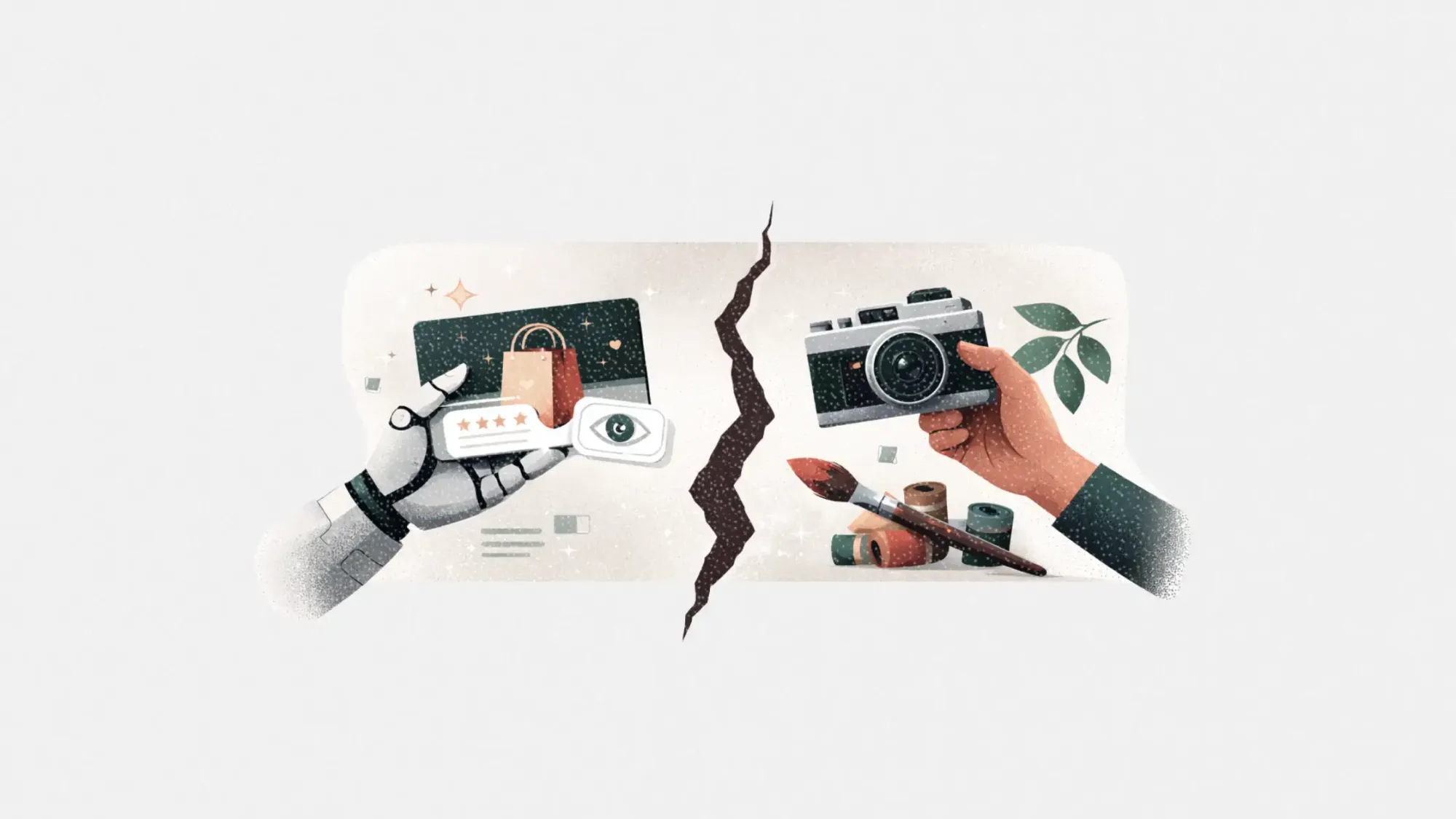
If this year’s Super Bowl commercials revealed anything, it is that brands are still trying to sell America on artificial intelligence. But while AI remains central to marketing innovation, public enthusiasm is not keeping pace with industry optimism.
For marketers, the challenge is no longer whether to use AI. It is how to use it without alienating audiences who increasingly view the technology with skepticism.
This article explores how growing distrust around AI-generated advertising is reshaping brand positioning, creative strategy, and messaging.
Short on time?
Here’s a table of contents for quick access:
- The growing trust deficit around AI in advertising
- Re-centering human agency in AI-driven campaigns
- What marketers should know about navigating AI backlash
- Will “no AI” become a brand differentiator?
 Patrecia Meliana
The growing trust deficit around AI in advertising
Recent data highlights a widening perception gap. According to research from the IAB and Sonata Insights, 82% of ad executives believe Gen Z and millennials feel positively about AI-generated ads. In reality, only 45% of those consumers say they feel that way. The gap has widened compared to 2024 findings.
AI in advertising is no longer a neutral production choice. It carries emotional weight, signaling values around authenticity, ethics, labor practices, and transparency. Even brands that do not sell AI products are reconsidering how prominently they reference the technology in campaigns.
Take “He Gets Us”, the Super Bowl regular campaign by Come Near Christian nonprofit organization. This year’s spot was intentionally shot on film and featured real people. According to Chief Creative Officer Simon Armour, avoiding AI was part of making the message feel warmer and more human in an increasingly digital world.
At the same time, eliminating AI entirely is unrealistic. Marketers see it as a tool for faster, more cost-efficient creative production. The tension is not about whether AI will be used. It is about how visible that usage should be.
Re-centering human agency in AI-driven campaigns
Interestingly, AI-generated ads are not guaranteed to fail. Research from VML Intelligence shows that only 47% of people would watch a movie starring AI-generated actors. A separate study from Taboola, in collaboration with researchers at Columbia University, Harvard University, Technical University of Munich, and Carnegie Mellon University, found AI-generated ads achieved an average click-through rate of 0.76% compared to 0.65% for human-created ads.
Disclosure also appears to matter. About 73% of Gen Z and millennial respondents say clear disclosure that AI was used would either increase or not impact their likelihood to purchase, according to IAB reporting.
Some brands are responding with bold stances. Aerie and Dove have publicly committed to avoiding AI in advertising. Others, like He Gets Us, Porsche, and Panda Express, are taking a subtler route, emphasizing human craftsmanship without loudly declaring an anti-AI position.
From an agency perspective, the nuance is critical. Justin Booth-Clibborn, Co-Managing Director and Executive Producer at Passion, points out that generative AI is used throughout creative workflows, even if it does not appear in the final output. For brands to posture as entirely anti-AI could backfire if the claim does not withstand scrutiny.
What marketers should know about navigating AI backlash
For Marketing Directors, Brand Strategists, and Chief Marketing Officers, the AI backlash requires strategic calibration rather than retreat.
Here are practical considerations:
- Audit your AI narrative
If your brand communicates around AI, clarify whether it is framed as innovation, efficiency, or empowerment. Avoid vague AI buzzwords that trigger skepticism.
- Lead with human outcomes
Consumers respond to how technology improves their lives, not to the technology itself. Emphasize craftsmanship, creativity, and human oversight.
- Be transparent, not defensive
Disclosure around AI usage can build trust. As research suggests, transparency does not automatically reduce purchase intent and may even strengthen credibility.
- Prepare for RFP shifts
Agencies report that requests for proposals that once mandated AI usage are now more cautious about implementation. Expect more thoughtful conversations about when and why AI should be used.
- Watch the ethics conversation
Concerns about job displacement, data privacy, environmental impact, and so-called AI slop are influencing audience perception. A single AI-generated visual can activate those anxieties.
Will “no AI” become a brand differentiator?
According to Gartner analysts, by next year, 20% of brands will lean into differentiation based on the absence of AI in their business and products.
This trend echoes the #nofilter movement in social media, when audiences gravitated toward unedited, realistic imagery over overly polished aesthetics. The idea of “no AI” could become a similar cultural signal.
But marketers should tread carefully. As Marco Pupo, Co-Founder and Chief Creative Officer at Atlantic, suggests, AI will likely become as normalized as Photoshop. The differentiator will not be whether brands use AI, but how responsibly and thoughtfully they deploy it.
In the end, AI is not disappearing from marketing. But overt AI branding may soften as trust becomes a competitive variable. The brands that win will balance efficiency with authenticity, and innovation with transparency.
AI hype may still dominate conference stages and investor decks. In consumer-facing campaigns, however, subtlety is becoming the smarter play.


Leave a Reply