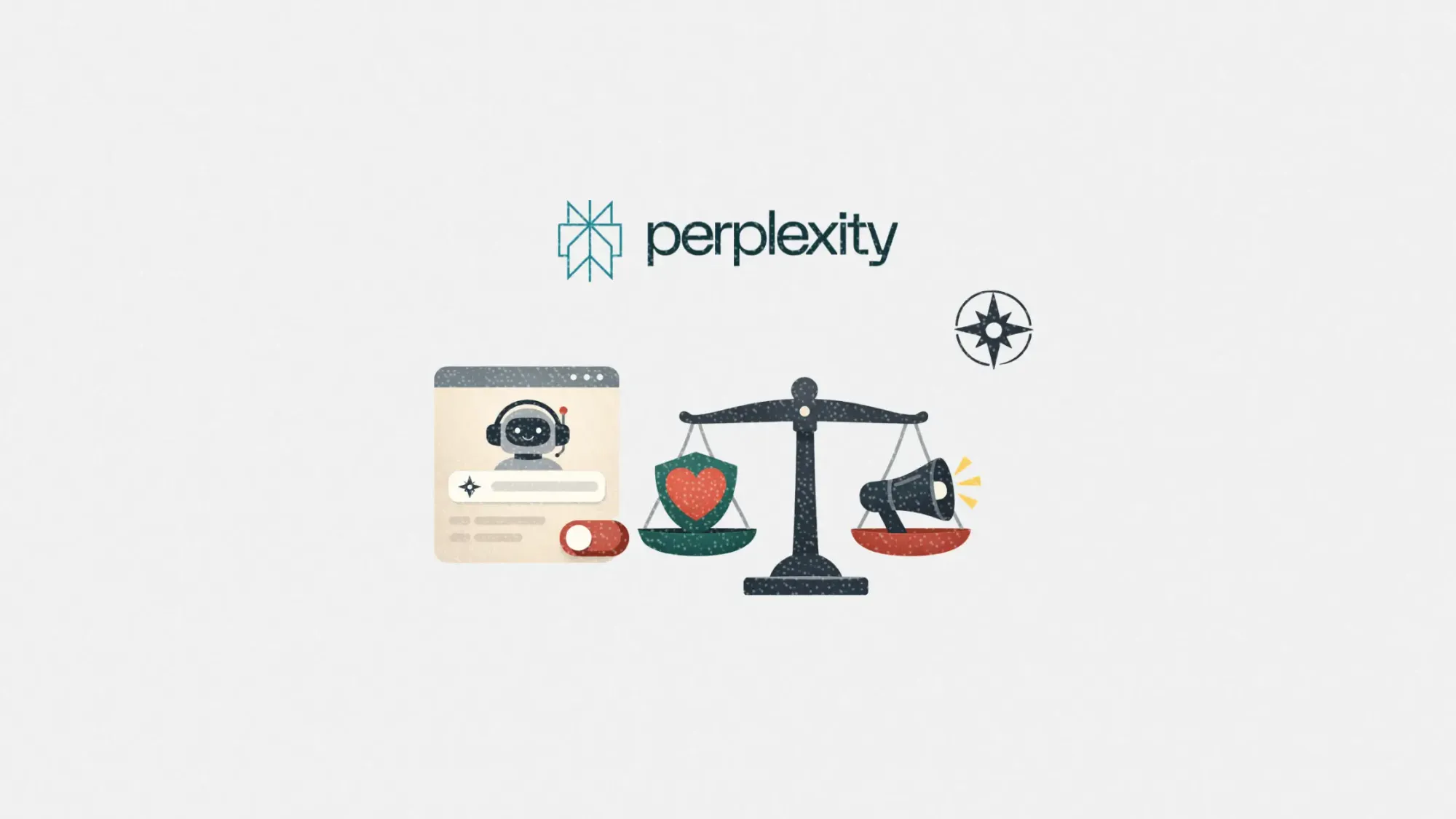
Perplexity is stepping back from advertising, just over a year after becoming one of the first AI search startups to test sponsored answers inside its chatbot experience.
According to a report by the Financial Times, the company is now winding down its advertising program, citing growing concerns that ads could erode user trust.
This article explores what Perplexity’s ad retreat signals about the future of AI search monetization, why perception now outweighs policy in AI product design, and what B2B marketers should take away from this strategic pivot.
Short on time?
Here’s a table of contents for quick access:
- What happened with Perplexity’s advertising experiment
- Why AI trust and perception now outweigh policy
- What marketers should know about AI search monetization
 Patrecia Meliana
What happened with Perplexity’s advertising experiment
Perplexity launched its advertising experiment in November 2024, positioning itself as one of the first AI search companies to integrate sponsored answers beneath chatbot responses. At the time, the company said ads were clearly labeled and did not influence its outputs.
The goal was ambitious. Perplexity aimed to build a sustainable revenue-sharing model with publisher partners and argued that subscriptions alone would not be enough to support its growing ecosystem. Advertising was framed as essential to long-term viability.
Now, that strategy is being reversed.
According to the Financial Times, Perplexity will wind down its advertising program by the end of 2026. Executives cited a deeper issue than labeling or placement: user perception. One executive reportedly said ads risk making users “suspicious of everything.” Another added that the company is “in the accuracy business,” and that advertising may be misaligned with what users expect from an AI answer engine.
Operationally, the program also remained tightly controlled. Fewer than 0.5 percent of brands who applied to advertise were admitted. Taz Patel, the executive leading the ads effort, departed the company before the experiment had fully matured.
In short, Perplexity tested ads, controlled them aggressively, and still concluded that the trust trade-off was too high.
Why AI trust and perception now outweigh policy
Perplexity’s shift underscores a broader tension in AI search: monetization versus credibility.
Unlike traditional search engines, AI tools do not simply surface links. They synthesize answers. That synthesis creates an expectation of neutrality and completeness. Even if ads are clearly labeled and technically separated from outputs, the mere presence of paid placements can introduce doubt.
As one executive reportedly told the Financial Times, a user needs to believe they are getting the best possible answer to keep using and paying for the product. If ads trigger skepticism, the long-term subscription model could be undermined.
This is a key distinction for marketers. In classic search, ads and organic results coexist within an understood framework. In AI search, the interface collapses discovery, recommendation, and explanation into a single response. The psychological contract changes.
Perplexity’s retreat suggests that for AI-native products, perception management may be as critical as compliance or disclosure policies. If users even suspect outputs are influenced by spend, trust erosion could be rapid and difficult to reverse.
What marketers should know about AI search monetization
For B2B marketers and PR professionals, Perplexity’s decision is not just a product update. It signals strategic uncertainty in AI search monetization.
Here are a few practical takeaways:
1. Paid placement in AI search is still experimental
If one of the earliest movers is stepping back, it suggests that scalable, trust-preserving ad models in LLM-driven interfaces are far from settled. Marketers should treat AI search ads as emerging, not foundational.
2. Trust is becoming the primary currency
AI platforms are positioning themselves as answer engines, not ad networks. Messaging that appears to manipulate or game these systems could backfire. Investing in credibility, authoritative content, and strong brand signals may outperform short-term paid experiments.
3. Subscription and enterprise models may dominate
Perplexity had argued that enterprise subscriptions alone were insufficient. This reversal hints that companies may instead double down on paid tiers, API access, and enterprise integrations rather than risk diluting trust with ads.
4. Publisher revenue-sharing remains unresolved
Perplexity’s original ad experiment included ambitions to share revenue with publisher partners. With ads winding down, the question becomes: how will AI search platforms sustain publisher ecosystems without direct advertising revenue?
For marketers, this is a reminder to diversify distribution and discovery strategies. AI search visibility, owned media, community building, and direct audience relationships all matter more when platform economics are in flux.
If you are evaluating AI marketing tools or AI search visibility strategies, this shift reinforces the need to prioritize long-term brand equity over opportunistic placements.
Perplexity’s retreat from advertising reflects a larger industry recalibration. In AI search, the margin for trust erosion is thin. Even clearly labeled ads can introduce enough doubt to undermine user confidence.
For marketers, the message is clear: AI platforms are still defining their business models. Betting heavily on any single monetization channel inside LLM-driven search may be premature.
If AI is in the “accuracy business,” marketers need to be in the credibility business.


Leave a Reply