
The subscription app economy is entering a new phase, and it is not the one most teams expected.
While the number of apps is growing at an unprecedented rate, success is becoming harder to achieve, not easier.
This article explores what RevenueCat’s latest State of Subscription Apps 2026 report reveals about market dynamics, and why growth is increasingly concentrated among a small group of top-performing apps.
Short on time?
Here’s a table of contents for quick access:
- Why the subscription app market is growing faster than ever
- Why growth is concentrating among top-performing apps
- Why older apps still dominate revenue
- What this market shift means for marketers
 Patrecia Meliana
Why the subscription app market is growing faster than ever
The supply side of the app economy is exploding. According to the report, new subscription app launches have grown roughly 7× since 2022, jumping from around 2,000 per month to nearly 15,000 by early 2026 .
A big driver behind this surge is AI. Development has become faster, cheaper, and more accessible, removing barriers that previously limited how many apps could be built.
The result is a flood of new products entering the market, many targeting niche use cases that were not viable just a few years ago.
But there is a catch. Demand is not growing at the same pace.
Why growth is concentrating among top-performing apps
Despite the surge in new apps, growth is becoming more uneven.
The top 25% of apps grew revenue by over 80% year-on-year, while the bottom 25% actually shrank by 33% . At the extreme end, the top 10% of apps saw growth exceeding 300%, while the median app grew by just around 5%.
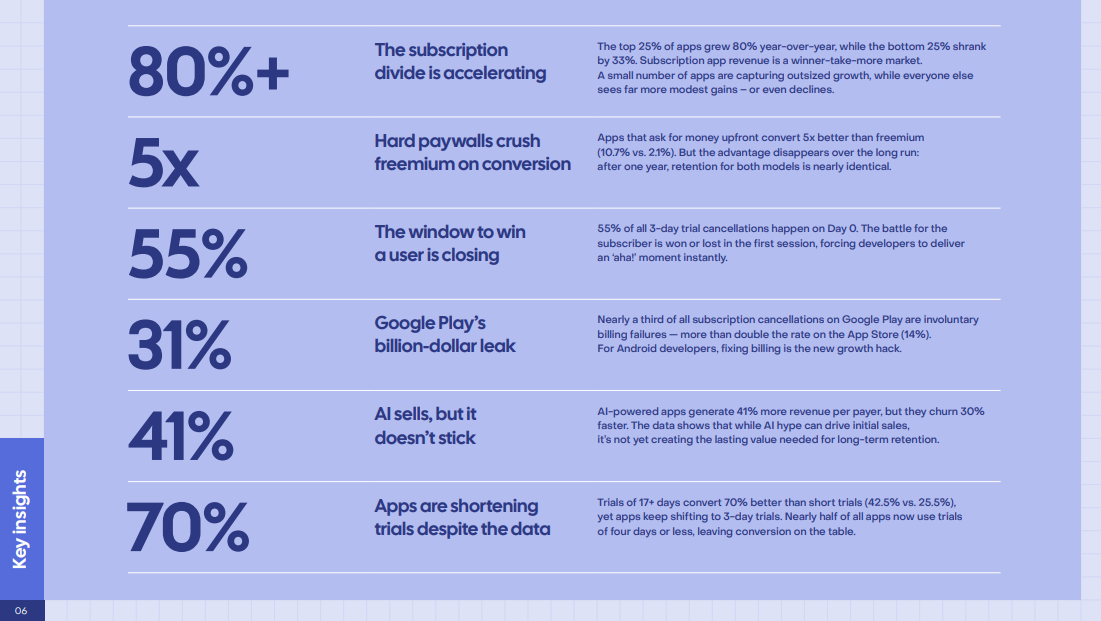
This creates what can only be described as a winner-take-more market. In practical terms, this means:
- A small group of apps capture disproportionate revenue growth
- Most apps struggle to scale or even maintain performance
- The gap between top and average performers keeps widening
For marketers, this changes the game. Incremental improvements are no longer enough. Competing now requires either exceptional execution or a defensible niche.
Why older apps still dominate revenue
One of the more surprising findings is that newer apps are not the primary drivers of revenue, despite the explosion in launches.
Apps launched before 2020 still account for 69% of total subscription revenue, while apps launched in 2025 or later contribute just 3% .
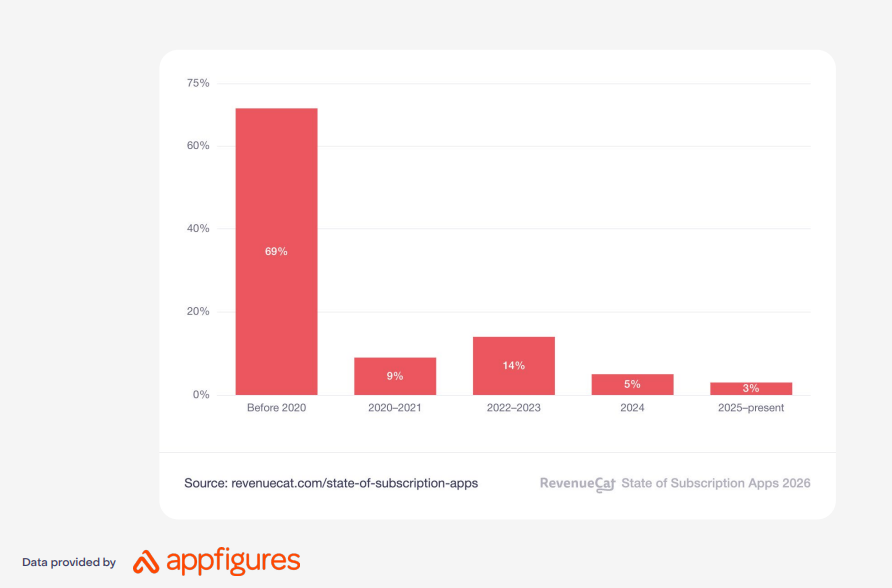
This highlights a key dynamic: time and optimization still matter more than novelty.
Older apps benefit from:
- Established user bases
- Refined monetization strategies
- Compounded retention and brand recognition
Meanwhile, newer apps face intense competition and rising acquisition costs from day one.
What this market shift means for marketers
For B2B marketers, growth teams, and app publishers, this report signals a clear shift in how success is achieved.
Here are the key implications:
- Distribution is now the bottleneck
Building an app is easier than ever. Getting users is not. Expect higher customer acquisition costs and more competition across channels.
- Retention is the real differentiator
With so many alternatives available, users churn faster unless value is delivered immediately and consistently.
- Execution speed matters more than ideas
AI is leveling the playing field on product creation. The advantage now comes from how quickly teams test, iterate, and optimize.
- Category strategy is critical
Niche apps are viable, but only if they can dominate a specific audience segment early.
The subscription app market is not slowing down. It is accelerating, but in a way that favors the best-prepared teams. More apps does not mean more opportunity for everyone. It means more competition, sharper execution requirements, and a growing gap between winners and everyone else.
For marketers, the takeaway is simple: the playbook has changed. Success now depends less on launching and more on sustaining growth in a crowded, fast-moving market.
 Patrecia Meliana
Leave a Reply