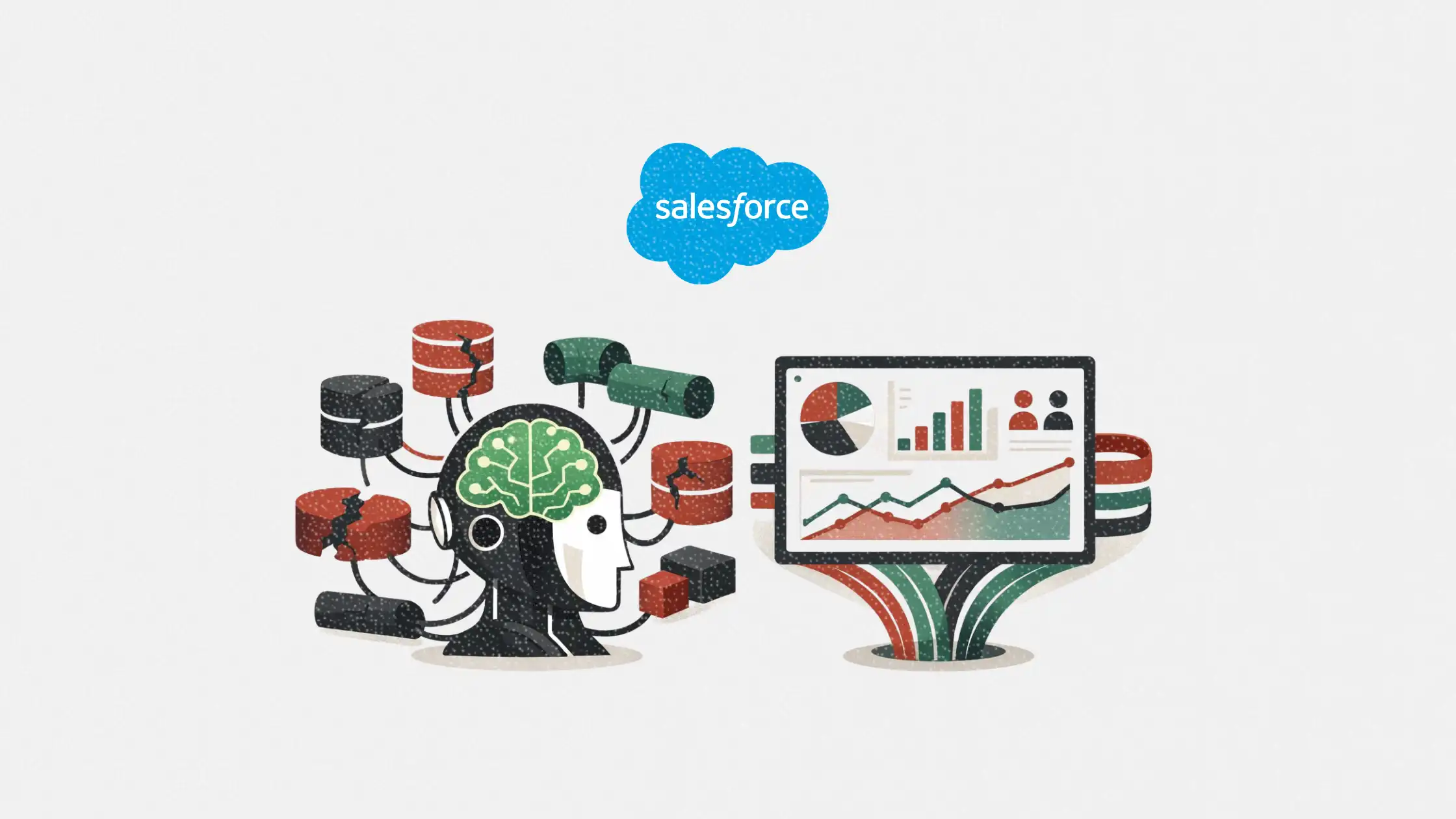
AI may be the headline story in marketing, but data is still the limiting factor. Salesforce’s State of Marketing 2026 report makes it clear that while teams are investing heavily in AI, many are struggling to deliver meaningful results due to fragmented and incomplete customer data.
This disconnect is creating a bottleneck across personalization, engagement, and automation.
This article explores why unified data remains the foundation for modern marketing, how data gaps are holding teams back, and what separates organizations that are moving forward from those that are stuck.
Short on time?
- Data fragmentation is limiting marketing performance
- Access to customer data is still incomplete
- Unified data is what separates high-performing teams
- Why data remains the biggest barrier to personalization
 Patrecia Meliana
Data fragmentation is limiting marketing performance
Despite advances in AI, most marketing teams are still operating on fragmented data systems.
The report highlights that siloed data remains one of the biggest barriers to effective marketing. Without a connected view of the customer, teams are limited in their ability to deliver relevant experiences or respond in real time.
This fragmentation creates a structural problem. AI systems rely on context to generate useful outputs, but when data is incomplete or disconnected, those outputs become less accurate and less actionable.
As a result, even well-funded AI initiatives struggle to deliver consistent performance improvements.
Access to customer data is still incomplete
One of the clearest indicators of this problem is the lack of access to cross-functional data.
- Only 58% of marketers have full access to service data
- 56% have access to sales data, and 51% to commerce data
At the same time:
- 69% of marketers struggle to respond promptly to customers due to lack of context
This creates a disconnect between expectation and execution.
While 83% of marketers say customers expect two-way conversations, most teams lack the unified data needed to support those interactions effectively
The result is a marketing environment where communication remains largely one-directional, despite the tools available to enable real-time engagement.
 Patrecia Meliana
Unified data is what separates high-performing teams
The report shows that data maturity is a key differentiator between high-performing teams and the rest.
- Teams with unified data are 42% more likely to regularly respond to customers
- They are also 60% more likely to use AI agents to scale their efforts
More broadly:
- High-performing marketers are 2.4 times more likely to have unified their data sources
This highlights a critical point.
Access to AI is becoming universal, but access to usable, connected data is not. That difference is what determines whether AI can be applied effectively.
Unified data does not just improve targeting. It enables:
- More accurate personalization
- Faster response times
- Better coordination across channels
In other words, it turns AI from a tool into a system that can operate with context.
Why data remains the biggest barrier to personalization
Even as marketers prioritize personalization, data limitations continue to stand in the way.
- 78% of marketers say they need more personalized content than they can produce
- 98% report at least one barrier to personalization
- 46% struggle with lacking customer preference data or relevance
These challenges are not caused by a lack of intent. They are driven by structural limitations.
Without accurate, connected, and accessible data:
- Personalization remains surface-level
- AI outputs lack relevance
- Customer experiences feel inconsistent
This explains why personalization continues to be a priority, but remains difficult to execute at scale.
Why this matters for B2B marketers
For B2B marketers and PR professionals, the implications are straightforward but significant.
1. Data is becoming the real competitive advantage
As AI tools become more accessible, differentiation will come from the quality and connectivity of customer data. Teams with stronger data foundations will be able to execute faster and more effectively.
2. Personalization depends on context, not just content
Creating more content is not the solution. Without the right data, even AI-generated personalization will fall short. Context is what determines relevance.
3. AI performance is limited by data quality
AI systems can only work with the information they are given. If data is incomplete or fragmented, outputs will reflect those limitations.
4. Cross-functional alignment is no longer optional
Marketing can no longer operate in isolation. Access to sales, service, and commerce data is essential for delivering cohesive customer experiences.
The takeaway is clear. AI may be transforming marketing, but data is still the foundation that determines whether those transformations succeed.


Leave a Reply