Marketing emails have quietly become one of the most AI-assisted channels in the stack. But while automation is scaling output, it is also introducing a new and less visible problem: consumer trust is no longer tied to what you send, but what people think you used to create it.
A new Adobe Express survey of 1,007 US consumers reveals a sharp contradiction in how audiences perceive AI in email.
This article explores that contradiction, why it matters now, and how marketers should rethink AI usage before it starts eroding brand equity instead of driving efficiency.
Short on time?
Here’s a table of contents for quick access:
- Why AI-written emails are creating a trust paradox
- The perception gap marketers are underestimating
- Why AI suspicion is becoming a churn trigger
- What marketers should know about managing AI-driven trust
 Patrecia Meliana
Why AI-written emails are creating a trust paradox
At first glance, consumer sentiment toward AI in email looks manageable. In fact, 70% of respondents said they would trust a brand more if it disclosed using AI to help write emails.
But that optimism quickly unravels when you look at actual behavior. The study found that 46% of consumers would be more likely to unsubscribe if they knew an email was clearly written by AI, while 50% said their trust in a brand would drop if they discovered AI was used at all.
This creates a paradox marketers cannot ignore.
Transparency appears to build trust in principle, but in practice, explicit AI usage signals lower authenticity and increases churn risk. The implication is clear: disclosure alone does not solve the trust problem. It may actually amplify it depending on execution.
 Patrecia Meliana
The perception gap marketers are underestimating
One of the most revealing insights in the report is not about behavior, but about uncertainty.
- 30% of consumers are not confident they can tell whether an email was written by AI or a human
- Yet 72% believe they have received AI-generated emails
- On average, respondents estimate receiving six AI-written emails per week
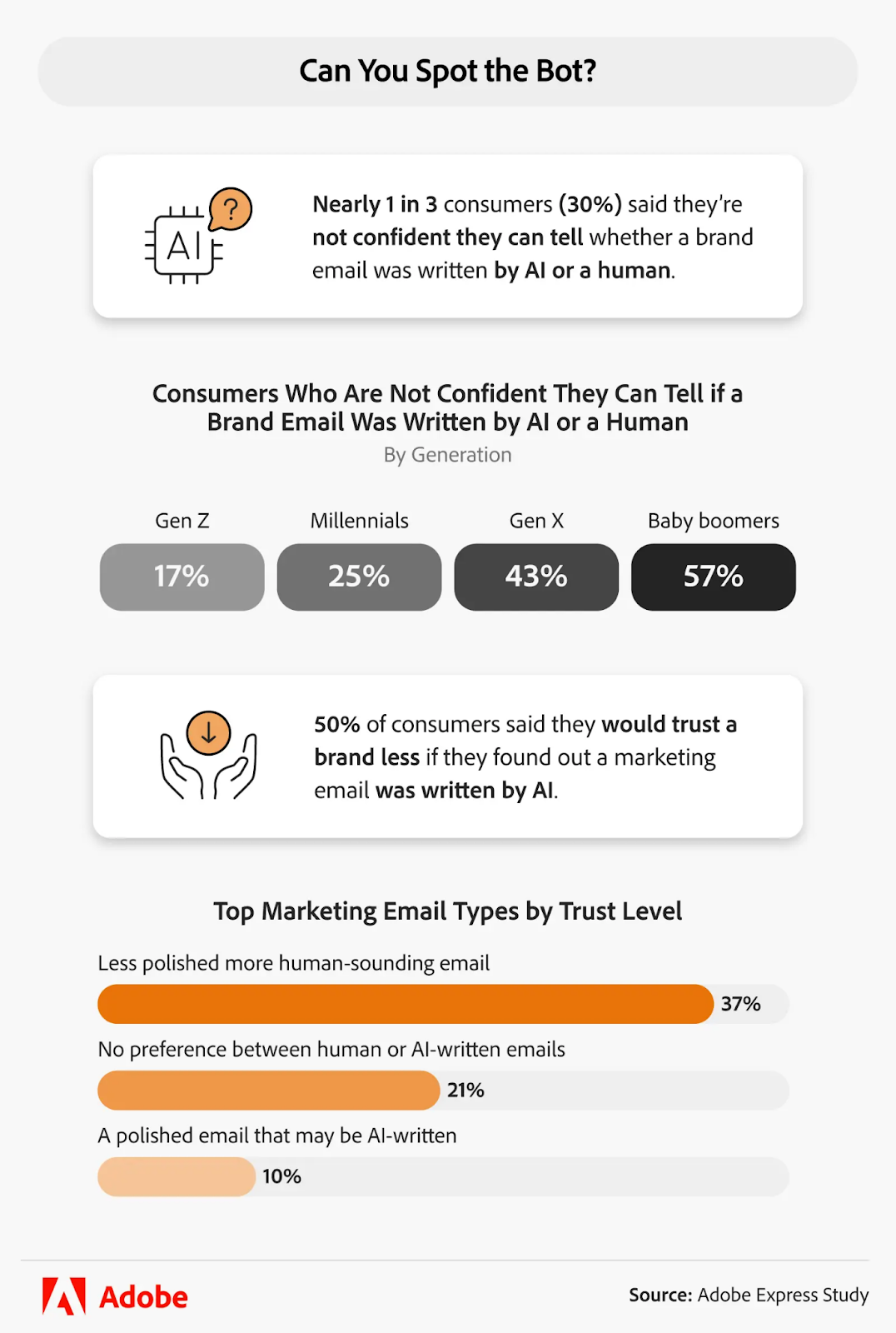
This gap between confidence and assumption creates a volatile environment for brands.
Consumers are not reliably detecting AI. They are guessing. And those guesses are shaping brand perception. That means your emails are not judged solely on quality or relevance. They are judged on whether they feel artificial, even if they are not.
This introduces a new kind of risk: Brands can be penalized for AI usage even when no AI was used at all.
In other words, marketers are no longer managing just content performance. They are managing AI attribution, whether accurate or not.
 Atikah Amalia
Why AI suspicion is becoming a churn trigger
The consequences of this perception gap are already showing up in unsubscribe behavior. Nearly one in five consumers, or 18%, say they have unsubscribed from a marketing email because they suspected it was written by AI, while 46% say they would be more likely to unsubscribe if that AI authorship was confirmed.
This is a critical shift. Historically, unsubscribes were driven by:
- Irrelevance
- Frequency
- Poor targeting
Now, perceived intent is entering the equation. When an email feels AI-generated, consumers may interpret it as:
- Low effort
- Lack of genuine interest
- Mass automation over meaningful engagement
Even if the content is relevant, the perceived shortcut can override its value. This reframes AI in email from a productivity tool into a retention risk multiplier.
Patrecia Meliana
What marketers should know about managing AI-driven trust
The takeaway is not to stop using AI. It is to use it with awareness of how it is perceived, not just how it performs.
Here are practical ways to approach that:
1. Treat AI as invisible infrastructure, not a visible feature
Consumers care about outcomes, not tools. Positioning emails as “AI-written” risks shifting focus away from value and toward process.
2. Optimize for perceived effort, not just efficiency
If an email feels templated or generic, it signals automation. Small signals of thoughtfulness can counter that perception.
3. Avoid over-standardization at scale
AI systems tend to produce structurally similar outputs. Over time, this creates recognizable patterns that trigger “this feels AI” reactions.
4. Test disclosure strategically, not universally
Given the paradox, disclosure should be context-dependent. Transactional transparency may work, but promotional messaging requires more nuance.
5. Monitor trust signals, not just performance metrics
Open rates and clicks won’t capture perception shifts early enough. Watch for:
- Subtle increases in unsubscribe rates
- Drops in long-term engagement
- Negative qualitative feedback
AI is not just changing how marketing emails are produced. It is changing how they are interpreted.
Patrecia Meliana
The Adobe Express data shows that consumer perception of AI matters as much as, if not more than, the actual use of AI itself.
For marketers, this means the challenge is no longer just scaling content efficiently. It is maintaining trust in an environment where audiences are actively questioning how that content is created. The brands that win will not be the ones that use the most AI. They will be the ones that use it without making customers feel like they did.


Leave a Reply