Your campaign crushed it at home. Then it launched in Brazil, and the tagline turned into a meme for all the wrong reasons.
That scenario is more common than many global marketing teams want to admit. New data from Lokalise shows that localization failures are not just awkward translation errors. They are expensive operational problems that can damage brand reputation, delay launches, and dilute years of brand-building work.
Lokalise surveyed 392 marketing and sales leaders who localize content across multiple countries and languages. The findings reveal what actually breaks during localization, which markets are hardest to adapt for, and why marketers still do not trust AI to handle culturally sensitive content without human review.
Table of contents
Jump to each section:
- What went wrong in localization campaigns
- Why creative campaigns struggle across markets
- What marketers should know before scaling localization
- Why AI translation still needs human oversight
- Localization is now a competitive advantage
 Patrecia Meliana
What went wrong in localization campaigns
The study paints a clear picture. Localization failures rarely come from one catastrophic mistake. They usually happen through a chain of small cultural and linguistic misses that quietly stack together until the campaign breaks.
Nearly 3 in 10 marketers and company leaders (29%) said poor translation or cultural misunderstanding led to brand embarrassment, customer backlash, or negative press.
The most common issue was not technical translation quality. It was tone.
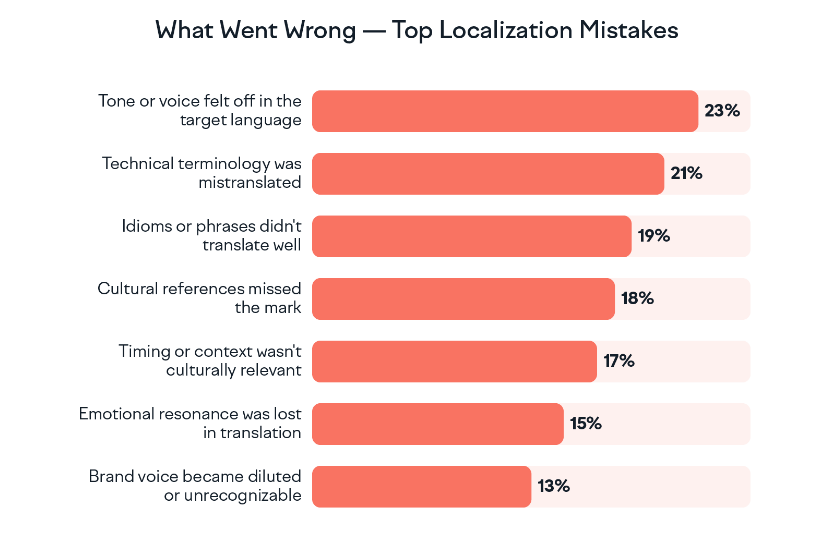
About 23% of respondents said their biggest localization mistake was messaging that felt off in the target language. That ranked higher than mistranslated terminology, missed idioms, or poorly adapted cultural references.
Other common localization problems included:
- Technical terminology mistranslations (21%)
- Idioms or phrases that failed to translate naturally (19%)
- Cultural references that missed the mark (18%)
- Timing or context that felt culturally irrelevant (17%)
- Emotional resonance getting lost in translation (15%)
The operational impact was significant.
About 41% of respondents said they had to pull, pause, or significantly revise a campaign after launch because of a localization issue. Meanwhile, 39% said their worst localization mistake cost more than US$10,000 once lost revenue, staff time, and reputation repair were factored in.
The study also highlights which markets marketers struggle with most. China, Japan, Middle East/North Africa, Germany, and South Korea ranked as the hardest regions to localize for.
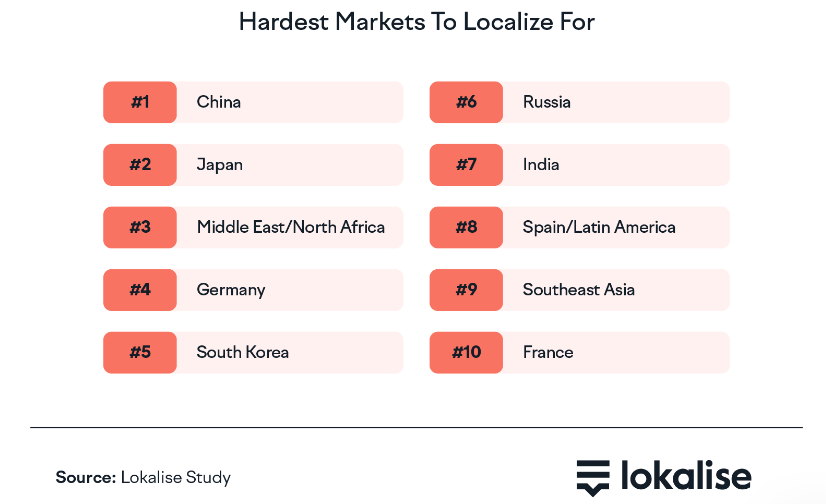
That challenge goes beyond language. These are markets where tone, social expectations, humor, symbolism, and cultural nuance carry enormous weight. Direct translation simply does not work.
Why creative campaigns struggle across markets
Creative work is where localization pressure becomes most visible. According to the study, humor is the element marketers lose most often during localization. About 43% said humor and jokes are most frequently lost in translation, while 39% said humor is the hardest creative element to localize successfully.
Cultural references followed closely at 39%, with wordplay and puns at 35%.
The findings reinforce something many global brands already know internally: the more culturally specific the campaign idea, the harder it becomes to scale globally without compromise.
That compromise is already happening.
About 66% of respondents said they had toned down or completely rewritten creative ideas to make them work in another market. Nearly half (45%) admitted localization constraints forced them to scrap a creative concept entirely.
Even brand voice suffers during expansion. Around 51% said their brand voice becomes diluted once translated into other languages. This creates a difficult balancing act for marketers.
Global consistency matters. But forcing identical messaging across markets can create cultural disconnects that hurt campaign performance.
The data also suggests localization quality directly affects competitive positioning. Around 40% said they had lost competitive opportunities due to slow or poor localization.
For international brands, localization is no longer a post-production task. It directly affects speed-to-market, campaign quality, and audience trust.
Patrecia Meliana
What marketers should know before scaling localization
One of the strongest patterns in the study is regret. More than one-third of respondents (37%) said their biggest localization regret was failing to test content with native speakers before launch.
At the same time, only 22% said they consistently test localized campaigns with native speakers before going live.
That gap says a lot.
Teams know what works. They simply do not operationalize it early enough.
When respondents were asked what advice they would give marketers localizing for the first time, the top answer was clear: invest in native speakers, not just translators. About 31% ranked native speaker involvement as the most important localization investment.
Other top recommendations included:
- Do not assume what works in one market works elsewhere (26%)
- Focus on cultural adaptation, not just translation (26%)
- Test campaigns with local audiences before launch (24%)
- Start with fewer markets and execute properly (22%)
- Bring localization experts into the process earlier (20%)
The broader message is strategic.
The strongest global marketing teams do not treat localization as cleanup work after the campaign is finalized. They integrate localization into planning, messaging development, and creative review from the beginning.
For marketers scaling internationally, that changes how campaigns should be built. Localization cannot sit downstream from strategy anymore.
Why AI translation still needs human oversight
AI translation tools are accelerating localization workflows fast. But the study suggests marketers still do not trust AI to independently manage emotionally sensitive or culturally nuanced messaging.
Nearly half of respondents (48%) said all AI-generated localization content should still be reviewed by humans before publishing.
The areas marketers felt most required human oversight included:
- Cultural appropriateness (34%)
- Emotional resonance (31%)
- Brand tone and voice (29%)
- Legal and compliance language (27%)
- Humor and wordplay (26%)
This reflects a broader shift happening across marketing workflows.
AI is becoming highly effective at scale, speed, and operational efficiency. But marketers still rely on humans for judgment, context, nuance, and risk management.
That distinction matters.
Localization errors are not just grammatical problems. They affect perception, trust, and reputation. A campaign that technically translates correctly can still fail emotionally or culturally.
For B2B marketers and PR teams, this is especially important as AI-generated content production increases globally. Automation can reduce localization bottlenecks. But human review remains critical for protecting brand integrity.
Localization is now a competitive advantage
The bigger takeaway from the study is not simply that localization mistakes are expensive.
It is that localization quality increasingly separates brands that scale globally from brands that stall.
The teams succeeding internationally are not necessarily the ones spending the most money. They are the ones operationalizing localization earlier, involving local expertise sooner, and building workflows designed for cultural adaptation instead of direct translation.