
Most B2B teams don’t know how much their caution is costing them. The playbook is familiar: gated ebook, SDR outreach, webinar, repeat. No one gets fired for it. But according to Axel Sukianto, VP Marketing at Truescope, it’s quietly draining pipeline every quarter – and the teams running it are often the last to notice.
Axel has spent over a decade leading marketing at B2B SaaS companies across Australia and the Asia-Pacific region, including stints at Dropbox, Cisco Meraki, and UpGuard, a cybersecurity platform that helps organizations prevent data breaches and monitor third-party vendor risk. Before all of that, he spent three years as a corporate lawyer in Sydney, which perhaps explains why he’s so precise about identifying where B2B marketing actually breaks down.
He now leads marketing at Truescope, an AI-powered media intelligence platform launched in 2020 that helps PR professionals, communications teams, and marketers track, analyze, and respond to media coverage across online, print, broadcast, and social channels in real time. He also founded Generate, the leading B2B marketing community in Australia and New Zealand, which has grown to over 1,300 members entirely through word of mouth.
Speaking with ContentGrip, Axel shares why B2B risk aversion is a structural problem rather than a personal one, what genuine marketing experimentation looks like beyond A/B testing, and why a point of view is the one thing AI still can’t manufacture.
Table of contents
Jump to each section:
- The sameness tax
- Why B2B teams play it safe
- What real experimentation looks like
- The 70/20/10 model
- On AI, conviction, and what you actually believe
- The one hour marketing cannot touch
The sameness tax
B2B marketers didn’t arrive at identical-looking campaigns by accident. The logic is internally sound: run the playbook that’s defensible, that leadership will approve, that won’t raise eyebrows in the next quarterly review. But Axel argues this consistency has a real cost that compounds silently.
“The teams that look identical to their category are paying a tax for it every quarter, and most of them don’t know how big the tax is,” he says.
The first place it shows up is at the top of the funnel. A buyer scrolls past five vendors making nearly identical claims and picks based on price, brand familiarity, or whoever was loudest in the last sales cycle. The problem isn’t rejection – it’s invisibility. “You weren’t rejected. You were never registered.”
Then the cost compounds. To compensate for that invisibility, teams spend more on paid, more on retargeting, more on outbound. “Every channel costs more because nothing is doing the persuasion for you, and it becomes a vicious cycle.” The fix, Axel says, is strong, clear positioning – not incremental optimization of a playbook that’s already saturated.
 Enricko Lukman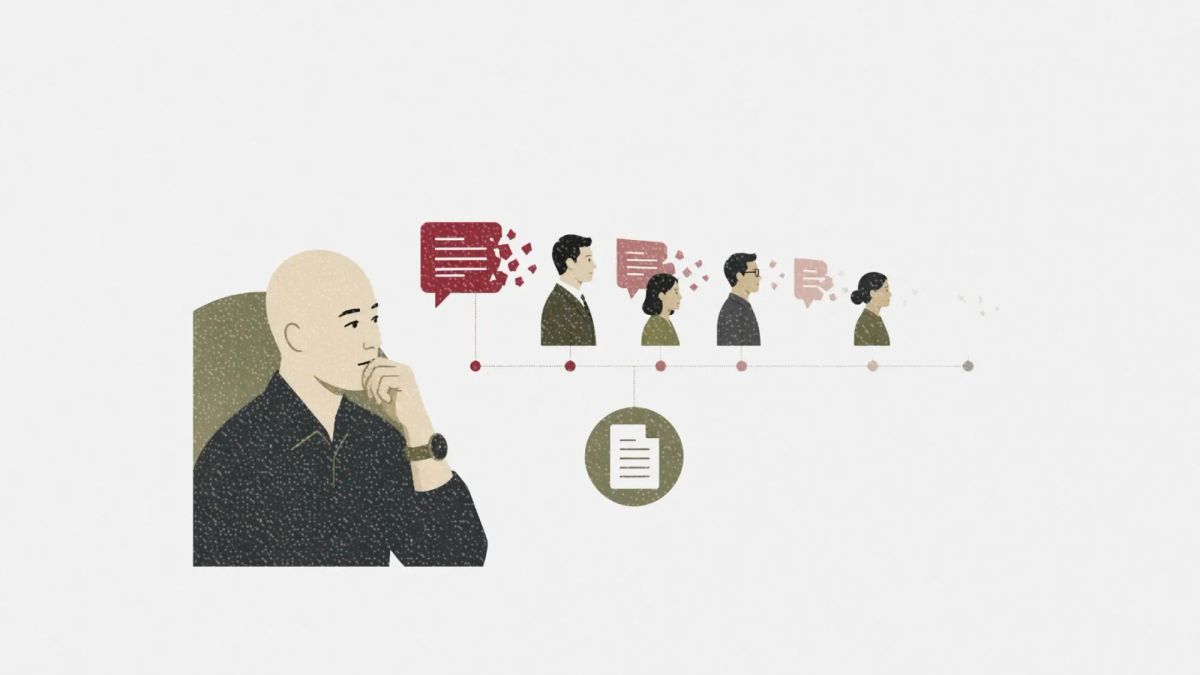
Why B2B teams play it safe
The instinct for caution in B2B marketing isn’t irrational. Axel sees it as a structural problem rooted in two specific pressures: tenure and attribution.
On tenure, his observation is direct: “CMOs have the shortest average tenure of any C-suite role.” (Editor’s note: Spencer Stuart’s 2025 data supports this – CMO tenure at S&P 500 companies stands at 4.1 years, compared to 7.6 years for CEOs and 4.7 years for CFOs.) When the seat under you is that unstable, he says, “you don’t bet the year on a campaign that won’t show up in the dashboard for nine months.”
The attribution problem compounds this. In B2C e-commerce, a paid campaign produces feedback almost immediately. In B2B, where sales cycles can run 12 months or longer, the loop is completely broken. “You ship a campaign in March and don’t know if it worked until November. By then, the buyer’s economy has shifted, the sales team is focused on something else, the messaging has changed. You can never cleanly attribute the win or the loss.”
The result is a system that rewards what’s countable inside a quarter and punishes what compounds over years. “It isn’t that B2B marketers lack courage. It’s that the system rewards what’s countable inside a quarter and punishes what compounds over years.” This is the context that makes the status quo sticky even when everyone privately admits it isn’t working.
What real experimentation looks like
For Axel, the word “experimentation” in marketing has been diluted to the point of meaninglessness. A/B testing button colors or iterating on landing page copy isn’t what he’s talking about.
“The experiments that move the needle test the core positioning and messaging. Who is the buyer? What problem are we naming? What category are we choosing to play in, and what category are we refusing to play in?”
His litmus test for whether something qualifies as a real experiment: are you willing to kill it? “A real experiment has a hypothesis and a kill criteria written down before you ship. If the result misses, you stop. You don’t quietly rebrand the loss as a learning and run the next campaign with the same assumptions.” Most teams, he says, skip that step – which is why most so-called experiments are theater.
The clearest recent example he’s seen of genuine experimentation is Ramp’s “Kevin from The Office” campaign, run in October 2025. The fintech company hired Brian Baumgartner, the actor who played Kevin Malone, installed him in a glass office in Manhattan’s Flatiron Plaza, and livestreamed him as their “CFO for a day” for seven hours. They released short videos recreating iconic scenes from the show. There was no feature list, no ROI calculator, no book-a-demo call to action.
Brian Baumgartner, Ramp’s CFO for a day. 600,000 receipts included.
“What made it work was the conviction to optimise for attention over conversion,” Axel says. “Ramp understood that B2B buyers are humans who scroll the same TikTok feed as everyone else, and that the first job of marketing is to stop the scroll, not close the deal.” He’s honest about the access this requires: “You need big bucks for this. Not everyone has the luxury of it, yes, but the idea of taking big bets remains.” For teams without that budget, the principle still applies even if the execution looks different.
For more examples of bold B2B content marketing that breaks from the standard playbook, ContentGrip has covered several cases worth studying.
The 70/20/10 model
So how does a marketing team actually balance a working demand generation engine with the space to run high-variance bets? Axel uses a framework he calls 70/20/10.
70% of budget and energy goes into the proven engine – the channels that pay the bills and the motions you can forecast. 20% goes into adjacent experiments: new segments, new messaging angles, a channel the team hasn’t tried before. 10% is the wild bet – “the thing that might not pay back this quarter or even this year, but if it works it changes the trajectory of the company.”
He’s currently watching B2B influencer marketing closely as a candidate for that 10% bucket. “More teams are testing it, the playbook isn’t written yet, and the upside is real for whoever cracks it first.”
His most important caution: don’t kill the 10% too early. “The bet that looks flat in week six is often the thing you fold into your 70% next year.” The challenge isn’t identifying bold ideas – it’s protecting them long enough to actually find out if they work.
Patrecia Meliana
On AI, conviction, and what you actually believe
Axel’s sharpest observation about the current marketing moment has nothing to do with tools or channels. It’s about what AI has made more valuable by making everything else more abundant.
“You can ship infinite content with a prompt. You can’t ship conviction with one.” His advice to marketers trying to break out of the safe playbook: stop working on the tagline and start developing an actual point of view – “an actual belief about your category, your buyer, and the way the world is changing that you are willing to defend in public when half the room disagrees with you.”
That, he says, is both the hardest thing to fake and the cleanest predictor of which brands compound over time versus which ones spend years buying impressions that disappear the moment the budget runs out.
The one hour marketing cannot touch
Away from spreadsheets and Slack, Axel has found an unlikely source of clarity: reformer pilates.
The appeal is only partly physical. “Sitting in front of a laptop for a living is unkind to a body. Reformer is the rare workout that fixes posture and works muscle groups you didn’t know you had.” But what he values most is the forced disconnection. “The instructor tells you to engage your obliques and you have to engage your obliques or you literally fall off the thing. No phone. No Slack.”
It is the one hour in his day where marketing is simply not an option. He adds, with the air of someone who has tested this theory many times: “Some of my best ideas about work show up the second I walk out of the studio.”
Axel is on LinkedIn and is open to connecting with marketers working through positioning and strategy challenges.