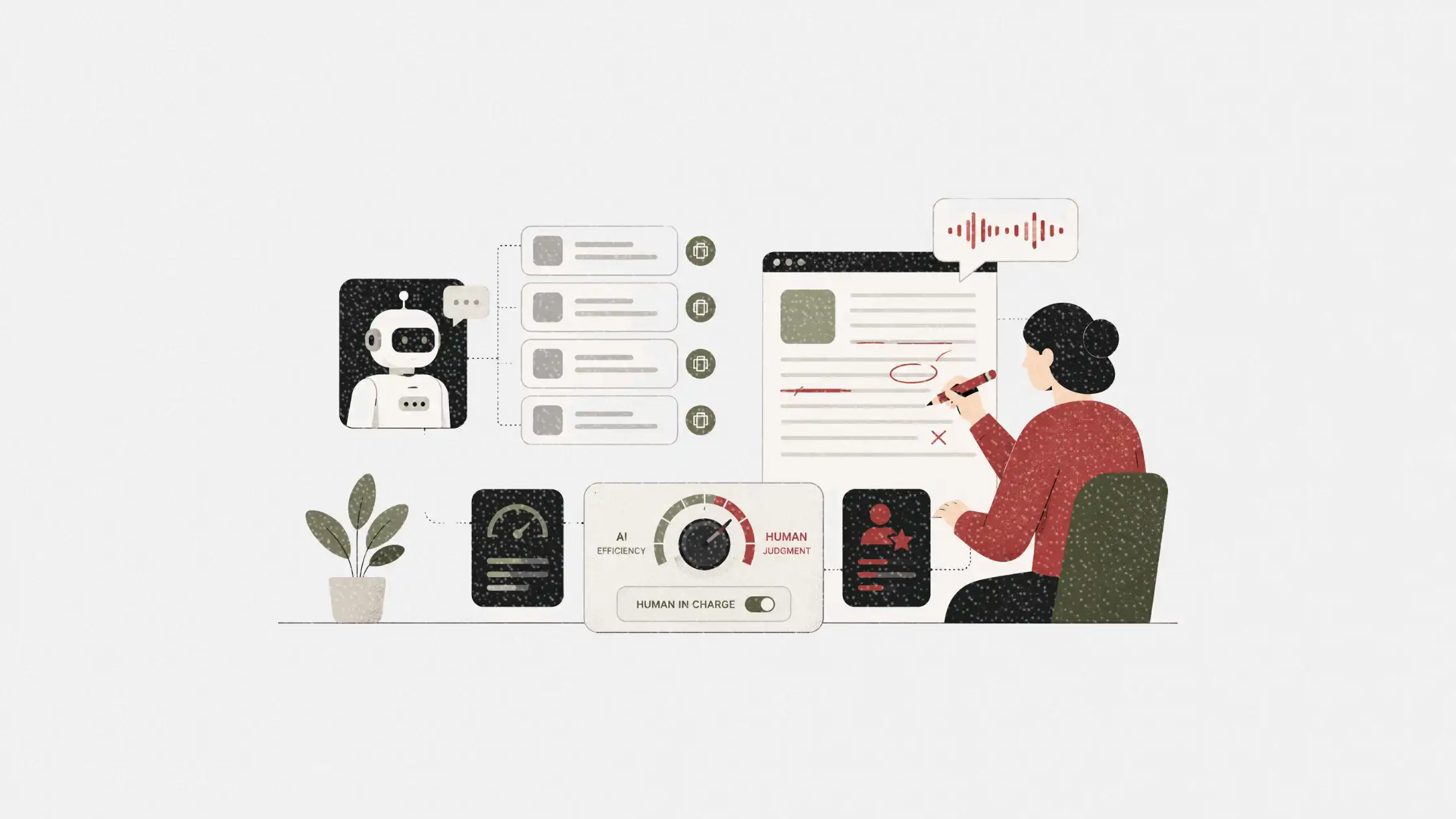
AI is now part of everyday marketing operations. Content teams use it to outline blog posts, summarize webinars, brainstorm campaigns, repurpose social content, and speed up research. For marketers under pressure to publish more content with smaller teams, that efficiency matters.
But speed introduces a new problem. As more brands rely on AI-assisted writing, content is starting to sound increasingly similar. Articles become technically correct but forgettable. Social posts become polished but generic. Brand personality gets flattened into safe, predictable language.
This article explores how marketers can use AI productively without sacrificing originality, editorial quality, or brand identity. It also looks at where AI actually adds value in content workflows, what marketers should review before publishing AI-assisted content, and why human judgment still matters more than automation.
Table of contents
Jump to each section:
- What is AI-assisted content marketing?
- Why does AI-assisted content often sound generic?
- Where AI actually helps content marketing teams
- How marketers can protect brand voice when using AI
- What marketers should check before publishing AI-assisted content
- Should AI detection tools be part of editorial review?
- The Human-in-Charge Framework
What is AI-assisted content marketing?
AI-assisted content marketing is when marketing teams use large language models (LLMs) such as ChatGPT, Claude, or Gemini to support content production. This includes drafting, summarizing, repurposing, outlining, and researching. The human team still owns strategy, editorial judgment, and final approval.
This is different from fully AI-generated content, where the model produces and publishes with minimal human review. The distinction matters more than most teams realize.
Why does AI-assisted content often sound generic?
The short answer: large language models are trained to predict the most likely next word. That makes them useful for structuring ideas and generating first drafts quickly. It also means they default to safe, familiar phrasing every time.
The result shows up in predictable patterns. Opening paragraphs repeat broad industry clichés. Articles explain concepts readers already know. Advice becomes vague enough to apply to any company in any market. A LinkedIn post may look polished while still lacking any real conviction.
The scale of the problem is measurable. As of 2025, 74.2% of new web pages contain detectable AI-generated content. When that much content is produced by the same tools trained on the same internet, output clusters toward the same bland professional middle ground. A 2025 SSRN study confirmed this: when a group of businesses lost access to ChatGPT during a temporary ban, their content became 15% more lexically diverse and 12% more syntactically varied. The only variable was the tool.
For readers, the effect is already measurable. 52% reduce engagement when they suspect AI-generated content, and preference for AI content has dropped from 60% to 26% in just two years.
The bigger issue is that brand voice is not just about tone. A strong brand voice reflects perspective, priorities, and experience. It comes from customer conversations, campaign learnings, founder opinions, and editorial judgment built over time. AI can organize ideas, but it cannot decide which insight matters most to your specific audience.
Running your drafts through a free AI detector early in the review process can help surface sections that have defaulted to generic phrasing before they reach readers.
Where AI actually helps content marketing teams
The most effective content teams treat AI as a production assistant, not a strategy replacement.
Marketers using AI save an average of 2.5 hours per day and three hours per piece of content. That is a real operational advantage. But the teams getting the most out of it are not the ones publishing the highest volume. They are the ones who are clearest about which tasks AI should own and which tasks humans must own.
AI performs well on repetitive and time-consuming work:
- Summarizing transcripts and research notes
- Extracting recurring themes from customer interviews
- Repurposing long-form articles into email snippets or social captions
- Generating headline and subheading variations
- Identifying repeated questions from support conversations
- Building draft content structures for review
These tasks save time without giving away editorial ownership.
A practical AI-assisted workflow often looks like this:
- Use AI to organize raw research or information
- Add human insight, examples, strategic context, and real opinions
- Edit for tone, rhythm, and brand alignment
- Verify all claims, statistics, and references against trusted sources
- Review whether the article genuinely solves a problem for the intended reader
That last step is the one most teams skip. A clean draft is not automatically a useful draft.
How marketers can protect brand voice when using AI
The fastest way to lose brand voice is to publish lightly edited AI drafts.
Most teams rely on vague prompts like “write a blog post about influencer marketing” and then spend minimal time refining the output. The starting point is weak, so the output is weak.
Better prompts create better starting points. Instead of vague instructions, give the model real context:
- Target audience details
- Brand tone guidelines
- Specific points of view
- Real customer challenges
- Preferred examples
- Topics or phrases to avoid
- Desired business outcome
For example, a weak prompt: “Write a blog post about influencer marketing ROI.”
A better prompt: “Write for a B2B SaaS marketing manager who is struggling to justify influencer marketing spend to a skeptical CFO. Keep the tone direct and practical. Avoid hype. Focus on measurement frameworks, creator selection criteria, reporting expectations, and how to communicate results to leadership. Do not use phrases like ‘in today’s landscape.’
The context changes the output significantly. But editing still matters regardless of prompt quality.
When reviewing AI-assisted drafts, focus on three areas:
- Specificity
Replace broad statements with real examples and actionable guidance. Instead of “track performance,” name the specific metrics that matter and explain why. Instead of “create engaging content,” explain what makes content useful or worth sharing for your particular audience.
- Rhythm
AI-generated writing often follows repetitive sentence structures. Vary pacing, shorten bloated sections, and remove filler language. Human-written content usually feels less mechanically balanced.
- Opinion
This is where brand identity becomes visible. Strong content should not only explain what marketers can do. It should take a position on what they should prioritize, which mistakes matter most, and why one approach outperforms another. Opinion separates content that earns trust from content that fills a page.
What marketers should check before publishing AI-assisted content
AI-assisted content should go through the same editorial review process as any other article, with a few additional checks.
Verify factual accuracy
AI systems generate confident-sounding statements that can be wrong. Any statistics, claims, product details, quotes, or legal references should be checked against the original source before publishing.
Check whether the article solves a real problem
A clean draft is not automatically a useful draft. If readers are looking for practical guidance, the content should include examples, trade-offs, frameworks, or actionable steps instead of broad observations.
Remove repetition
AI drafts often repeat the same idea in slightly different wording across multiple sections. Tighten aggressively. Replace repeated points with stronger examples or sharper analysis.
Review brand alignment
Ask honestly whether this article sounds like something the company would actually publish. If the tone feels too formal, too sanitized, or disconnected from how the brand normally communicates, revise it before it goes live.
Evaluate originality
Originality does not require a completely new idea. But readers should feel that the article contains human perspective, useful synthesis, or strategic insight that makes it worth their attention, something they could not get from the first three results on Google.
Should AI detection tools be part of editorial review?
Yes, but only as a signal, not a verdict.
AI detection tools can help editors identify sections that feel overly predictable or machine-generated. If a section is flagged, the right questions to ask are:
- Does this section sound too generic?
- Are there enough concrete examples?
- Does the writing reflect the brand’s real perspective?
- Is the language overly polished or repetitive?
- Could customer language make the section feel more grounded?
Those questions are about editorial quality. A low AI score does not automatically make content useful. A highly human-written article can still be shallow, repetitive, or unclear. Detection tools point toward places worth reviewing. They do not tell you whether the content is actually good.
The Human-in-Charge Framework
The teams getting the most from AI are not necessarily publishing the most content. They are building clearer systems around how AI gets used and where human judgment takes over.
Here is a simple framework for keeping humans in charge without slowing down production:
|
Task |
Who Owns It |
|
Topic strategy and angle |
Human |
|
Research and source gathering |
AI + Human verification |
|
First draft structure |
AI |
|
Insight, examples, and opinion |
Human |
|
Tone and rhythm editing |
Human |
|
Fact-checking |
Human |
|
Final brand alignment review |
Human |
|
Publishing decision |
Human |
The principle underneath the table: AI compresses the time it takes to get from blank page to reviewable draft. Humans determine what the draft should actually say, whether it says it well, and whether it reflects the brand’s real thinking.
97% of companies applying AI to content still maintain human oversight, even as AI adoption accelerates. That number reflects a practical reality: volume without judgment produces content that no one trusts or remembers.
The real risk is not that AI makes your content worse. It is that it makes your content invisible. When every competitor uses the same tools with the same prompts, average quality becomes the floor, not the ceiling. The brands that close that gap early, before it becomes a trust problem, will have a harder-to-copy advantage than any SEO tactic can build.