Most guides on finding influencers hand you a listicle of platforms and call it a day. That is not useful when you are a B2B marketer trying to reach the CFO, Head of RevOps, or VP of Engineering at exactly the kind of company your sales team has been trying to get in front of for months.
LinkedIn is where that search has to start. 59% of B2B buyers consume creator content on LinkedIn, more than on any other platform. The buyers you want to reach are already there, and the creators shaping their opinions are posting every day. The problem is not supply. The problem is discovery: LinkedIn was not designed as an influencer marketing platform, and the general-purpose search experience reflects that.
This guide walks through five methods that work specifically for B2B discovery on LinkedIn, ranging from free native tools to purpose-built databases. Each method is practical, step-by-step, and built around the reality of B2B ICP fit, not follower counts.
Table of contents
Jump to each section:
- Why finding B2B influencers on LinkedIn is harder than it looks
- Method 1: LinkedIn native search and Boolean operators
- Method 2: Sales Navigator’s creator-specific filters
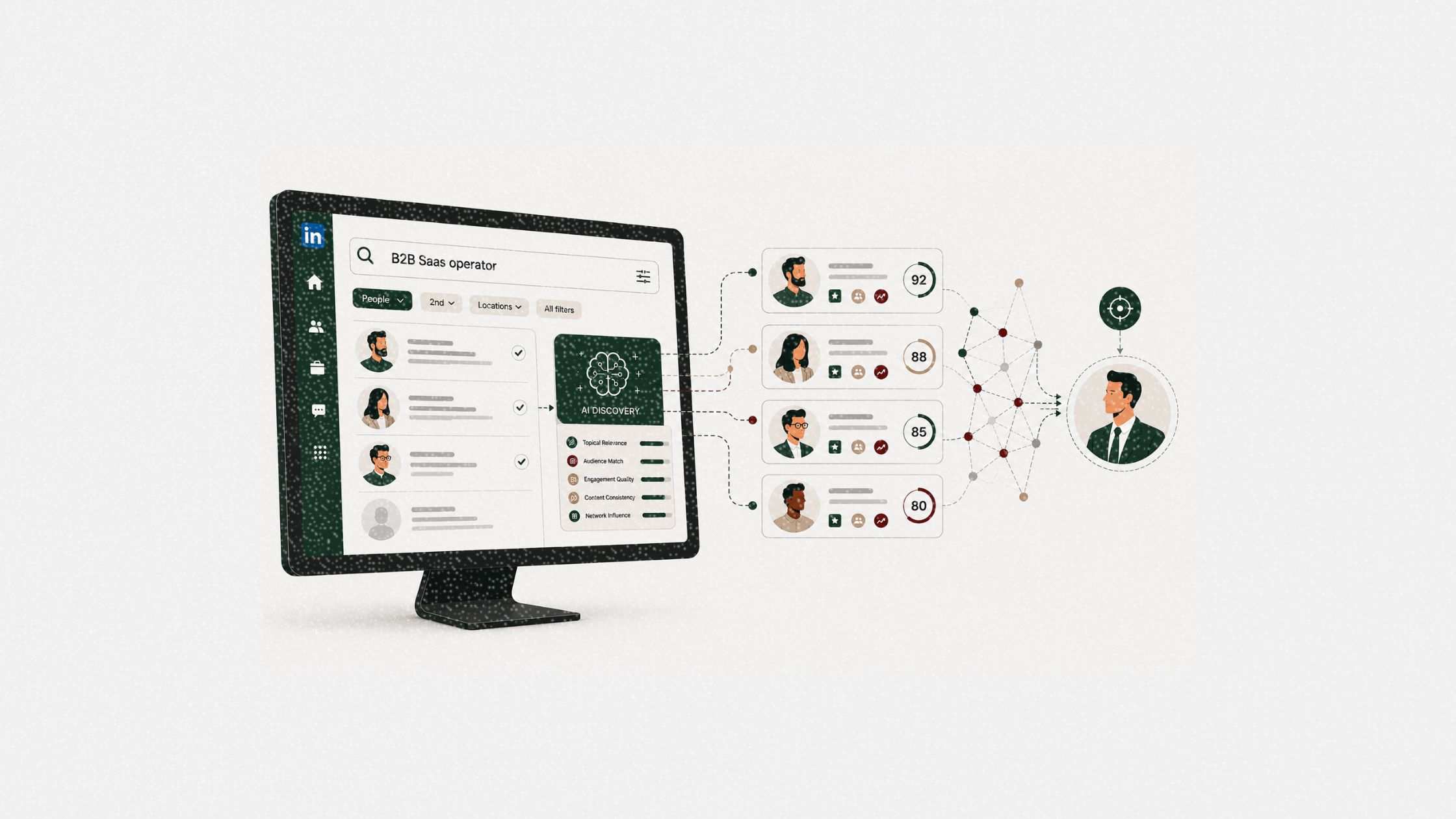
- Method 3: Lessie’s AI-powered B2B discovery
- Method 4: Mining your existing customers and community
- Method 5: Substack and newsletter crossover prospecting
- How to vet what you find
- From shortlist to working roster
Why finding B2B influencers on LinkedIn is harder than it looks
The discovery friction is structural. LinkedIn does not expose follower counts on standard profiles the way Instagram or TikTok do. Its native search is optimized for job seekers and recruiters, not for marketers trying to filter by niche, engagement rate, or audience industry. The platform’s algorithm surfaces content within your existing network, which means if your network is not already seeded with the right operator-creators, they stay invisible.
The payoff for solving this problem is significant. 79% of B2B buyers engage with creator content at least monthly, and 82% say it influences their purchasing decisions, per LinkedIn’s “Collaborate with Confidence” guide. 71% of marketers say being recommended by a subject-matter expert influencer is influential in building a successful B2B brand, per a LinkedIn and Ipsos 2025 survey. Those are not awareness metrics. Those are pipeline-stage numbers.
55% of B2B marketers are now partnering with creators or influencers on LinkedIn, per the same LinkedIn and Ipsos survey, which means the brands building creator rosters today are already a step ahead of the other half that have not started. The five methods below are how you close that gap efficiently.
Method 1: LinkedIn native search and Boolean operators
This is the free starting point. LinkedIn’s search bar supports Boolean operators, and most marketers never use them. Used correctly, they can surface ICP-relevant creators without any paid tool.
Start with the People filter in LinkedIn search, then layer in keyword combinations that describe your target creator’s role, content angle, or subject-matter expertise. Boolean rules on LinkedIn:
AND narrows the search. “RevOps” AND “Salesforce” AND “newsletter” returns people whose profiles mention all three terms.
OR broadens it. (“Chief Marketing Officer” OR “CMO” OR “VP Marketing”) widens your job-title net without running three separate searches.
NOT excludes noise. Adding NOT “agency” or NOT “consultant” filters out people who write about your space commercially rather than as practitioners.
Quotes enforce exact phrases. Searching “demand generation” finds that exact string rather than both words scattered across a profile.
A practical starting query for a SaaS company in the RevOps space: “revenue operations” AND (“newsletter” OR “substack” OR “podcast”) NOT “agency”. Run that, sort by People, and scan for profiles with consistent posting history and an audience of practitioners.
Two limitations to know going in: LinkedIn’s free search shows only a limited number of results per query and restricts how many profiles you can view before throttling. For deeper discovery, you will need one of the paid methods below. But for building an initial prospect list of 15 to 20 names at no cost, this is the correct first move.
Method 2: Sales Navigator’s creator-specific filters
Sales Navigator is LinkedIn’s premium B2B prospecting tool with 25+ advanced search filters, covering the full database of LinkedIn’s 1 billion members. It was built for sales teams prospecting leads, but the same filter depth that finds buyers also finds creators.
The specific filters most useful for B2B influencer discovery are:
Content keywords. Sales Navigator lets you filter by keywords that appear in a person’s recent posts, not just their profile. Searching for “SaaS” in content keywords finds people actively writing about SaaS, not just people who listed it as a past job. For creator discovery, this is far more useful than profile-keyword search.
Seniority and function. Pairing “Director” or “VP” seniority with a job function like “Marketing” or “Operations” finds practitioners with enough career context to have genuine audience authority.
Follower count. Sales Navigator does not expose follower counts in most filter combinations, but pairing it with a dedicated discovery tool or manual profile review fills that gap.
Saved searches and alerts. Once you have built a useful query, save it. Sales Navigator will alert you when new profiles match the criteria, which means your creator prospecting list updates automatically.
Pricing for Sales Navigator starts at US$99/user/month (Core) on monthly billing, with annual contracts running roughly 20% cheaper. For B2B teams already running Sales Navigator for outbound, the influencer discovery use case is an incremental gain on a tool they are paying for regardless.
The workflow that works: build your list in Sales Navigator, then open each profile manually to assess posting frequency, content quality, and comment-section engagement before moving anyone to your shortlist.
Method 3: Lessie’s AI-powered B2B discovery
If Sales Navigator is the research layer, a purpose-built AI discovery tool is the influencer layer. Lessie solves the core problem with LinkedIn-native search: no native visibility into audience composition, engagement rates, or posting consistency.
Lessie searches 100+ live sources for verified contact data and creator profiles, with LinkedIn-inclusive discovery built for B2B use cases. Where Sales Navigator finds anyone matching a job title, Lessie is oriented toward surfacing the people most likely to be active creators and influence your ICP, not just passive members of the platform.
The features most relevant for B2B discovery:
Natural language search. Rather than building Boolean strings manually, you describe the creator you are looking for in plain language. Lessie parses the query and surfaces matching profiles, which meaningfully speeds up the initial longlist phase.
Verified contact data. Once you have identified a creator worth approaching, Lessie appends verified work emails and direct contact information. This matters when you want to go beyond cold LinkedIn DMs for outreach.
Multi-source matching. By querying 100+ sources rather than a single platform database, Lessie surfaces creators who may not appear prominently in LinkedIn’s own search, including those who cross-post between LinkedIn and newsletters or who have growing but not yet large followings.
Lessie starts at US$34/month, making it the most accessible paid option covered in this guide. For lean B2B teams running their first influencer program, it provides functional LinkedIn-inclusive discovery without the per-seat cost of Sales Navigator or the enterprise pricing of larger platforms.
“The brands I see succeeding at B2B influencer discovery on LinkedIn are not relying on one method,” says Dinda Anandita, Account Director at Content Collision. “They are combining a structured discovery tool with manual network mining to find the people their ICP actually trusts. The tool gives you scale; the manual layer gives you the contextual fit that no algorithm captures yet. Getting both right is what separates a shortlist worth actioning from a spreadsheet that never converts.”
Method 4: Mining your existing customers and community
The most underutilized asset in B2B influencer discovery is not a new AI tool. It is your own customer list.
Your happiest customers are already practicing experts in your ICP’s problem space. A subset of them is almost certainly active on LinkedIn. Some of them have audiences. The difference between this method and cold outreach is that the creator already has first-hand experience with your product or category, which gives any partnership an authenticity floor that paid campaigns rarely achieve.
The discovery workflow:
Go through your current customer list, particularly mid-market and enterprise accounts. For each company, search LinkedIn for employees in relevant roles (Head of RevOps, Director of Marketing, VP of Customer Success). Look at their profiles: are they posting consistently? Do they have more than a few hundred followers? Is their comment section populated with practitioners in your ICP rather than bots or generic reactions?
You are not looking for mega-creators. A customer with 3,000 highly engaged followers who posts three times per week about the exact problem your product solves is more valuable than a 50,000-follower generalist.
The second layer is your event and webinar history. People who have spoken at your virtual events, contributed to your content, or engaged publicly with your brand on LinkedIn have already self-selected as potential advocates. Check their profiles. Employee-shared content reaches 561% more people than company page posts, per GaggleAMP’s employee advocacy analysis, and the same amplification logic applies to customer advocates posting independently about their experience with your category.
When approaching existing customers about a creator partnership, the frame matters. Lead with what they get: amplification for their own content, co-branded visibility, access to your audience, or a product benefit relevant to them. Not a “can you post about us” ask.
Method 5: Substack and newsletter crossover prospecting
The most sophisticated B2B creators in 2025 and 2026 are not single-platform. They publish on LinkedIn and they run a Substack, a beehiiv newsletter, or a LinkedIn-native newsletter. Finding them via their newsletter presence often surfaces creators that pure LinkedIn search misses.
The logic: a B2B creator with a 6,000-person Substack on enterprise data strategy is probably cross-posting highlights on LinkedIn and pointing LinkedIn connections to the newsletter. Their LinkedIn profile may show modest follower counts if their audience has not yet migrated to follow them there, but their actual influence, measured by the inbox access they have to your exact ICP, can be substantially larger.
How to find them:
Search Substack’s Explore or Discover section by category (Marketing, Technology, Business, Finance). Filter for newsletters that match your ICP’s professional interest. Check whether the author has an active LinkedIn profile linked from their Substack bio. Read several issues to gauge content quality and practitioner credibility.
Substack surpassed 5 million paid subscriptions by March 2025, up from 4 million four months prior. A sponsored placement in a relevant B2B newsletter is not just influencer marketing; it is inbox access at a CPM that digital ad benchmarks rarely match when adjusted for conversion intent.
The crossover profile to prioritize: a creator who posts three to five times per week on LinkedIn, runs a newsletter on the same topic, and has a comment section full of practitioners in titles matching your ICP. That combination signals a genuine audience, not just algorithmic reach.
How to vet what you find
Discovery produces a long list. Vetting produces a shortlist worth contacting. These are the signals that separate a creator with genuine B2B influence from one who looks good in a database.
Comment quality over comment quantity. Scan the comments on their last ten posts. Are the commenters in relevant roles at relevant companies? Are comments substantive, or are they generic praise from other creators gaming LinkedIn engagement? A post with 40 thoughtful comments from practitioners is worth more than one with 400 generic reactions.
Posting consistency. Check whether they were posting six months ago at the same rate. Irregular posting history often signals a creator who surged briefly and faded, which is a problem for an always-on B2B partnership.
Audience-to-engagement ratio. A creator with 8,000 followers and consistent 3% to 5% engagement per post has a more activated audience than one with 40,000 followers and 0.2% engagement. The majority of LinkedIn influencers (71.36%) have an average engagement rate of 0 to 1%, per The Influencer Marketing Factory’s analysis of 5,500 US-based LinkedIn creators, so engagement rates above 2% are meaningfully above the platform average and worth noting.
Audience composition. If your discovery tool surfaces audience data, check that the follower base matches your ICP. A 15,000-follower marketing creator whose audience is 60% other marketers looking for jobs is not the same as one whose audience is 60% marketing directors at mid-market SaaS companies.
No competitive conflicts. Before reaching out, check whether they have recent sponsored content or visible partnerships with direct competitors. This is basic diligence, but it is frequently skipped in the rush to build a shortlist.
For a deeper look at the tools that automate parts of this vetting workflow, the AI influencer marketing tools comparison covers hands-on testing of Modash, Favikon, Lessie, Stormy, and IMAI on identical B2B discovery queries.
From shortlist to working roster
A shortlist of 15 to 25 vetted creators is the right scope for a first B2B LinkedIn influencer program. Beyond that, you need infrastructure that most B2B teams do not yet have in place.
Before reaching out, get your outreach process right. The first contact sets the tone for the entire partnership. Lead with what is in it for the creator: distribution of their content to your audience, co-branded visibility, or early access to a product relevant to their niche. A personalised DM that references a specific post they wrote will always outperform a generic partnership pitch.
Internally, document each creator in a simple CRM (Lessie and most discovery platforms include one; a spreadsheet works for 15 to 25 names). Track: follower count at time of discovery, estimated engagement rate, audience composition notes, any prior brand deals, and your initial contact date. For broader context on building the full LinkedIn creator strategy once your roster is in place, the LinkedIn influencer marketing playbook covers Thought Leader Ads setup, content formats, and attribution approaches specific to B2B.
The discovery process described in this guide is not a one-time exercise. B2B creators move, shift focus, or grow their audiences quickly. Building a saved search in Sales Navigator and running a quarterly discovery pass in Lessie takes less than an hour and keeps your pipeline of potential partners fresh.
The brands building durable B2B influencer programs in 2026 are not running one-off creator campaigns. They are building rosters, maintaining relationships, and amplifying creator content via Thought Leader Ads once the organic performance is proven. Discovery is where it starts, but the compound value comes from what you build once you have found the right people.