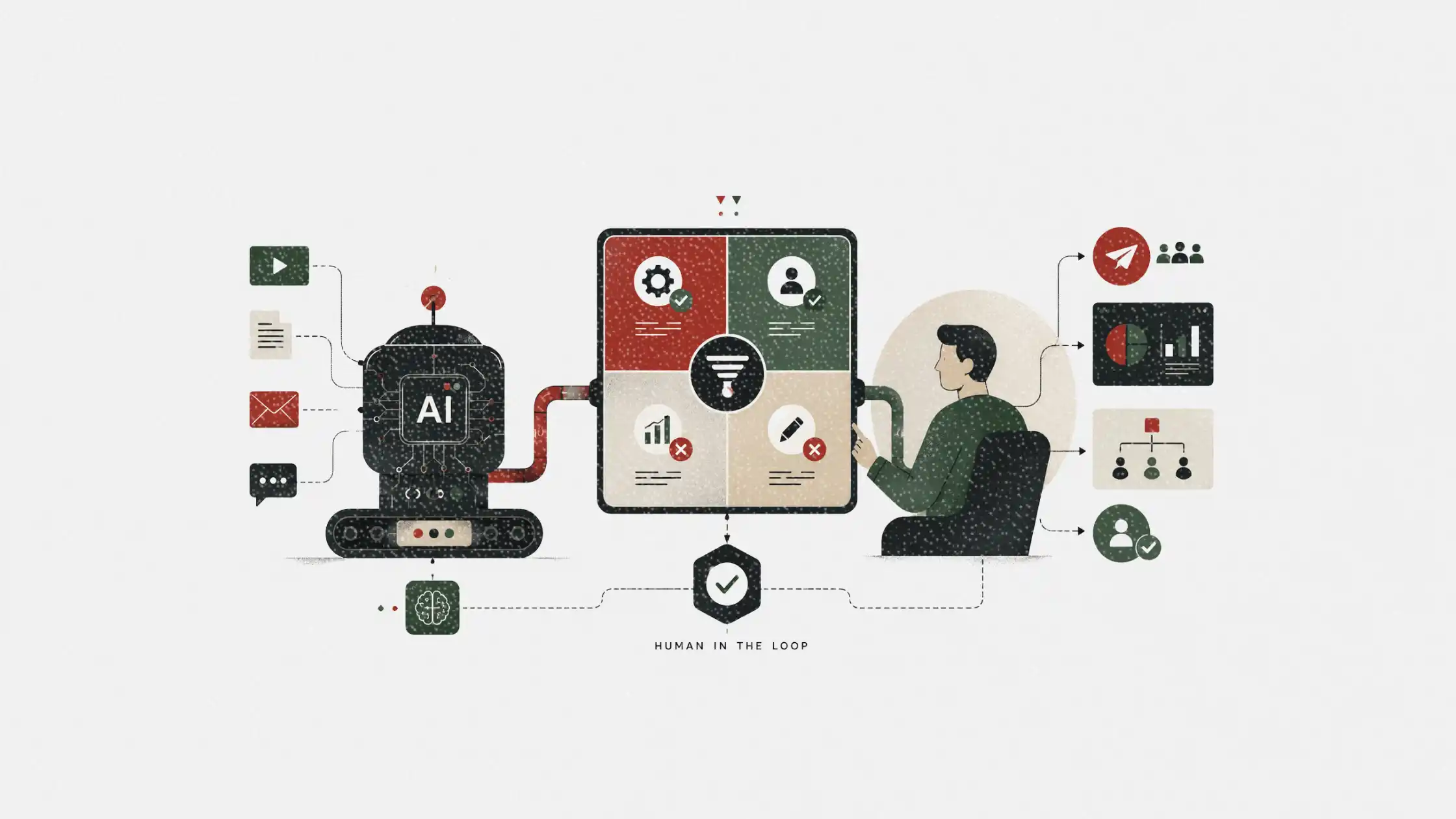
Most marketing teams that struggle with AI automation are not failing because the tools are bad. They are failing because they are automating the wrong things first.
The appeal of automating everything is real. You have a tight team, growing workload, and a dozen AI tools in your tab bar. The instinct is to start somewhere and figure it out from there. But that approach burns time on setup, maintenance, and debugging workflows that should not exist at all.
This article gives you a practical framework for deciding which marketing tasks are worth automating, which ones need a human in the loop, and which ones you should not touch yet.
Table of contents
Jump to each section:
- Why most teams automate the wrong tasks first
- The four-quadrant filter
- Tasks that are strong automation candidates
- Tasks that need a human in the loop
- A practical starting framework
 Enricko Lukman
Why most teams automate the wrong tasks first
The common mistake is automating what is visible, not what is expensive.
Marketers tend to reach for automation on tasks they actively dislike, like social media scheduling or meeting notes. Those are fine targets. But the highest-ROI automation targets are usually the tasks that run quietly in the background and drain hours each week without anyone noticing: lead enrichment, content distribution, performance reporting, email segmentation, and routing.
According to HubSpot’s State of Marketing Report 2026, 93% of marketers already use automation for administrative tasks like scheduling, note-taking, and documentation. That is nearly universal. The differentiation is no longer whether you automate admin work. It is whether you automate the strategic execution layer on top of it.
If your team is only touching administrative automation, you are leaving most of the value on the table.
The four-quadrant filter
Before automating any marketing task, run it through these four questions:
- Is it high-volume and repetitive?
Automation pays off when a task happens often enough that the compounding time savings justify the setup cost. A task you do twice a month is rarely worth building a workflow for. A task you do 30 times a week is almost always worth it.
- Does it follow a clear, documentable logic?
AI and automation tools execute processes. They do not invent them. If you cannot write down the exact steps and decision rules for a task, you cannot automate it reliably. The quality of your playbook determines the quality of your automation output.
- Does getting it wrong have low stakes?
The higher the consequence of an error, the more a human needs to stay in the loop. Social media scheduling has low stakes. A pitch to a tier-one journalist, a client proposal, or a campaign budget allocation has high stakes. Automate the former; assist the latter.
- Does it require context that lives only in your head?
Tasks that depend on brand voice, relationship nuance, editorial judgment, or organizational history are not ready for full automation. You can use AI to assist, but the human layer needs to remain active.
Tasks that are strong automation candidates
These categories pass the four-quadrant filter reliably for most marketing teams:
- Content distribution and repurposing
Once a piece of content is approved, the downstream distribution work is highly formulaic. Turning a blog post into LinkedIn snippets, email newsletter copy, and social captions follows predictable rules and can be templated into an AI workflow. The creative judgment happens at the source material stage. Everything downstream is execution.
- Lead enrichment and routing
Pulling company data, job titles, and firmographic information on inbound leads, then routing them to the right sequence or sales rep, is entirely rule-based. It is also one of the most time-consuming tasks in B2B marketing operations. Automating this alone can save several hours per week per person doing it manually.
- Performance reporting and data consolidation
Pulling metrics from multiple platforms, formatting them into a consistent template, and flagging anomalies is work that machines do better than humans. The analysis and interpretation still require judgment. The data collection and formatting do not.
- Email campaign triggers and segmentation
Behavior-based email triggers, re-engagement sequences, and list segmentation based on activity signals are well-suited to automation. The logic is definable, the volume is high, and the stakes of individual sends are manageable.
- Media monitoring and mention tracking
Tracking brand mentions, keyword alerts, and competitor coverage across the web and flagging relevant items for a human to review is a strong automation use case. The human reads what matters. The machine handles the scanning.
Tasks that need a human in the loop
These are places where AI can assist, but should not operate autonomously:
1. Journalist and influencer outreach
Personalized outreach to media contacts depends on relationship context, editorial timing, and pitch angle judgment. AI can help you draft and research, but the send decision and final copy should go through a human who understands the relationship.
2. Brand voice-sensitive content
Thought leadership pieces, campaign copy, and anything that forms part of a brand’s public positioning need editorial oversight. AI drafts can be useful starting points, but the finished output requires a human who understands what the brand sounds like and what it should not say.
3. Budget and strategy decisions
No automation tool should be making spend allocation decisions without human sign-off. AI can surface recommendations and run scenario analysis, but the decision layer stays with a person.
4. Client-facing communication
Emails to clients, responses to complaints, and account management communication involve stakes and nuance that automated responses tend to flatten in ways that damage relationships.
A practical starting framework
If you are mapping your marketing operations for automation opportunities, here is a simple audit process:
- List every recurring task your team does that is not a one-off project
- Estimate the hours per week each task consumes across all team members
- Score each task on repeatability, documentability, and error tolerance
- Prioritize the top three by hours consumed multiplied by automation readiness
- Build playbooks for those three before touching any automation tool
The playbook step is non-negotiable. AI and automation tools execute what you teach them. If you skip the documentation phase and try to build the workflow first, you will either automate a broken process or spend most of your time troubleshooting edge cases the tool was never designed to handle.
Choosing what to automate is a strategic decision, not a technical one. The teams getting the most out of AI in their marketing operations are not the ones with the most tools.
They are the ones who took the time to understand their own processes well enough to know which parts a machine can run and which parts need a human hand.