Salesforce has launched AI marketing agents designed to help teams build pipeline, generate content, and run campaigns with shared customer and business context across its platform.
The release positions “agentic” workflows as an execution layer for marketing operations, where agents assist with lead qualification, content production, and goal-driven campaign optimization as customer behavior changes.
Table of contents
Jump to each section:
- What Salesforce launched: the agent roles and what’s available now
- Why agentic marketing is a shift from automation to delegated execution
- Competitive landscape: Salesforce vs HubSpot, Adobe, and Microsoft
- Operational considerations: data, guardrails, and measurement
- What marketers should test first
What Salesforce launched: the agent roles and what’s available now
Salesforce described multiple agent capabilities that work with marketers across planning and execution:
- Agents for pipeline creation and lead qualification: This includes Qualified’s AI SDR Agent, Piper, intended to identify and qualify website visitors in real time through conversational interactions. Salesforce also introduced a Prospecting Agent, Hunter, designed to identify prospects, initiate outreach, and run nurture sequences.
- Agents for content generation: Agentforce Content Agent is positioned to generate omnichannel campaign content (email, mobile messages, SMS, RCS conversations, and promotional experiences) and support localization within the same workflow, grounded in customer context and brand guidelines.
- Agents for goal-driven campaign execution: Agentforce Marketing Goals Agent is framed as a way to run campaigns by setting goals, budgets, and guardrails, then letting agents create, execute, and optimize within those constraints.
- “Headless” campaign management via tools: Campaign management capabilities are exposed as MCP tools so teams can orchestrate workflows from interfaces like Slack.
Availability details provided include: Piper and Hunter as generally available now, campaign management in Slack using MCP generally available in June ’26, and the Content Agent and Marketing Goals Agent in pilot.
Salesforce also included early performance signals from customers: Rawlings reported 75% faster campaign creation using Agentforce Marketing; Emplifi said it reduced lead qualifying reps by about 20% while increasing opportunity creation by more than 22% using Qualified; and Indeed said it consolidated its martech stack by 40% after implementing Marketing Cloud Next.
 ContentGrip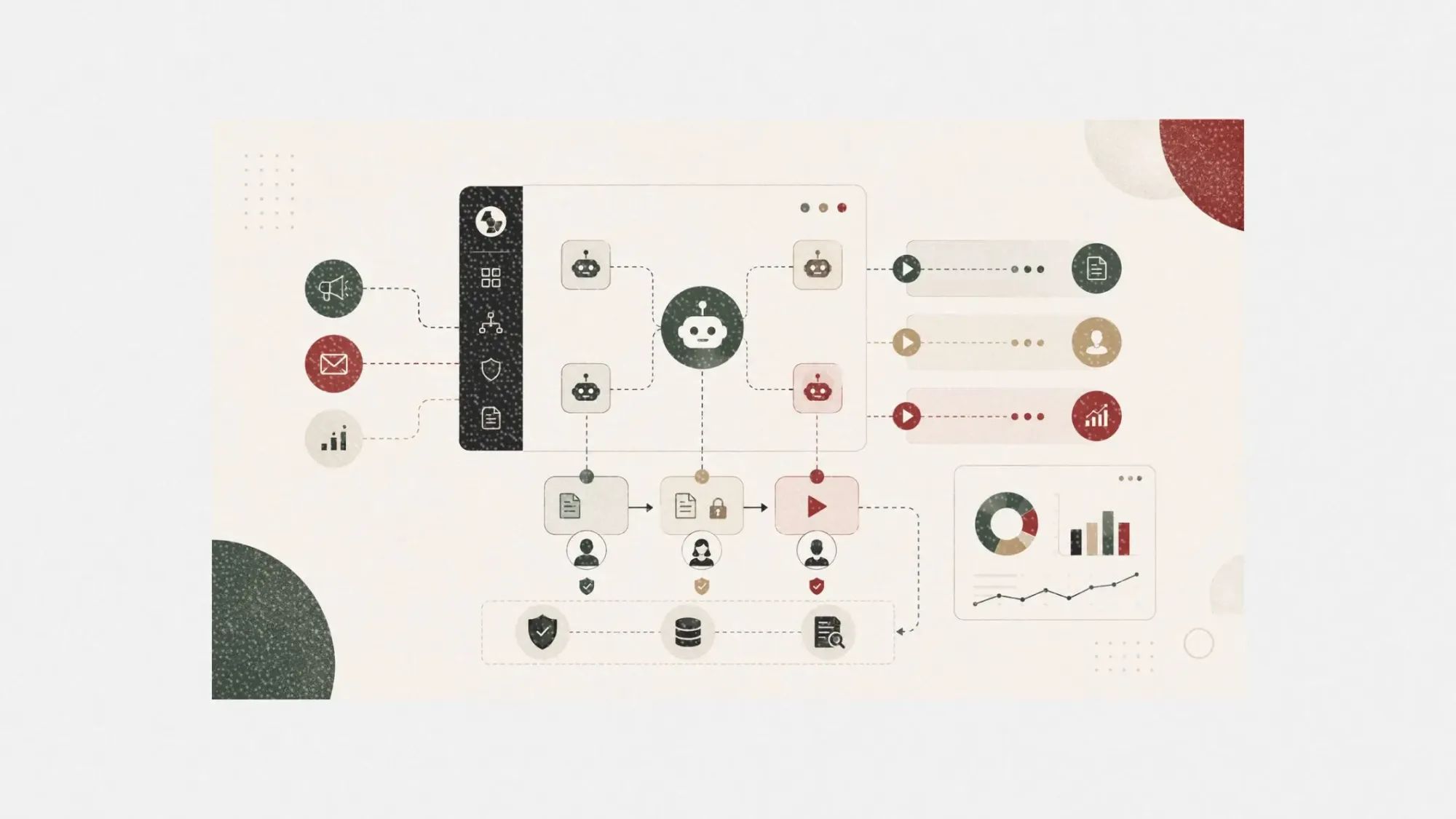
Why agentic marketing is a shift from automation to delegated execution
Traditional marketing automation typically executes predefined flows: if X happens, send Y message, update Z score. “Agentic” systems imply something different: a delegated operator that can interpret goals, reason over context, and choose actions across channels, while still being constrained by guardrails.
This aligns with two broader trends highlighted here:
- AI-powered CRM: Agents are being built closer to the system of record where transactional and behavioral data is created, which can reduce latency between signal and response.
- Marketing and sales convergence: Lead qualification, pipeline creation, and campaign execution are being framed as a continuous revenue workflow, not separate team handoffs.
For marketers, the practical implication is that competitive advantage may shift away from who has the most dashboards and toward who can safely shorten the loop between insight, decision, and execution.
Competitive landscape: Salesforce vs HubSpot, Adobe, and Microsoft
Salesforce’s move overlaps with multiple established enterprise vendors that are layering AI into marketing execution, including HubSpot, Adobe, and Microsoft Dynamics 365.
Where Salesforce can differentiate is the “shared context” argument: agents that operate across marketing, sales, service, and commerce using unified customer and business data. In theory, that reduces common failure modes like disconnected personalization (for example, promoting a product someone already bought) and fragmented engagement history.
However, competitive pressure will show up in how quickly these agents drive measurable outcomes without creating governance or brand risk. Vendors with strong creative pipelines (often associated with Adobe) or simpler all-in-one growth stacks (often associated with HubSpot) may compete on speed-to-value and usability, while Microsoft can compete on workflow distribution through collaboration and productivity surfaces.
Operational considerations: data, guardrails, and measurement
Agentic marketing is only as reliable as the data and constraints around it. Teams evaluating these capabilities should plan for:
- Data readiness: identity resolution, event instrumentation, product catalog cleanliness, and consistent lifecycle definitions. Agents that “act” amplify errors when inputs are messy.
- Guardrails and autonomy limits: clear constraints on budget spend, audience eligibility, frequency caps, and prohibited claims, plus approvals for higher-risk changes.
- Brand and compliance control: especially for regulated industries or highly scrutinized claims, where generated content needs review workflows and traceability.
- Measurement design: separating productivity gains (time-to-launch, operational load) from performance lift (pipeline impact, conversion, retention) to avoid confusing speed with effectiveness.
The customer metrics shared so far are directional, but teams will still need disciplined experimentation to validate impact by channel and segment.
What marketers should test first
A practical rollout approach is to start with constrained, high-signal use cases before expanding autonomy:
- Website lead qualification: test conversational qualification on high-intent pages with tight routing rules and human review of transcripts.
- Content production for variants: generate controlled sets of copy variants for specific segments and languages, and validate brand compliance before broad deployment.
- Goal-based optimization in a sandbox: define a narrow campaign goal with strict guardrails, then compare agent-managed performance to a baseline human-managed workflow.
- Cross-team handoff reduction: track whether agentic workflows reduce time lost between marketing and sales, not just content creation time.
If results are positive, the next step is scaling governance and measurement, not simply expanding the number of automated campaigns.