You already have the pillar. You spent real time on it, it covers the topic properly, and it has been sitting on your site for months. Now you are wondering why it is not ranking the way you expected.
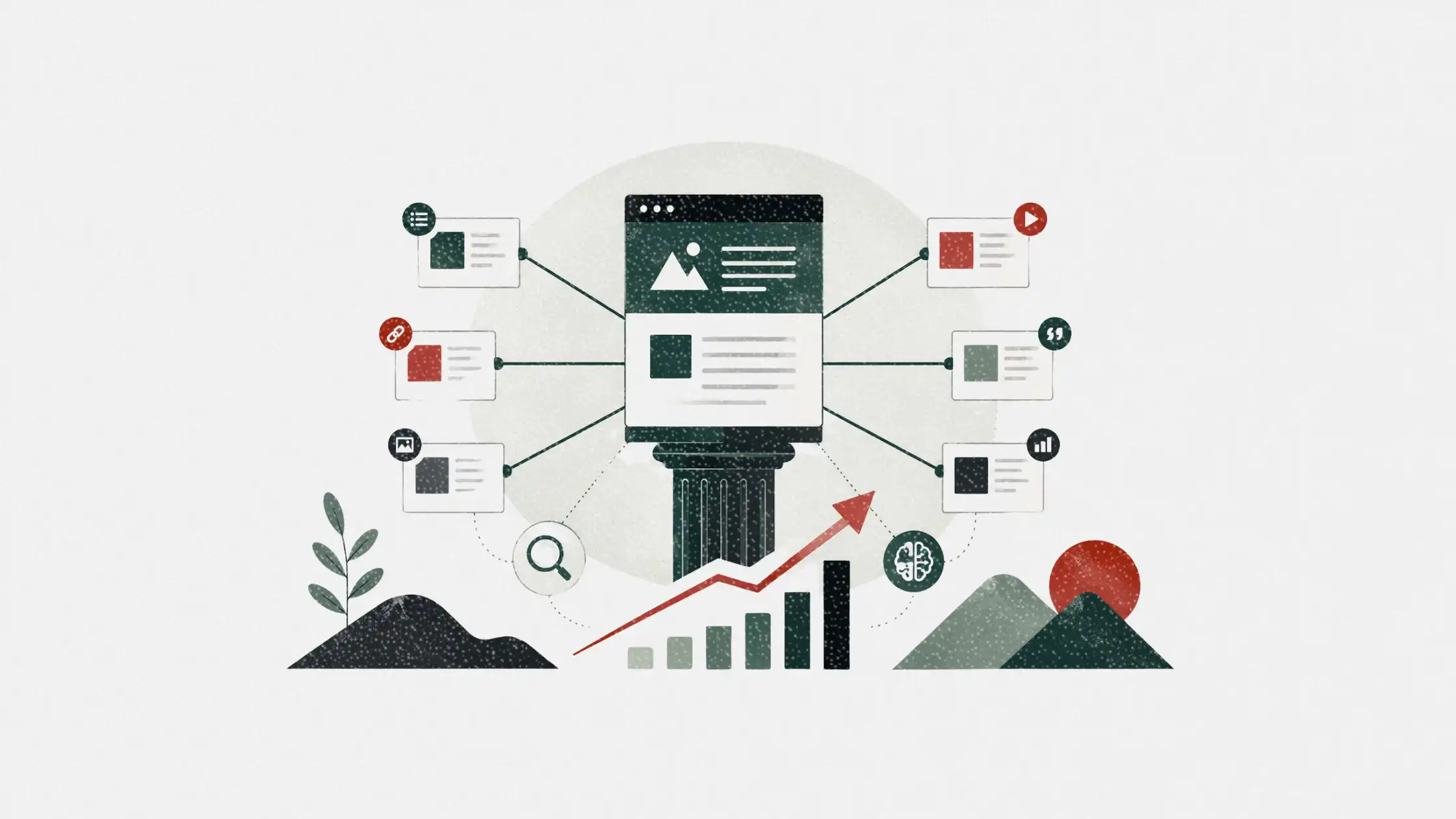
The issue is almost never the article itself. A pillar page without a supporting cluster is like a hub with no spokes. It has no network of related content pointing inward to reinforce its authority, no architecture telling search engines you genuinely own the topic. According to HireGrowth’s 2025 analysis cited by Search Engine Land, content grouped into topic clusters drives roughly 30% more organic traffic and holds rankings 2.5x longer than standalone pieces. Most teams publish the pillar and stop. The second half of the work is building what goes around it.
This article is specifically for teams starting from an existing pillar, not from a blank slate. If you are building a cluster from scratch, the process is different and covered separately in our topic cluster build guide. What follows assumes you have a pillar, you have content around it (or want to create it), and you need to connect the whole thing into something that compounds.
Table of contents
Jump to each section:
- Step 1: Treat the pillar as a gap map, not a finished product
- Step 2: Build the cluster map from what the audit reveals
- Step 3: Fill gaps in order of authority signal, not convenience
- Step 4: Retrofit the pillar to close the loop
- Why the payoff is bigger now than it was two years ago
- Keeping the cluster healthy over time
 Patrecia Meliana
Step 1: Treat the pillar as a gap map, not a finished product
Before you write or restructure anything, read your pillar article the way an editor reads a manuscript being sent back for revision. You are not checking whether it is good. You are cataloguing every subtopic, question, and use case it raises but does not fully resolve.
If your pillar is “A complete guide to content repurposing,” it probably mentions formats, tools, workflows, measurement, and distribution. Each of those is a candidate cluster article. Some will already exist on your site. Others will need to be written. Some will exist in a form that overlaps with something else you have published.
Map every subtopic the pillar surfaces against your existing content and you will find three categories: gaps (nothing exists on this subtopic), candidates (an article exists but does not link to the pillar), and cannibalization risks (two articles cover the same subtopic and neither connects to the other).
Fix the candidates before you write a single new word. Adding the link back to your pillar from existing articles is the fastest ranking signal you can generate. It costs nothing and starts working immediately. If you want to run this same audit across your entire site rather than one pillar, the topical authority audit guide covers that in full.
Step 2: Build the cluster map from what the audit reveals
A workable cluster for an existing pillar sits between 8 and 15 supporting articles. Fewer than 8 and the topical signal is too thin. More than 15 and you are almost certainly overlapping, which creates cannibalization problems to clean up later.
The test for whether an article belongs in the cluster is simple: would someone who just finished reading your pillar want to read this next? If yes, it belongs. If it requires a different starting point or serves a completely different audience, it does not.
Build your map in a spreadsheet. Columns: article title, target keyword, search intent (informational, comparison, how-to, definition), status (existing or to write), and the exact anchor text you plan to use when linking back to the pillar. That last column matters more than most teams give it credit for. Consistent, descriptive anchor text across every cluster article is one of the clearest signals you can give search engines about what the pillar page is actually about.
Step 3: Fill gaps in order of authority signal, not convenience
Not all cluster gaps are worth filling in the same order. Some subtopics have higher search volume. Some sit closer to a purchase decision. Some are purely educational. The ones that give your pillar the most authority signal fastest are the educational, high-volume subtopics. Start there.
The more specific, lower-volume subtopics still matter but they do more work at the bottom of the funnel than at the top. Publish the broader pieces first and let them begin building page-level authority before layering in the narrow ones.
As you write each gap article, link back to the pillar early in the piece, not in a related articles section at the bottom. If your pillar is genuinely the most comprehensive resource on the broad topic, referencing it in the first half of the article is natural. Also link cluster articles to each other where the topics genuinely connect. Two articles in the same cluster that address adjacent questions should point to each other in addition to both pointing back to the pillar.
 Patrecia Meliana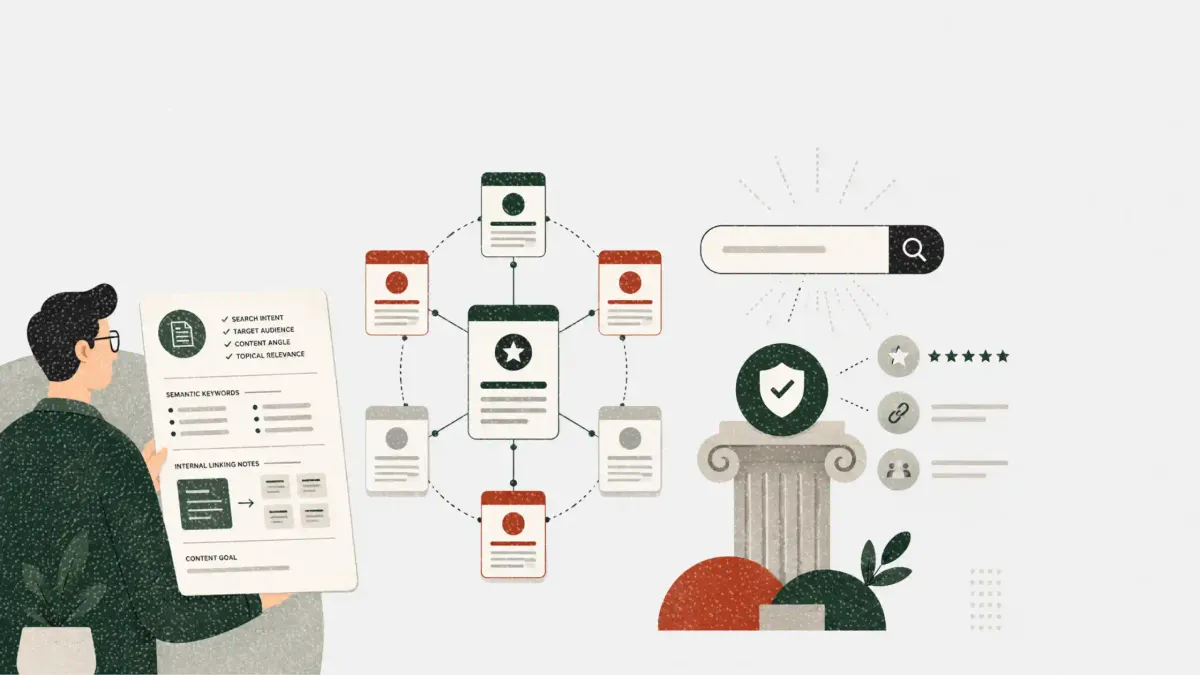
Step 4: Retrofit the pillar to close the loop
Most teams forget this step entirely. Once your cluster articles exist, the pillar needs to acknowledge them. Not with a curated list of links at the bottom, but woven into the body where each subtopic naturally comes up.
Go through the pillar paragraph by paragraph. Every time it raises a subtopic that now has a dedicated cluster article, add a contextual link. If it says “choosing the right distribution channels is where most teams lose momentum,” and you now have a full article on that, link it there. The link should feel like a natural extension, not a cross-promotion.
A pillar that links outward to a full cluster signals topical depth to search engines. It also reduces bounce by giving readers a clear path to go deeper on whatever part is most relevant to them.
Why the payoff is bigger now than it was two years ago
Portent’s 2024 case study documented a 207% increase in organic sessions for content hub implementations. That figure captures what happens when a team shifts from treating articles as isolated assets to treating them as a connected architecture.
There is also an AI visibility dimension that has emerged recently. Research cited by XICTRON found that AI citation rates increased from 12% to 41% for topics organized in a pillar-cluster structure compared to standalone pages.
As Google AI Overviews, Perplexity, and similar surfaces become more prominent, the sites most likely to be cited as sources are the ones with coherent, interconnected content on a topic. That is a distribution channel most teams are not building toward yet.
Keeping the cluster healthy over time
A cluster built from an existing pillar needs ongoing maintenance. That means refreshing cluster articles when the subtopic changes, updating internal links when you publish new related content, and checking at least twice a year that your pillar is still the most authoritative article in the cluster.
If a cluster article has grown more comprehensive than the pillar itself, you have a structural problem worth addressing before it becomes a ranking problem.
Treat the cluster map as a living document rather than a completed project. You add to it, prune from it, and revisit the internal links as the content library grows. The teams that build compounding organic traffic are the ones who do this consistently, not the ones who build the cluster once and move on.
 Patrecia Meliana