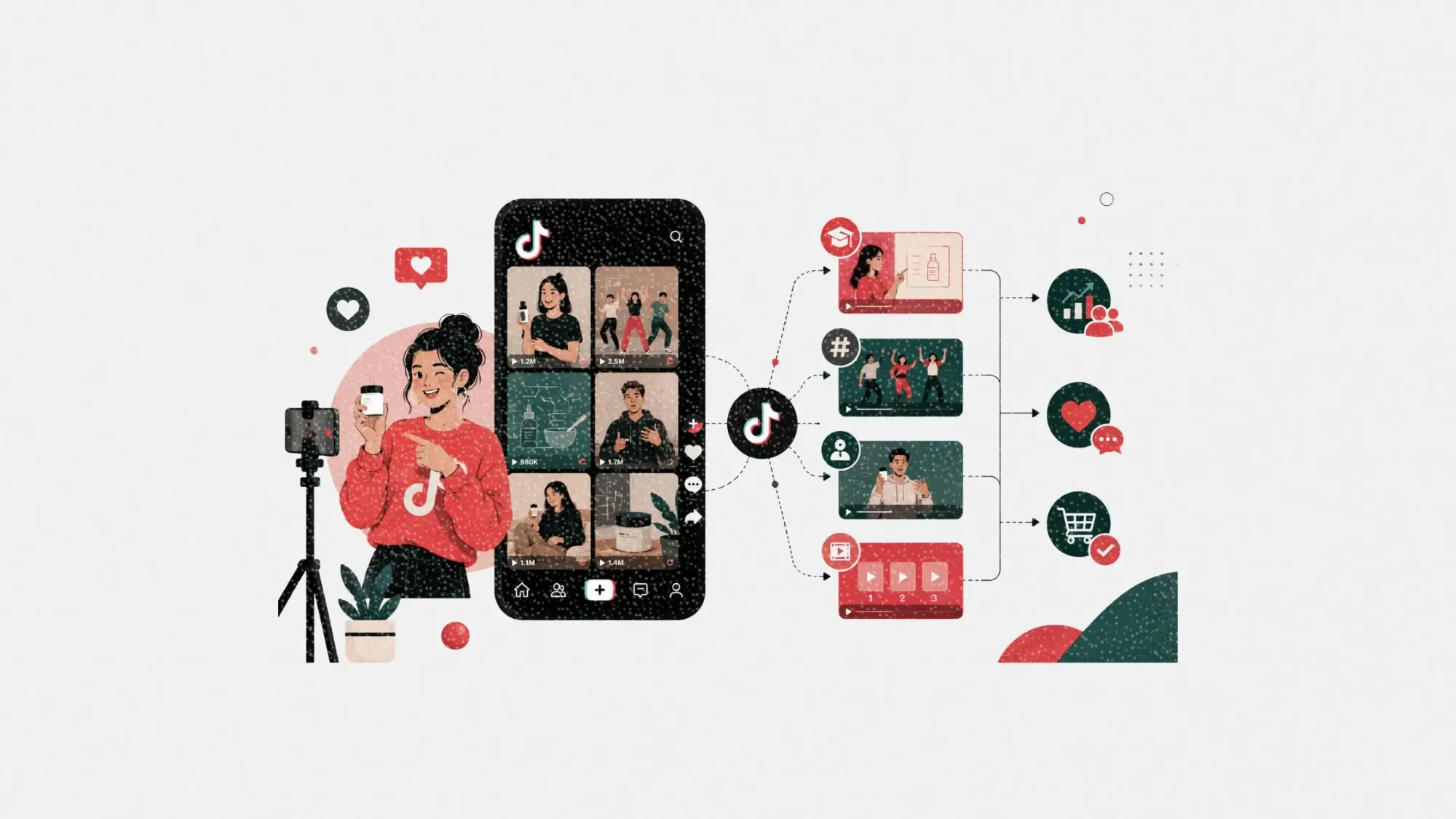
TikTok content types are the distinct video formats brands use to reach, engage, and convert audiences on the platform. The best-performing types in 2026 include educational how-to content, UGC-style and creator-led video, behind-the-scenes storytelling, trend participation with a brand-specific spin, and episodic series formats.
Performance varies by objective: some formats drive reach, others drive saves and rewatches, and others drive clicks and conversions. Brands that consistently outperform competitors treat TikTok as a format system, selecting and testing a defined portfolio of content types, rather than chasing whatever sound or challenge is trending that week.
Table of contents
Jump to each section:
- What “best-performing” means on TikTok
- The TikTok content formats brands should test first
- Format matrix: effort, KPI, and best use case
- Examples from brands using these formats well
- How to build a repeatable TikTok testing plan
What “best-performing” means on TikTok
“Best-performing” on TikTok is not a single number. The platform’s algorithm evaluates content on completion rate, rewatch behavior, shares, and comments, and different formats naturally drive different signals.
A tutorial drives saves and rewatches. A trend adaptation drives shares. A product demo drives profile visits and link clicks. Before selecting formats to test, brands need to align the definition of performance to a specific objective.
The three most relevant objective buckets are:
- Awareness: video views, follower growth, reach
- Engagement quality: engagement rate by views, shares per post, comments
- Conversion: click-through rate, TikTok Shop GMV, link-in-bio clicks
According to Dash Social’s 2026 TikTok benchmarks, the overall average TikTok engagement rate across brand accounts has dipped to 3.4% from 3.9% the prior year. Publishing-sector accounts lead at 5.3% engagement by views. Shares are emerging as a particularly important distribution signal: TikTok posts now average 796 shares per post, and content with emotional or entertainment value is driving disproportionate share volume.
One counterintuitive finding from the same report: brands posting fewer than six times per week see 93% higher engagement than those posting at record volumes. Intentional posting beats high frequency.
 Ariana Sorensen
The TikTok content formats brands should test first
Educational and how-to content
Short explainers and tutorials perform consistently across brand categories. They drive saves and rewatches, two of TikTok’s highest-weight algorithm signals, and they compound over time through TikTok’s search function. When a user searches a how-to query inside TikTok, educational videos that directly answer the question surface ahead of trend content. This makes educational format one of the few genuinely durable options on a trend-heavy platform.
According to Influencer Marketing Hub’s TikTok Marketing Report, educational content accounts for 16.1% of best-performing brand posts, second only to UGC.
UGC-style and creator-led content
UGC-style content, meaning lo-fi, first-person video that looks like it came from a real user rather than a brand, consistently outperforms polished production. A 2025 analysis by Precis measuring 10 e-commerce brands found that UGC outperformed non-UGC content by +55% ROI on average. Unbranded UGC performed +19% better than branded versions. Content with minimal logos or overlays outperformed more traditional ad-format videos by +81% ROI.
The mechanism is simple: TikTok audiences are trained to scroll past anything that looks like an ad. When branded content looks and sounds native to the platform, it clears the first filter that eliminates most brand content.
IMH’s report confirms UGC is the single best-performing content type on TikTok at 55.7% of top-performing posts.
Behind-the-scenes content
Behind-the-scenes content, showing real people, real processes, and unedited moments, aligns with TikTok’s own stated direction for 2026. In its What’s Next 2026 trend report, TikTok describes “Reali-Tea” as the dominant audience behavior shift: users are moving away from curated aesthetics and fantasy feeds toward honesty, real process, and community participation. Brands that show how something is made, who is behind the product, or what actually happens behind the scenes are feeding directly into this shift.
This format works particularly well for trust-building in longer sales cycles, making it relevant for brands whose audience needs to warm up before converting.
 Ariana Sorensen
Trend participation with a brand-specific spin
Trend-based content drives shares and reach faster than almost any other format. The failure mode is generic participation: dropping a brand logo onto whatever audio is popular that week produces content that gets ignored. The brands that perform well in this format treat trending audio and formats as creative constraints rather than scripts. They find the intersection between what is trending and something genuinely specific to the brand’s identity.
According to Sprout Social’s 2026 TikTok trends guide, 93% of consumers expect brands to keep up with online culture, but they favor brands that engage authentically over those that chase trends blindly.
Episodic and series content
Series content, repeatable formats an audience can follow across multiple videos, builds return viewers and community. It drives follower growth more reliably than isolated viral posts because it gives people a reason to subscribe rather than just watch once. This format has higher setup cost but a compounding payoff: each new episode pulls viewers back to earlier episodes, building watch time across the account.
Format matrix: effort, KPI, and best use case
| Format | Production effort | Primary KPI | Best use case | When not to use |
|---|---|---|---|---|
| Educational / how-to | Low to medium | Views, saves, rewatches | Awareness, search discovery | When the topic needs more than 90 seconds to explain well |
| UGC / creator-led | Low | Engagement rate, conversions | Social proof, product discovery | When no genuine community voice or creator relationship exists |
| Behind-the-scenes | Low | Completion rate, comments | Brand humanization, trust-building | When there is no genuinely interesting process to show |
| Trend participation | Low to medium | Views, shares, follows | Culture fit, reach expansion | When the trend is already past peak or does not fit brand voice |
| Product demo | Medium | CTR, link clicks, conversions | Consideration, purchase intent | When the product requires complex explanation beyond short-form |
| Episodic / series | Medium | Return viewers, follower growth | Retention, community building | When the team cannot commit to a consistent publishing cadence |
Examples from brands using these formats well
Duolingo built its TikTok presence almost entirely on entertainment and trend participation. The brand’s mascot-led, lo-fi skits fit natively into the platform’s aesthetic without looking like ads. The result is a brand voice that drives consistent shares and cultural relevance without depending on paid amplification to distribute.
Ryanair runs behind-the-scenes and self-aware humor content as its primary pillar. Greenscreen filters and sarcastic captions turn a “budget airline” positioning, which could easily produce negative sentiment on a platform like this, into a content system that the audience actively participates in.
Notion uses educational how-to content consistently. Productivity tutorials serve the existing user base while drawing in new audiences through TikTok’s search function, creating a format that compounds in value over time rather than spiking once and fading.
Saje Wellness combines trend participation with brand-consistent aesthetics, proving that staying true to brand tone while adapting trending formats is a workable combination rather than a compromise.
The pattern across all four: none of them chase trends as their primary strategy. Each operates around one or two core format pillars and uses trend moments selectively to amplify content that already has a proven performance base.
 Patrecia Meliana
How to build a repeatable TikTok testing plan
The common mistake brands make is running TikTok reactively. Someone sees a trending sound, requests a video, the team scrambles to produce it, and the output has no relationship to what has actually worked for that account before. The result is a content feed that looks inconsistent to both the algorithm and the audience.
A format-based approach inverts this:
- Start by selecting two or three format pillars from the matrix above that match your primary objective and production capacity.
- Commit to running each pillar for at least four to six weeks before drawing conclusions.
- TikTok’s algorithm needs a sufficient posting history to understand what an account is about; switching formats every week resets the signal and delays distribution.
Dinda Anandita, Account Director at content-led PR agency Content Collision, frames this as a portfolio problem: “Most brands burn their TikTok budgets chasing the latest sound without first testing which formats consistently move their specific audience. The brands that compound on TikTok build a format portfolio first, then use trend moments to amplify what is already working.”
Within each format pillar, run structured creative tests: vary the hook, the length, the CTA, or the production style, but keep one variable at a time so performance differences are attributable. After each testing cycle, review which posts drove the KPIs that match your stated objective rather than the ones with the highest raw view count. View count is a reach signal, not a performance signal, unless reach is genuinely the objective.