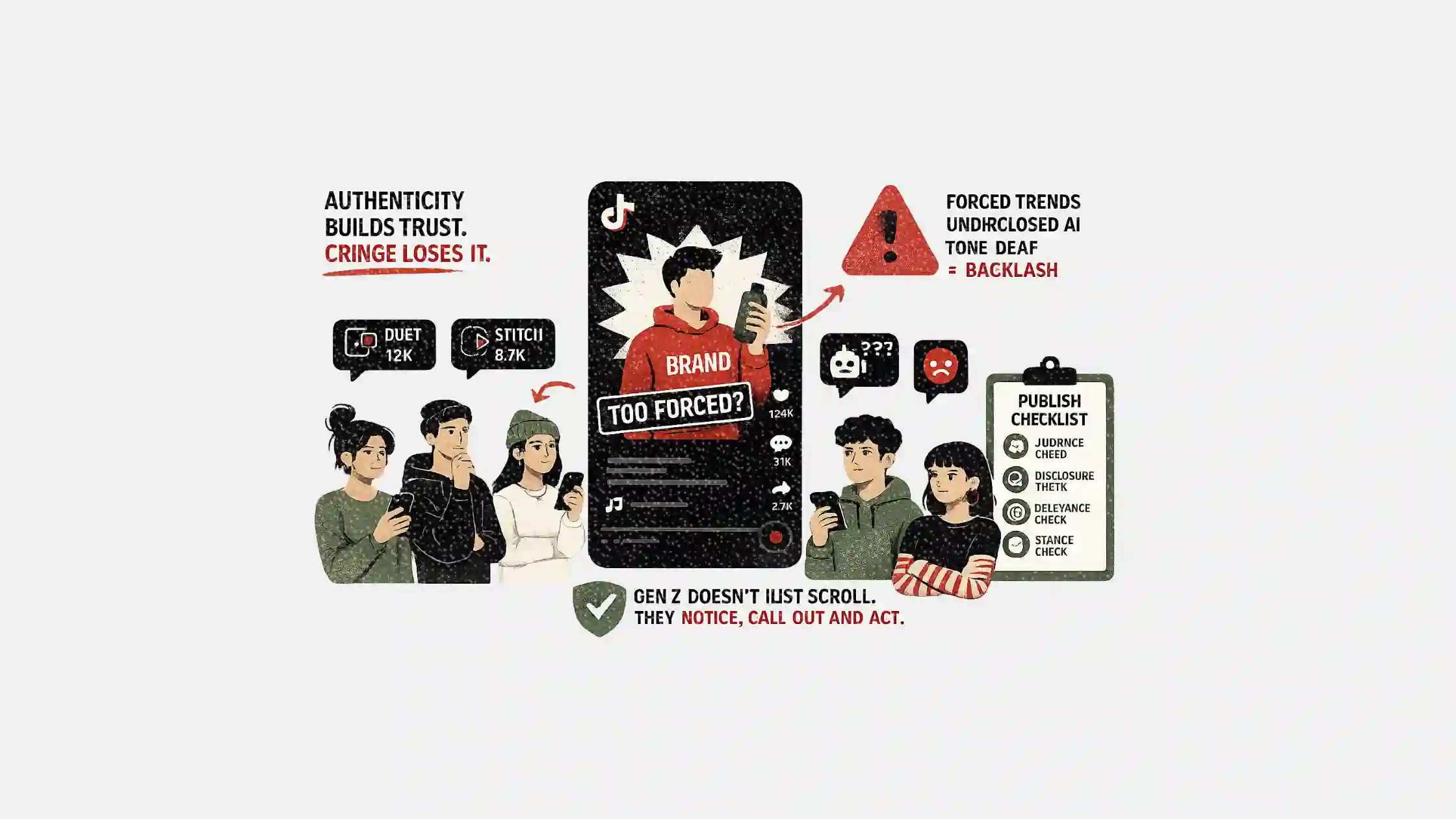
TikTok does not give brands much time to recover from a bad call. A post that reads as forced, fake or tone deaf can be duetted, stitched and screenshotted into a pile within hours, and the platform’s recommendation system keeps resurfacing it long after the original mistake is deleted.
For marketers targeting Gen Z, brand safety on TikTok is no longer only about staying away from harmful or adjacent content. It now includes avoiding the kind of content that reads as inauthentic enough to trigger a public callout.
This shift matters because Gen Z does not just scroll past content they distrust. They act on it, and the data shows the consequences are real, measurable and growing.
Table of contents
Jump to each section:
- Why TikTok raises the stakes
- The data behind the backlash
- What actually triggers the cringe
- A practical framework before you publish
- If backlash happens anyway
 Patrecia Meliana
Why TikTok raises the stakes
TikTok’s recommendation system does not behave like a typical social feed. A clip can resurface weeks after it was first posted, which means a single misstep keeps finding new audiences instead of quietly fading out.
Layer on a generation that grew up watching brands market to them and has gotten fast at spotting scripted or performative content, and the margin for error narrows considerably. This generation increasingly treats the platform as a discovery and research tool rather than pure entertainment, which means they are evaluating brand content more critically than older audiences give them credit for.
Combine that scrutiny with TikTok’s duet and stitch features, and individual criticism turns into compounding visibility for the brand’s mistake.
The data behind the backlash
Three recent data points illustrate how steep the cost of a misstep has become, and what actually rebuilds trust once it happens.
First, Gen Z is the generation most willing to act on its frustration with a brand. A March 2025 Harris Poll found that 53% of US Gen Z adults say they have, are, or will participate in an economic boycott, a higher share than any other generation surveyed. Boycotting is no longer a fringe response reserved for major corporate scandals. It has become a default reaction available to a generation that treats brand behavior as part of its identity, and TikTok is usually where that reaction starts and spreads.
Second, undisclosed AI content is becoming one of the fastest ways to lose Gen Z’s trust. Sprout Social’s Q3 2025 Pulse Survey found that the single thing Gen Z most wants brands to stop doing is posting AI generated content without clearly labeling it, and 56% of Gen Z respondents said they are more likely to trust brands that commit to publishing content created by humans. This lines up with the wider pattern explored in our piece on AI failures and brand trust, where undisclosed automation tends to do more reputational damage than the underlying mistake itself.
Third, the data points to what actually works as a counterweight to cringe. Talker Research’s Gen Z Trust and Attention report, based on a survey of 2,000 Gen Z Americans conducted in February 2026, found that 67 percent of respondents said data and statistics make them feel more confident in a brand, and 70 percent said they find a brand more credible when it shares useful content or genuine insight rather than polished promotional messaging.
Gen Z is not rejecting brand content outright. They are rejecting content that feels manufactured for the algorithm instead of made for them.
 Patrecia Meliana
What actually triggers the cringe
A few patterns show up again and again in the campaigns that backfire.
Trend jacking without context is one of the most common. Jumping on a trending sound or format the day it peaks, without any real connection to the brand’s voice or product, reads as desperate rather than playful, and Gen Z is fluent enough in TikTok’s formats to spot the gap immediately.
Performative stances with no follow-through are another recurring trigger. Posting about a cause once, without budget, policy or product changes behind it, gets read as opportunism rather than genuine commitment. This generation tends to research whether a brand’s actions match its messaging before deciding whether to extend trust, a pattern also visible in the broader shifts described in Gen Z consumer trends and key insights.
Undisclosed AI voices or faces cause damage that compounds over time. Using AI generated avatars, voiceovers or influencer style content without labeling it tends to surface eventually, and the reveal usually does more harm than the content itself would have if it had simply been disclosed upfront.
Corporate tone in a creator native format rounds out the list. Treating TikTok like a billboard, with scripted dialogue, brand jingles or a voice that sounds like it came out of a press release, signals that the brand has not actually spent time on the platform it is posting to.
 Atikah Amalia
A practical framework before you publish
A short review layer before anything goes live on TikTok catches most of the problems above. Run new content through these four checks before it gets scheduled.
1. Audience check
- Would this survive being read by someone outside the marketing team, ideally someone closer to the target demographic than the people who approved it?
- Does the tone sound like a person who actually uses TikTok, or like a script written for a different platform and ported over?
2. Disclosure check
- Is any AI involvement, whether in the voice, the visuals or the script, clearly disclosed rather than hidden?
- Would the disclosure still feel honest if it surfaced later through a third party rather than the brand itself?
3. Relevance check
- Does the trend or format being used still connect logically to the brand, or is it borrowed purely because it is popular this week?
- Is there a reason this specific brand is the one posting this, beyond wanting visibility?
4. Stance check
- If the post touches a social or political position, is there an action, budget or policy behind the statement, not just a caption?
- Could the brand defend this position next month if asked to show what changed because of it?
 Patrecia Meliana
If backlash happens anyway
Even careful brands will occasionally get it wrong, and how a brand responds in the first few hours matters as much as the original content. A real person, not a templated statement, should acknowledge the mistake quickly and directly.
Vague non apologies or quietly deleted posts tend to extend the news cycle rather than close it. Gen Z is generally willing to forgive a misstep if the correction looks like genuine accountability rather than crisis management theater.
The brands that hold up well on TikTok over time are not the ones that never make mistakes. They are the ones that are consistent about disclosure, willing to share real data and insight instead of only polished promotion, and quick to act when something does not land.
Brand safety on TikTok increasingly means brand honesty, and Gen Z is paying close enough attention to notice the difference.