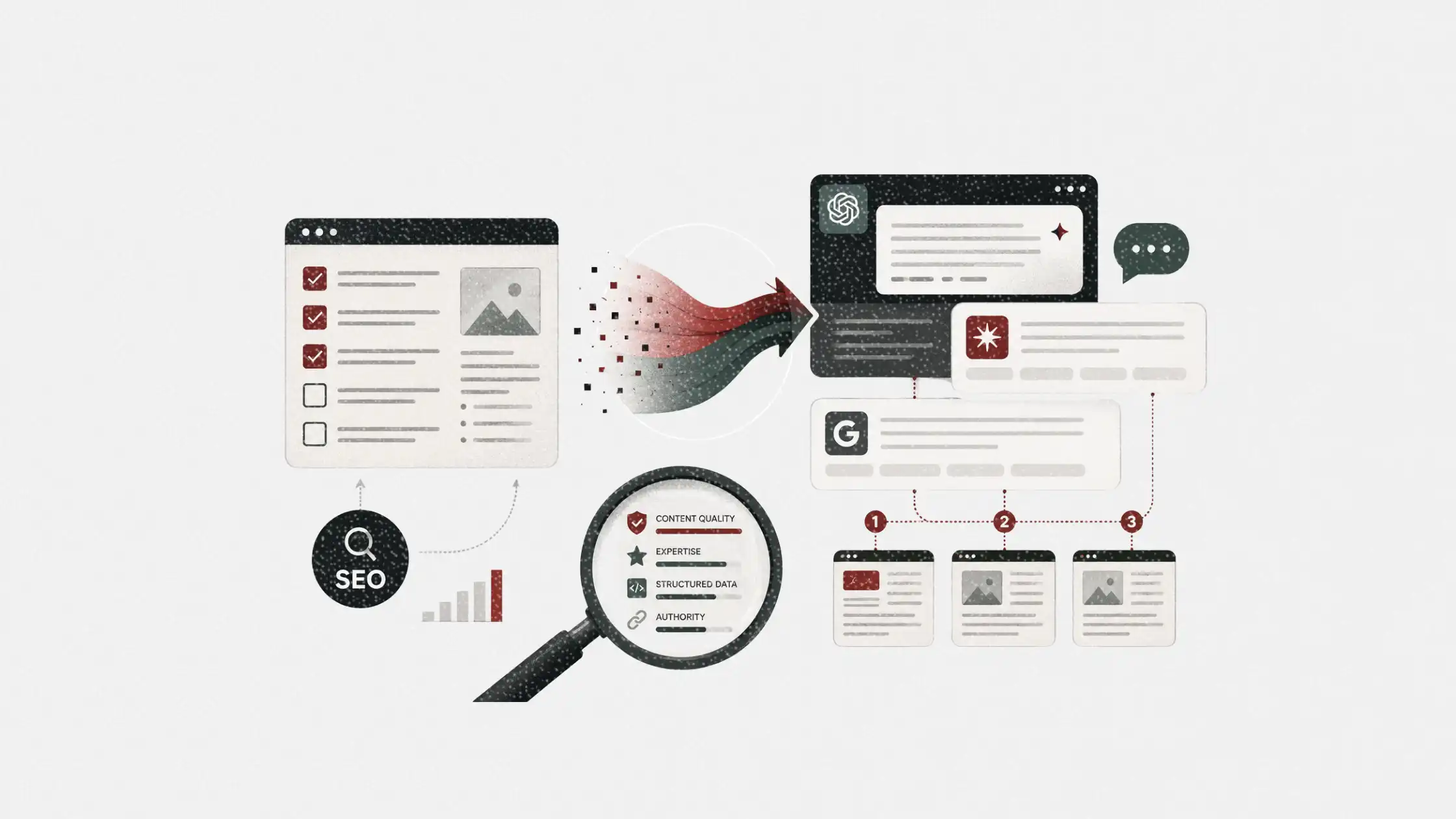
Your content might rank well on Google and still be completely invisible to AI. That is the uncomfortable truth behind generative engine optimization (GEO). As ChatGPT, Perplexity, and Google AI Overviews become primary discovery channels for buyers, the rules for content visibility have shifted in ways that traditional SEO audits simply do not capture.
According to research from Onely, the share of organic keywords triggering a Google AI Overview grew from 1.5% to roughly 32% in just 12 months between September 2024 and September 2025 — a 20x increase. Meanwhile, Ahrefs found that when AI Overviews appear, click-through rates for the top-ranking organic page drop by 58%.
That is not a slow-moving trend. That is a structural shift in how your audience finds answers, and it means your content audit needs a new layer.
This guide walks you through how to run an AI search content audit using a practical GEO checklist built for marketing teams. It covers what GEO actually requires, how to assess your existing content, and what to fix first.
Table of contents
Jump to each section:
- What is a GEO content audit and why it matters now
- Before you start: set your audit scope
- The GEO content audit checklist
- What to prioritize after your audit
What is a GEO content audit and why it matters now
A traditional content audit asks: does this page rank? A GEO content audit asks: can an AI engine read, understand, and cite this page?
Those are different questions with different answers.
Generative engines like ChatGPT and Perplexity synthesize responses from sources they consider authoritative, structured, and clearly written. They do not return a list of ten blue links. They produce one answer and cite a handful of sources. If your content is not in that set, it does not matter that you are ranking in position three on Google.
The foundational research on this comes from a Princeton University study presented at ACM KDD 2024. That study tested nine different GEO optimization strategies across thousands of content samples and found that adding statistics, authoritative citations, and quotations to content improved visibility in generative engine responses by up to 40%. Keyword stuffing, by contrast, showed minimal effectiveness and in some cases performed worse than doing nothing at all.
This is a meaningful finding for content teams: the tactics that drove traditional SEO rankings are not what gets you cited by AI engines.
Before you start: set your audit scope
A GEO audit does not have to cover your entire site on the first pass. Start with the content types most likely to be surfaced by AI:
- Informational and educational content (“how to,” “what is,” “guide to”)
- Comparison and evaluation content (“best,” “vs,” “alternatives”)
- FAQ pages and answer-format content
- Your highest-traffic evergreen articles
HubSpot’s GEO statistics research found that LLMs are 28 to 40% more likely to cite content with clear formatting — hierarchical headings, bullet points, numbered lists, and tables. FAQs are the format most cited by generative engines because they match the way users phrase queries to AI tools.
Your informational content is your highest-priority audit target.
The GEO content audit checklist
Work through this checklist section by section. Flag each item as pass, needs work, or not applicable.
Section 1: Technical crawlability
AI engines cannot cite content they cannot access.
- robots.txt allows major AI bots. Check that GPTBot (OpenAI), PerplexityBot, and GoogleBot are not blocked. Review your robots.txt file at yourdomain.com/robots.txt.
- llms.txt file is present. This emerging standard (similar to robots.txt but for LLMs) helps AI systems understand your site structure and preferred content. Add it at yourdomain.com/llms.txt.
- Page load speed is under 3 seconds. Slow pages reduce AI crawl efficiency. Use Google PageSpeed Insights to check.
- Mobile rendering is clean. AI engines index mobile versions. Test on real devices or with Google’s Mobile-Friendly Test.
- No significant JavaScript rendering issues. Pages that rely heavily on JavaScript to load content can be partially or incorrectly indexed. Use Google’s URL Inspection Tool to see the rendered HTML.
Section 2: Structured data and schema
Proper JSON-LD schema directly improves how well AI engines extract and interpret your content.
- Key pages have relevant schema markup. At minimum: Article schema on blog posts, FAQPage schema on FAQ content, HowTo schema on step-by-step guides, and Organization schema on your homepage and about page.
- Schema validates without errors. Run every schema-marked page through Google’s Rich Results Test. Errors in schema markup reduce extraction accuracy.
- Author information is included in Article schema. Name, job title, and a link to an author bio page. This supports E-E-A-T signals that AI engines use as credibility indicators.
- Date fields are present and accurate. Both datePublished and dateModified should reflect real dates. Outdated or missing dates reduce citation likelihood on time-sensitive topics.
Section 3: Content structure and extractability
AI engines parse content differently from human readers. Your structure either helps or hinders extraction.
- The primary answer appears in the first 30% of the page. CXL research cited in the Onely checklist found that 55% of AI Overview citations come from the first 30% of page content. If your key answer is buried, rewrite the intro to lead with it.
- Headings are question-shaped or clearly descriptive. H2s and H3s that read like user queries are more extractable than vague section labels.
- Definitions are explicit. If you introduce a concept, define it in plain language in the same paragraph.
- Each section is self-contained. A reader (or AI engine) should be able to read one H2 section and come away with a complete, standalone answer to a discrete question.
- Lists and tables are used for scannable information. Do not bury comparable data or step-by-step instructions in long prose paragraphs.
For a deeper look at how specific formatting choices affect citation rates, including FAQ structure, readability scoring, and question-answer formatting, see 7 ways to increase your chances of being cited by AI search.
Section 4: Content quality and citation signals
This section focuses on what auditors should verify, not how to execute each tactic. The goal is to flag gaps rather than rebuild content from scratch.
- Statistics are sourced and specific. Vague claims like “many marketers report” are not citable. Replace them with attributed, specific data: “According to [source], X% of marketers…”
- External citations link to authoritative sources. Cite original research, peer-reviewed studies, government data, or recognized industry reports. Link directly to the source, not to a summary article.
- Content includes expert perspective. Quotes from named practitioners, data from original research you conducted, or direct experience-based observations all raise E-E-A-T signals.
- Content directly answers the likely query, not around it. Read your H2 section headings as if they were questions. Does the content that follows actually answer them? Edit any section that circles the topic without landing the answer.
Section 5: Entity clarity and brand consistency
AI engines build an understanding of entities: your brand, your authors, your topics of expertise. Inconsistency creates confusion.
- Your brand name is consistent across all pages and platforms. Do not mix abbreviations, capitalization variations, or alternate names.
- Author bios are detailed and consistent. Every author on your site should have a bio page with a consistent name, title, photo, and credentials. Link to author bios from all articles.
- Your topical authority is concentrated. AI engines favor sources that go deep on fewer topics over sources that cover everything shallowly. Identify your two to three core topical clusters and audit whether your content reinforces or dilutes them.
- Internal links connect related content logically. AI engines use internal link structure to understand topical relationships. Pages in the same cluster should link to each other with descriptive anchor text.
Section 6: AI search visibility monitoring
You cannot optimize what you are not measuring.
- You are tracking AI referral traffic in GA4. In Google Analytics 4, filter for referral sources that include chatgpt.com, perplexity.ai, and bing.com/chat. This is a baseline, not a complete picture, since AI-influenced traffic often appears as direct.
- You are running manual citation checks. On a monthly cadence, go to ChatGPT, Perplexity, and Google AI Overviews and run the ten to twenty queries most relevant to your content. Note whether your brand or pages are cited. Track this over time in a simple spreadsheet.
- You have added AI discovery as an option in conversion forms. Self-reported “how did you hear about us?” data from customers who found you via AI is currently one of the most reliable signals available.
- You are monitoring brand mentions in AI responses for accuracy. Generative engines sometimes summarize your content incorrectly. Know what they are saying about you so you can correct the underlying content if needed.
What to prioritize after your audit
Running the checklist will surface more issues than you can fix in one sprint. Here is how to triage.
- Fix first: technical crawlability
If AI bots cannot access your content, nothing else matters. Check robots.txt and llms.txt before anything else.
- Fix second: schema errors
Research cited in the GitHub GEO tools community has found that proper JSON-LD schema lifts LLM extraction accuracy from 16% to 54%. This is high-leverage work with measurable payoff.
- Fix third: lead with the answer
Rewriting intros to front-load the primary answer is typically the fastest content change with the most immediate impact on AI citation rate.
- Fix fourth: source your statistics
Go through your top-performing pages and replace vague claims with cited, specific data. This is the single most effective content-level change based on the Princeton research.
- Defer: full rewrites
Do not rebuild pages from scratch unless they fundamentally cannot be fixed at the paragraph level. Surgical edits outperform full rebuilds in both speed and GEO impact.