Snapchat has published new guidance on how brands can use humor to connect with younger audiences, positioning comedy less as a “tone” and more as a social behavior marketers need to understand. The details were outlined in the company’s Snapchat for Business post.
The research was conducted with Omnicom Advertising, surveying more than 6,000 social media users aged 13 to 28 across the US, UK, Canada, France, Germany, and India. A central tension runs through the guidance: young audiences say they want brands to be funny, but they also describe many brand attempts as coming off like “older people trying to joke with them.”
Table of contents
Jump to each section:
- Why “being funny” is now a brand capability, not a copy tweak
- What Snapchat’s research suggests about how Next Gen humor works
- The timing problem: when brands join a joke, they change it
- What this means for marketers
Why “being funny” is now a brand capability, not a copy tweak
A common assumption in marketing is that humor is mostly execution: write a witty line, cut a punchy edit, pick the right meme format. The contrasting reality Snapchat is pointing at is that humor for ages 13 to 28 functions as a social language, not just entertainment.
That distinction matters because social languages have rules, and they punish outsiders who treat them like templates.
Two strategic observations to keep in mind:
- In Next Gen marketing, humor is not a message. It is a membership test.
- When audiences use jokes to signal belonging, “trying” reads louder than “saying.”
In practice, this means the risk is not just “the joke doesn’t land.” The risk is that the audience interprets the brand’s attempt as a signal that the brand does not understand the room, and that meta-signal becomes the takeaway.
What Snapchat’s research suggests about how Next Gen humor works
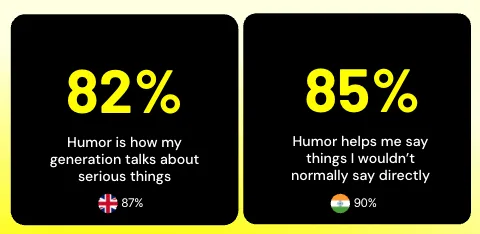
Snapchat frames humor as “emotional infrastructure” for younger audiences: a way to build relationships, process serious topics, and navigate culture. The research highlights a few mechanics that matter for brand creative decisions.
First, context is the punchline. Snapchat notes that nearly nine in 10 respondents say you need to “get the reference” for some jokes to make sense, and 79% agree that explaining a joke ruins it. For marketers, that is a warning against over-explaining in captions, brand voice guides, or campaign landing pages that try to “make the joke safe.”
Second, randomness still has logic. While “completely random” humor is popular, 92% agree the best jokes seem random but actually have logic behind them. That is useful because it reframes what good brand humor looks like: not polished randomness, but coherent weirdness that an in-group can follow.
Third, irony is a working mode, not a posture. Snapchat says 91% believe things can be funny and serious simultaneously. Brands often treat humor and sincerity as opposites, but for this audience, the blend is the point.
A third strategic observation:
- The fastest way to kill modern humor is to treat it like a campaign asset instead of a living reference.
This also explains why Snapchat can offer a “structure” for comedy writing, yet still run into a practical limit: writing jokes is not the hard part. The hard part is knowing which references your audience will grant you permission to touch.
The timing problem: when brands join a joke, they change it
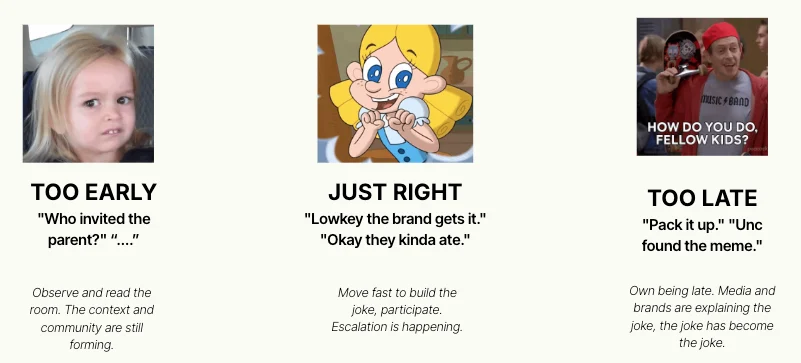
Snapchat’s guidance is blunt about lifecycle. It describes a “Goldilocks Moment” for brands: not too early (when the community is still forming the language), not too late (when mainstream repetition makes it stale), but “just right” when the joke is spreading and still evolving through remixing.
Here is the uncomfortable implication: brands are never neutral participants. Once a brand enters a trend, it changes the meaning of the trend, and often accelerates its decline. That is why the same joke can feel funny in one place and awkward in another, and why 91% agree timing affects whether it lands.
A fourth strategic observation:
- For brands, timing is creative. Entering late is not a media problem; it is a meaning problem.
This is also where Snapchat positions its own product reality: it emphasizes private sharing, creator content, Stories, and AR Lenses as places where humor moves from discovery to sharing, and where audiences participate by making and remixing content, not just consuming it.
What this means for marketers
Snapchat’s guidance is less about “write funnier lines” and more about building a repeatable way to decide when humor is strategically safe, culturally relevant, and worth the brand’s presence.
- Treat humor like audience research, not just brainstorming.
Snapchat’s findings suggest that if your team cannot explain the reference economy behind a joke, you probably cannot ship it. The work starts earlier than the script. - Design for “share with a friend,” not “laugh at an ad.”
Snapchat highlights how jokes move through private chats and close sharing. That should shift measurement thinking toward share behavior and remix potential, not only impressions. - Avoid explanatory captions that “translate” the joke.
With 79% saying explaining ruins it, the safer move is often to simplify execution and let the audience complete the meaning, rather than forcing clarity. - Build a timing filter that can say “no,” fast.
The “too early / just right / too late” framing is a practical governance tool. It gives social teams language to justify observation-only phases without sounding risk-averse. - Use participatory formats when the joke is the point.
Snapchat’s emphasis on AR tools and creator collaboration signals a broader pattern: audiences want to co-author humor. For brands, that can mean shifting from “brand tells joke” to “brand sets the stage.”
The deeper shift is that humor is becoming a proxy for cultural literacy. That creates opportunity, but it also narrows the margin for error because the audience is not grading the joke, they are grading the brand’s right to be in the conversation.
Over time, this pushes marketing teams toward a different operating model: lighter-weight creative, faster feedback loops, and clearer internal rules about when participation adds value versus when it just adds noise. If the future of humor is collaborative and context-driven, the most resilient brands will not be the ones chasing every trend. They will be the ones building the capability to recognize which jokes their customers already share, and which ones they will reject on sight.
This article is created by humans with AI assistance, powered by ContentGrow. Ready to automate your content marketing?
Book a discovery call today.