ARMY culture has always been part music, part inside jokes, part learning. Fans don’t just stream songs, they trade references, obsess over lyrics, and often pick up Korean phrases along the way because it helps them feel closer to the world BTS has built.
That’s the lane Google is stepping into with four limited-time, interactive BTS experiences inside the Gemini app, designed around playful fandom behaviour: guessing songs from vibes, following moments in real time, and turning curiosity into something you can actually do.
The company shared the update in an official announcement and tied it to a campaign film that frames Gemini as a daily-life companion for questions, planning, and creative exploration.
Table of contents
Jump to each section:
- What the “Unlock BTS” Gemini experiences actually are
- Why this fits fandom behaviour (and why that matters)
- How Google is product-marketing Gemini through pop culture
- What this means for marketers
What the “Unlock BTS” Gemini experiences actually are
The entry point is intentionally simple: in the Gemini app, users can type “Unlock BTS” or “7777” to access four BTS-themed interactions (available for a limited time in select languages).
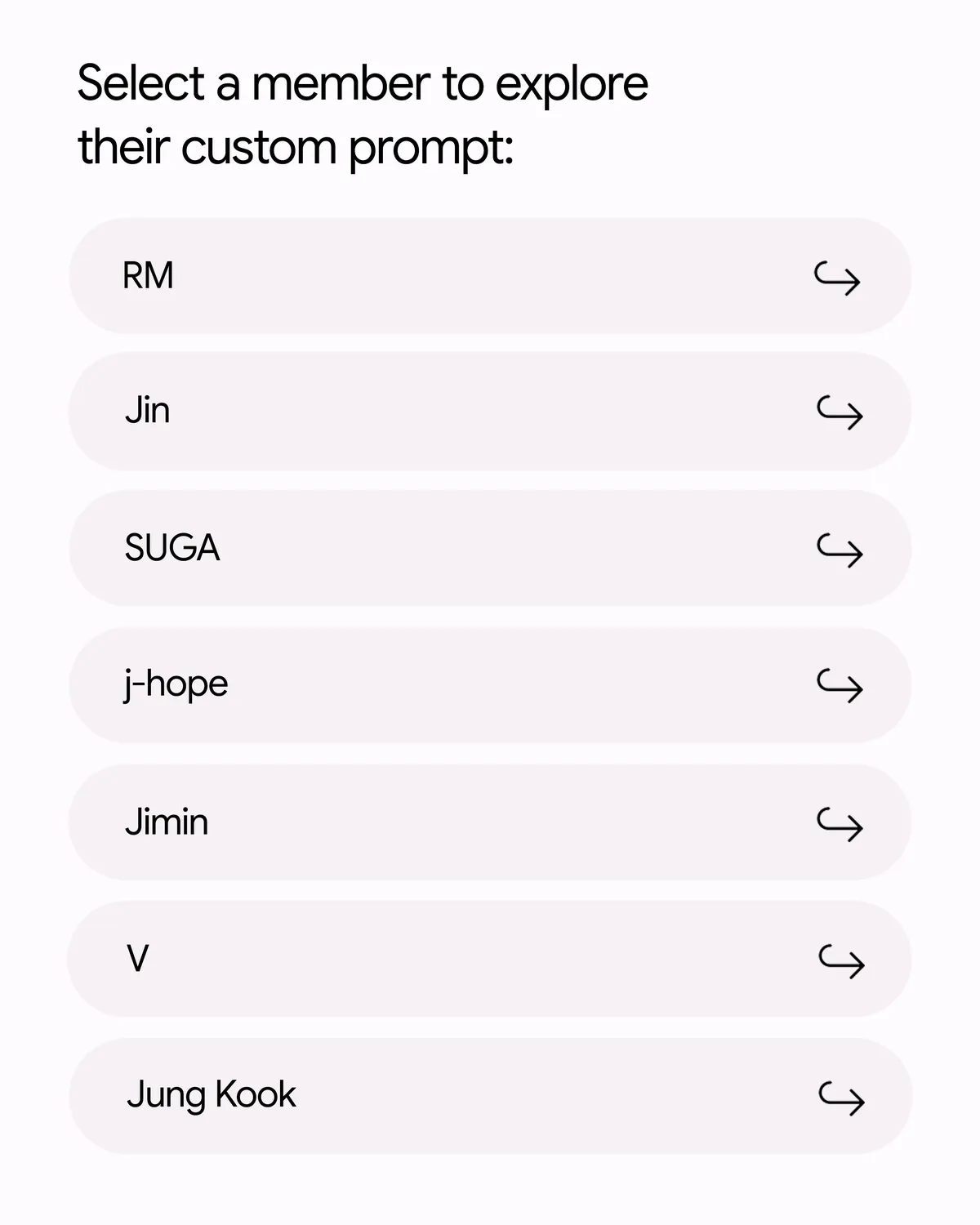
One experience is built around curiosity and parasocial proximity: “Reveal what BTS asks Gemini” lets users explore real-world prompts associated with the members, like RM’s cultural travel exploration or Jung Kook’s interest in bikes. It’s less about celebrity trivia and more about turning “What would they ask?” into “What can I try?”
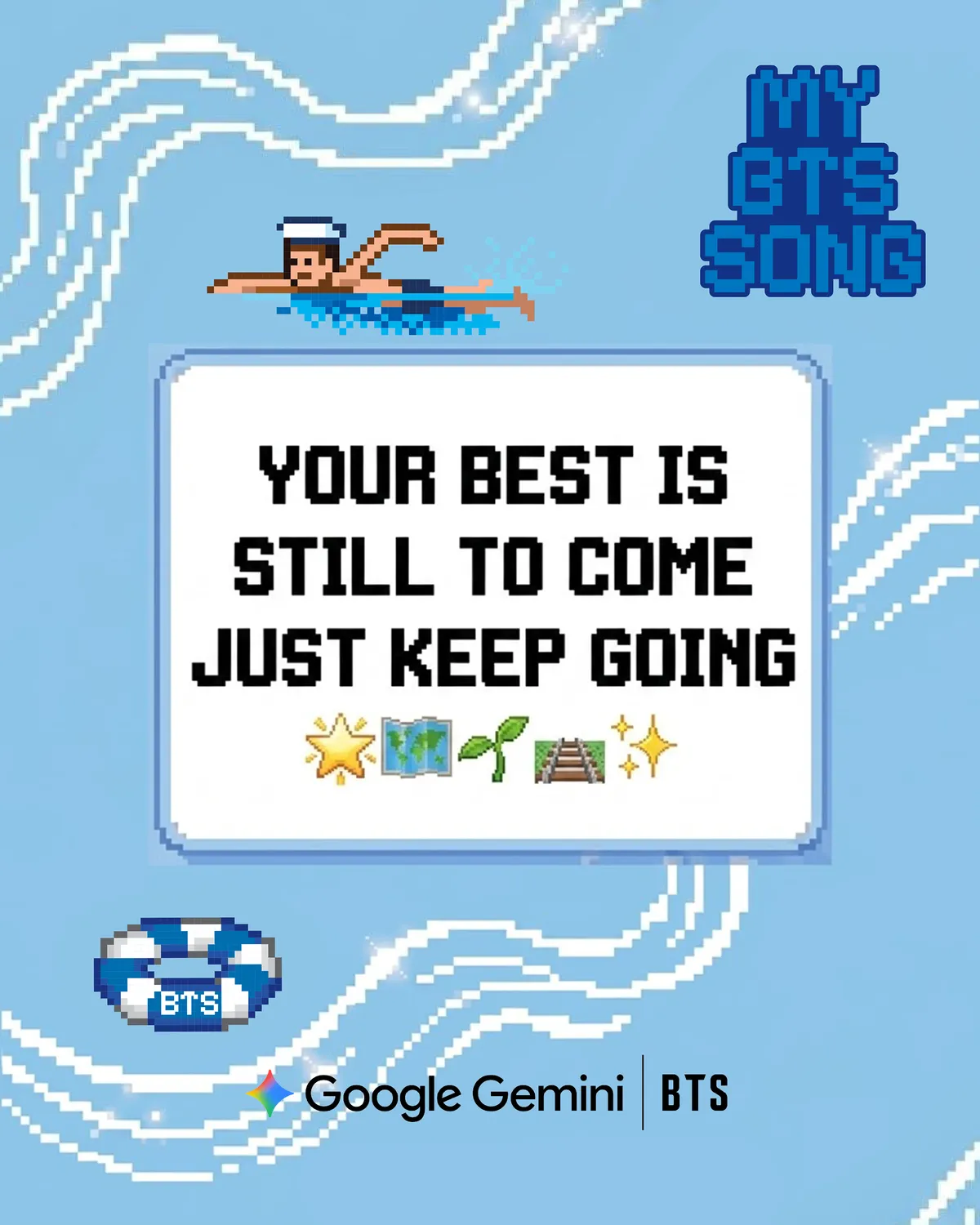
A second feature, “Guess the BTS song,” uses a mood-and-lyrics angle through an emoji quiz, then recommends a BTS track based on the vibe. It turns discovery into a game, which is exactly how fans already behave when they build playlists for friends.
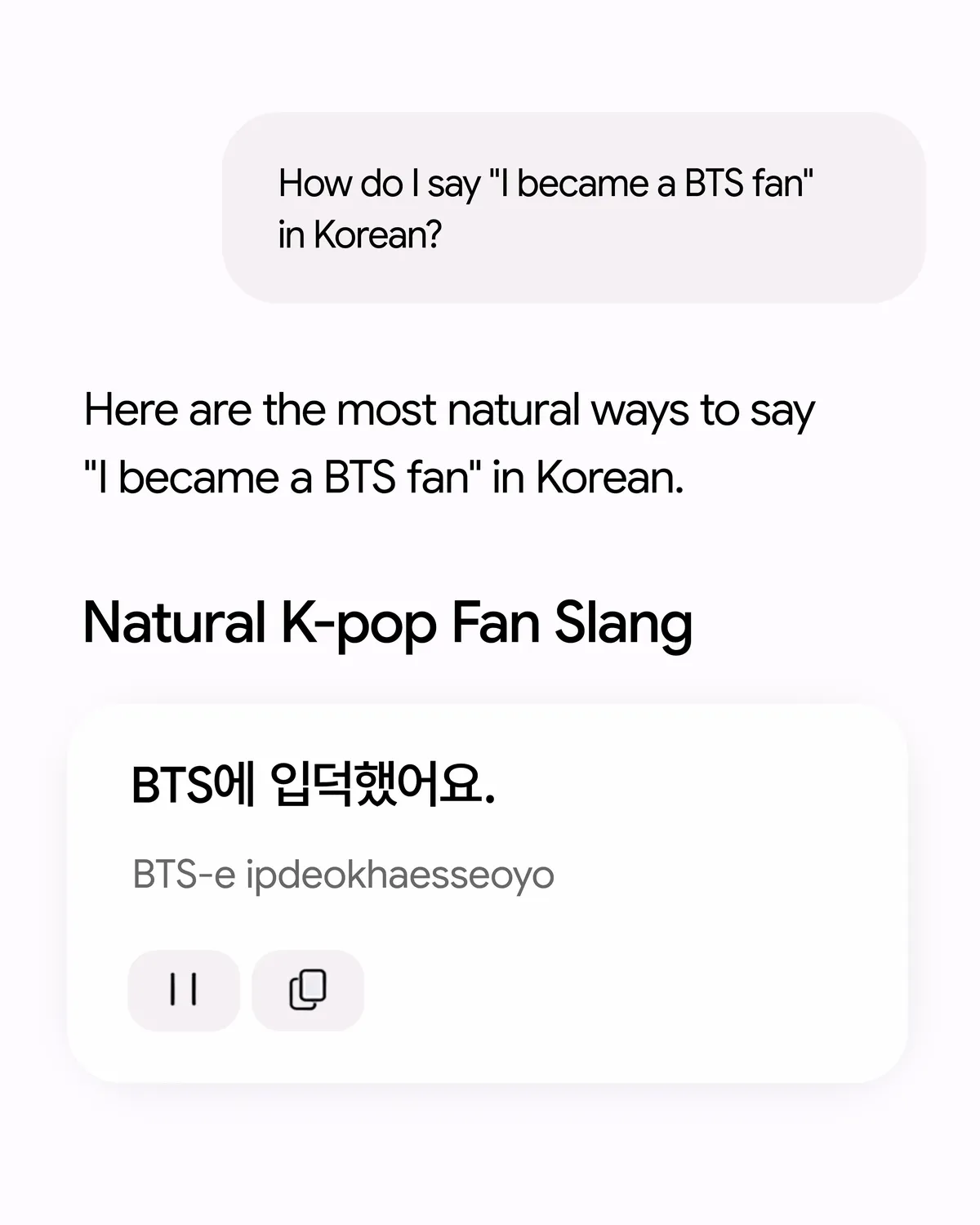
There’s also a utility layer: “Follow along at every tour stop” pulls together a daily digest of trending news from the past 48 to 72 hours, plus a two-week schedule synced to the user’s local time zone. And “Learn everyday Korean” focuses on practical phrases used in fan letters, comments, and everyday conversation, with audio pronunciation guides and interactive practice.
To mark the launch, Google released a YouTube film featuring RM, JIN, SUGA, j-hope, JIMIN, V, and Jung Kook using Gemini in daily life.
Why this fits fandom behaviour (and why that matters)
BTS fandom has always treated “being a fan” as a verb. It’s not passive consumption. It’s learning references, following updates, collecting moments, and sharing them in ways that signal identity and belonging.
That’s why the Korean learning feature is more than a language tool. It’s aligned with how global fans already participate: trying to comment with the right phrase, understanding a lyric without waiting for translations, or writing something meaningful in a fan letter.
The emoji quiz works for similar reasons. It turns knowledge into play, and it makes recommendations feel personal without requiring fans to type a perfect prompt. The hook is not “AI music discovery.” The hook is “Can you guess this song from the vibe?” and that’s a behaviour fans already bring to group chats.
Even the news-and-schedule feature is built around a real fan need: staying current without doing the manual work of checking multiple places, reconciling time zones, or missing the small moments that become big inside the community.
How Google is product-marketing Gemini through pop culture
This collaboration reads like a tutorial that doesn’t feel like a tutorial.
Instead of telling people “Gemini can do X,” the experience gives fans pre-framed, low-effort ways to try it. The prompt shortcuts (“Unlock BTS” / “7777”) reduce the intimidation factor of a blank input box. The interactions are structured like fandom mini-games and utilities, which makes trying the AI feel closer to play than productivity.
It also positions Gemini less as a one-off novelty and more as a habit. Planning travel, exploring hobbies, bridging language gaps, getting daily updates, picking a song, those are repeatable behaviours. The BTS layer is the reason people show up the first time, but the intent is clearly to get users comfortable returning.
Crucially, the campaign doesn’t require fans to leave the product. The experiences live directly inside the Gemini app, making the brand partnership a product surface, not just an ad.
What this means for marketers
Pop culture collaborations only work when they match how the community already behaves. This one is a useful case study in building for fans first, then letting the marketing benefits show up naturally.
- Design the “first try” moment like a fandom ritual.
“Unlock BTS” and “7777” are not just prompts, they feel like cheat codes. That kind of framing lowers friction without feeling corporate, because it mirrors how fans already share tips and shortcuts. - Turn features into experiences people can describe in one sentence.
“Guess the song from emojis” is instantly shareable as an idea. Marketers should pay attention to that: the simplest description often spreads the fastest. - Make utility feel personal, not just functional.
News digests and schedules can sound generic, but placing them in a BTS context makes them feel like fan tools. The same strategy applies outside entertainment: utility sticks when it feels made for a specific community. - Use collaboration to teach product behaviour, not just brand affinity.
The experiences quietly train users how to interact with Gemini: explore prompts, ask questions, follow updates, practice language. That’s product education disguised as play. - Limited-time drops can create urgency without gimmicks.
By making the experiences available for a limited time (and in select languages), Google frames this as a moment. For marketers, the lesson is that scarcity works best when the “drop” is genuinely interactive, not just a badge or a landing page.
What’s most interesting here is the cultural signal: AI products are moving toward community-shaped onboarding. Instead of asking users to learn a tool from scratch, brands are starting to wrap AI behaviours inside familiar fandom formats, quizzes, prompts, and micro-utilities.
For marketing teams, that raises the bar. The question is no longer “Which celebrity can we partner with?” It’s “Can we translate what our product does into something a community would actually enjoy doing?”
And if you get that translation right, the collaboration doesn’t just generate attention. It creates repeated, learnable behaviour, which is the real prize.