
If you have a favorite Hello Kitty character, picking that character can be a small way to show your personality. In Figma‘s collaborative whiteboard FigJam, that kind of choice is now part of an ordinary brainstorm. The cursor that follows you across a shared canvas can carry a familiar Sanrio face instead of looking like everyone else’s.
The design platform and Sanrio have brought Hello Kitty and Friends into FigJam for a limited run from November 1 to 8, 2026. Their official collaboration announcement describes 12 characters, matching decorative tools and a birthday celebration that moves from a digital workspace to the streets of New York. It is less a merchandise drop than an invitation to spend time with the characters while making something with other people.
Table of contents
Jump to each section:
- Inside the Sanrio FigJam takeover
- A birthday party beyond the browser
- Why a familiar face matters in a work tool
- What marketers can learn from fandom in everyday tools
Inside the Sanrio FigJam takeover
The first surprise is how ordinary the characters’ new surroundings are. Hello Kitty, Kuromi, My Melody, Cinnamoroll, Pompompurin and Pochacco are among the familiar faces entering FigJam, a place usually associated with sticky notes, diagrams and group planning. The promotion lets users choose a character and bring themed cursors, washi tape, colorful notes and photobooth-style frames into that shared space.
The distinction matters. A themed mug sits next to the computer, but a themed cursor travels through the actual activity. Someone can add a note, draw a connection or join a team exercise while the character is visible to collaborators. The character is not the assignment. It becomes part of the atmosphere around completing it.

The tie-in reaches beyond the whiteboard. Figma Community users can temporarily select their top three Sanrio characters for their profiles and choose matching backgrounds. A dedicated playground file offers FigJam tips, while downloadable coloring pages and a Figma Slides template give people other ways to bring the designs into their projects.

This is a different kind of character placement from a traditional branded screen skin. The characters appear in places where people already collaborate, not just on a promotional landing page they might visit once. Figma says its designers worked closely with Sanrio to retain recognizable character palettes and personalities without interfering with the underlying work.
A birthday party beyond the browser
The campaign has a second life for people who would rather leave the laptop behind. Figma and Sanrio are planning a Hello Kitty birthday pop-up in New York on November 7 and 8, with themed drinks, mystery character keychains and a charm bar where visitors can personalize their keepsakes. The first 150 visitors on each day are also set to receive limited-edition sweatshirts and patches.
A separate photobooth on the Lower East Side is scheduled for November 6 and 7, giving visitors a free themed photostrip. The birthday weekend connects an ephemeral online experience to something tangible: a photo, a charm, a memory of meeting other people who recognize the same characters.
More than 60 planned meetups will bring the collaboration to Figma community groups and campuses around the world, according to Figma. The company has not published attendance results for those gatherings.
The events matter to the story because Sanrio’s characters have long traveled across product categories, while Figma’s community already meets around making and sharing creative work. The New York pop-up is one part of the program. Outside the city, the FigJam features and community templates are available to users globally during the stated promotion period.
Why a familiar face matters in a work tool
Hello Kitty first appeared in Japan in 1974 and became recognizable far beyond any single toy or television appearance. Sanrio’s wider character family lets people favor different visual styles and personalities. Here, that familiarity is brought into a tool that people may already be opening for school, a team meeting or a design session.
Figma chief marketing officer Nairi Hourdajian described the collaboration as “a little nostalgic, a lot of fun” in the company’s announcement. The nostalgia is a useful part of the appeal, but the more interesting detail is where it shows up. Instead of asking someone to leave a workspace to consume branded content, the characters meet people in the middle of an existing activity.
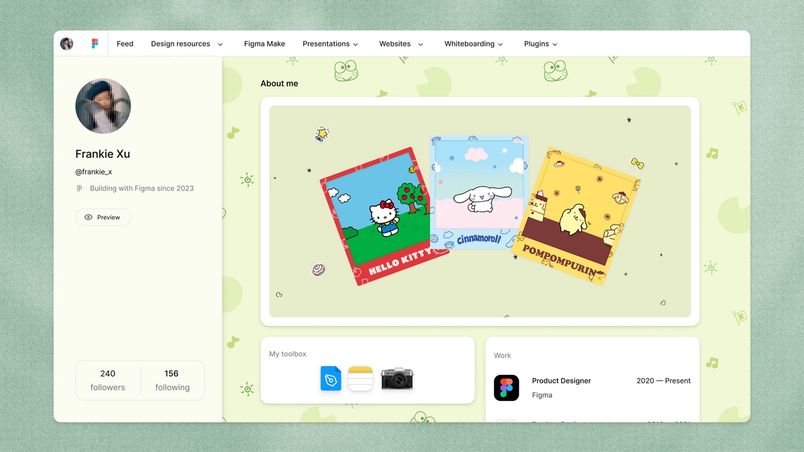
That makes the partnership a small test of how much identity and playfulness users want in collaborative software. A customized profile or cursor lets someone express a preference without requiring the rest of the group to participate in a campaign. It can also provide a shared reference point if others recognize the character.
The comparison with more familiar licensed experiences is revealing. MINISO’s Sanrio summer pop-ups across Southeast Asia brought characters into physical retail spaces with themed installations and merchandise. Sanrio’s F1 Academy partnership puts the character universe around a motorsport event. Figma takes the same principle of recognizable character identity and locates it inside a software product.
Those comparisons should not be mistaken for proof that the FigJam partnership has drawn new users or increased loyalty. Figma says it intends to assess feature use, community attendance and the celebration’s overall reach, but the partners have not disclosed outcome figures for this collaboration.
What marketers can learn from fandom in everyday tools
Licensed characters usually arrive with an audience that already knows their names, colors and personalities. The more consequential choice is where to put them. Figma and Sanrio have placed that familiar world inside a task people are already doing, then given them ways to carry it into a community setting.
- Start with a recognizable behavior. Choosing a favorite character is a familiar act of personal expression. A themed cursor lets that choice fit naturally into a shared board, without asking users to learn a new campaign game.
- Make the product itself part of the experience. The FigJam themes, profile options and Slides templates are the promotion. That gives the partnership more practical surface area than an isolated ad or landing page.
- Give the community something to do together. The announced meetups and birthday pop-up extend the collaboration beyond individual customization. They offer places where the character preference can become a conversation or shared activity.
- Separate announced scope from demonstrated impact. Twelve available characters and more than 60 planned meetups describe what the brands intend to offer. They do not yet show whether participants return, create more or spend more time in the software.
The campaign also highlights a useful tension in character licensing. Fans may recognize a character immediately, but that recognition alone does not make every collaboration meaningful. The setting has to make sense. In this case, decorative choices fit a product built around creativity and self-expression.
There is also an unusually literal fit between Sanrio’s language of friendship and a collaborative whiteboard. Both brands speak about making things with other people. That shared theme is easy to describe in a press release, yet the experience gives users something concrete to try.
For marketers, the larger idea is not that every workplace tool needs a cartoon character. It is that cultural familiarity can enter products and communities through small, voluntary interactions, rather than demanding everyone’s attention all at once. Whether this particular partnership pays off will depend on what people actually do with it after the novelty of the characters’ arrival wears off.
