
Ogilvy and Creative Artists Agency have brought licensed celebrity likenesses into a generative AI advertising workflow. Their new ECHO system is designed to turn one approved talent shoot into many campaign assets without treating the performer’s image as an unrestricted creative input.
In its November 9 announcement, Ogilvy described a partnership between parent company WPP and CAA that connects the agency’s creative production tools with The CAA Vault, which captures and licenses talent likeness, voice and intellectual property. The commercial proposition is faster adaptation for different markets and formats, with the person being recreated retaining approval rights.
Table of contents
Jump to each section:
- How ECHO changes a celebrity shoot
- Why the cost promise needs evidence
- Consent becomes part of production infrastructure
- What marketers should know about AI talent campaigns
How ECHO changes a celebrity shoot
ECHO is an AI production workflow built on licensed talent scans. CAA’s Vault holds high-fidelity likeness and voice material, while Ogilvy’s creative team uses that material to develop additional advertising executions inside WPP Open, the group’s broader AI marketing platform.
A conventional celebrity campaign requires deciding which formats and markets justify expensive production time. ECHO proposes a different sequence: establish a legitimate source shoot, create potential variations from it, then route those outputs through usage checks and human approval before distribution.
Ogilvy global chief innovation officer Carol Reed framed the challenge this way: “Clients want more content, and [talent agencies] have high quality assets.” The gap is not the absence of celebrity footage. It is the operational difficulty of using that footage repeatedly without losing control of rights.
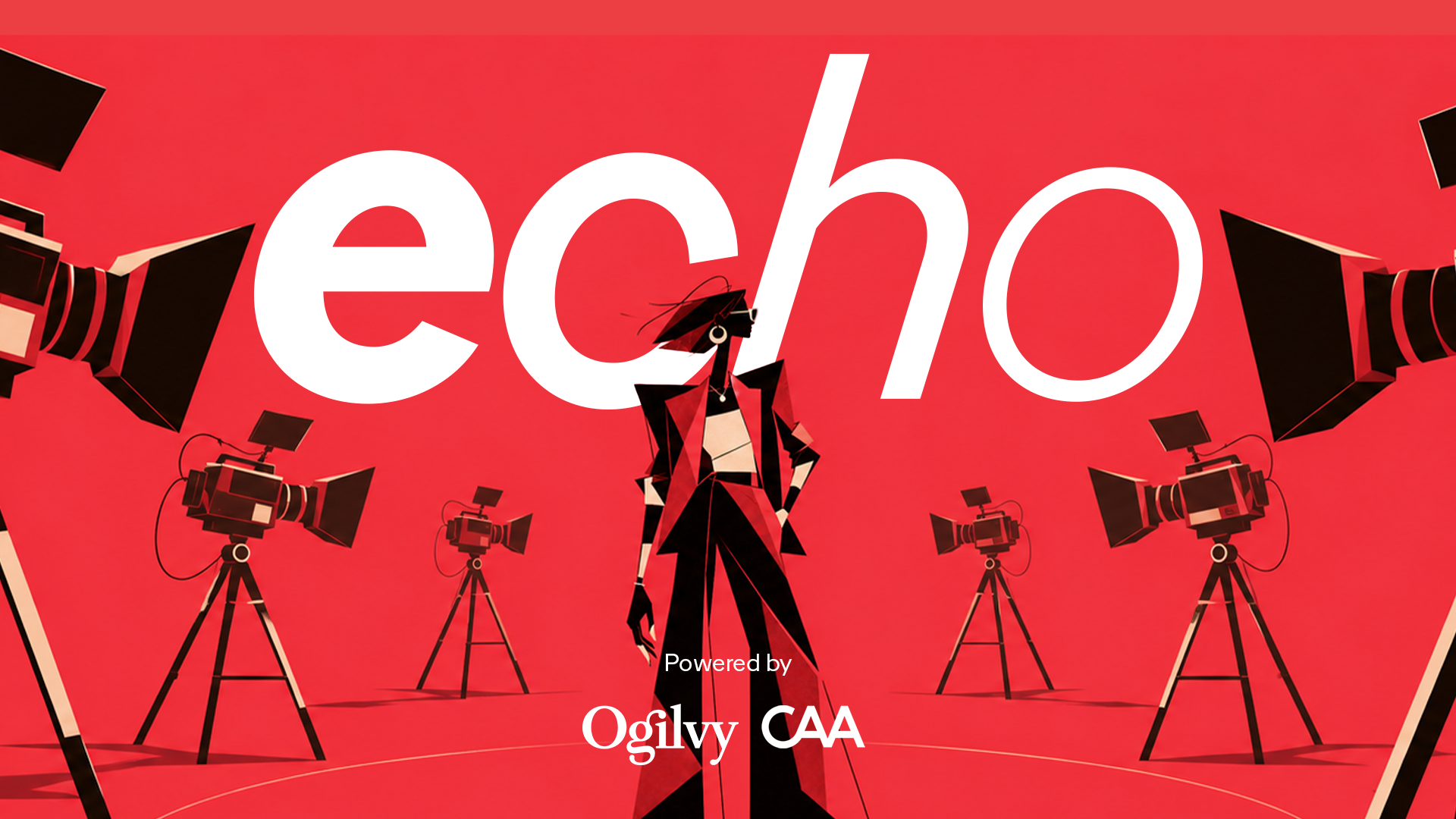
Ogilvy has also shared a short video explaining the launch and its interest in scaling brand content without giving up permissions.
https://www.facebook.com/ogilvy/videos/deepfakes-are-threatening-the-25b-celebrity-endorsement-market-what-if-ai-could-/2327634377986059
Why the cost promise needs evidence
The possible production economics are significant, but these are company projections rather than measured outcomes from named advertiser campaigns.
30 to 50 assets could be produced from a shoot that would traditionally yield eight to 10, with an estimated 65% to 75% reduction in average cost per asset, according to Ogilvy.
| Production dimension | Conventional shoot | ECHO proposal |
|---|---|---|
| Campaign variations | Fixed set from the original shoot | Additional localized, platform-specific versions |
| Likeness source | Original filmed performance | Licensed digital scans in CAA Vault |
| Release approval | Production and rights review | Automated restrictions plus final talent sign-off |
Lower unit costs would not establish better advertising outcomes. Reach, brand response, audience acceptance and actual production expense would need to be measured in live campaigns before marketers can judge the return.
The deeper distinction is between producing more ads and earning permission to use them. An asset that needs a new rights negotiation for every variation is not truly scalable, regardless of how quickly software renders it.
Consent becomes part of production infrastructure
ECHO is notable because approval is meant to operate inside the asset workflow rather than after a campaign has been produced. Ogilvy says machine-readable licensing terms and brand-safety rules check generated assets, and talent must explicitly approve every consumer-facing execution before release.
Cleared creative also carries a visible watermark identifying the performer as having approved an AI recreation. That connects two questions: whether the brand has permission to generate the likeness and whether the audience understands what it is seeing.
More than 1,200 respondents participated in Ogilvy’s proprietary research across the US, UK and India. The company says explicit talent approval strengthened ad appeal among more than 76% of respondents globally, according to Ogilvy.
That survey offers a directional hypothesis, not proof that ECHO campaigns will outperform conventional endorsements. The figures are company-reported, and Ogilvy has not named participating brand pilots or published independent campaign-effectiveness results.
An adjacent example is Adobe Firefly for enterprise, which integrates generated content into creative workflows. ECHO focuses more narrowly on rights-controlled performance: the generated object is not simply brand-safe imagery, but a recognizable person’s licensed likeness.
This is where an agency workflow starts to resemble rights infrastructure. Consent is becoming a production input, not a final legal checkbox.
What marketers should know about AI talent campaigns
For advertisers, ECHO provides an early example of organizing synthetic endorsement production around explicit authorization. The implications extend beyond how many files a creative team can make.
Treat rights as asset-level controls. A general endorsement agreement should not be assumed to authorize every generated language, market, channel or scenario. ECHO’s approval portal is an example of putting limits into production operations.
Test outcomes, not output counts. Compare response and effectiveness across approved creative versions. Ogilvy’s volume estimates are relevant to production planning, but do not substitute for performance results.
Differentiate consent from disclosure. A performer may approve a digital replica while an audience still needs clear context about AI generation. Those questions are related but not interchangeable.
Check what remains unproven. ECHO is commercially available through WPP and pilots are underway, but Ogilvy has not disclosed named customer results. Procurement teams should separate availability from demonstrated value.
The underlying competitive move is less about making synthetic celebrities appear convincing than about making their permissions manageable. A brand can accelerate creative output only when contracting, review, disclosure and measurement keep pace.
AI is expanding what agencies can make from one production session. The more consequential question is who maintains control when those assets are multiplied, localized and distributed.
