For a toy collector, the next visit to Shake Shack could be less about choosing a burger and more about checking which little figure is available that week. The restaurant’s holiday partnership with POP MART turns a meal into a chance to add another character to a collection.
The character at the center is Nyota, created by designer KaKa. POP MART describes Nyota as a girl who finds inspiration in quiet moments and enjoys spending time with her cats. Instead of borrowing a loud entertainment spectacle for Christmas, the brands are building their collaboration around those small comforts, with food, collectibles and a reason to come back.
Five limited-edition designs will be released in successive weeks in participating international markets, bringing the designer-toy idea of collecting a series into the restaurant visit. The rollout begins December 1 in the Philippines and Thailand, where it continues into January 2027.
Table of contents
Jump to each section:
- Five weeks of Nyota collectibles
- One character with different local flavors
- A calendar instead of a blind box
- What marketers should know about collectible campaigns
Five weeks of Nyota collectibles
In the Philippines, the collection runs from December 1, 2026 to January 4, 2027. 8List’s coverage of the local release details five designs, each connected to something people associate with a Shake Shack visit: a burger, fries, a shake, a gift and a takeaway bag.
The first collectible features Nyota with a ShackBurger and is scheduled for December 1–7. The fries-themed design follows December 8–14, the shake design December 15–21, the gift design December 22–28 and the bag design December 29–January 4.
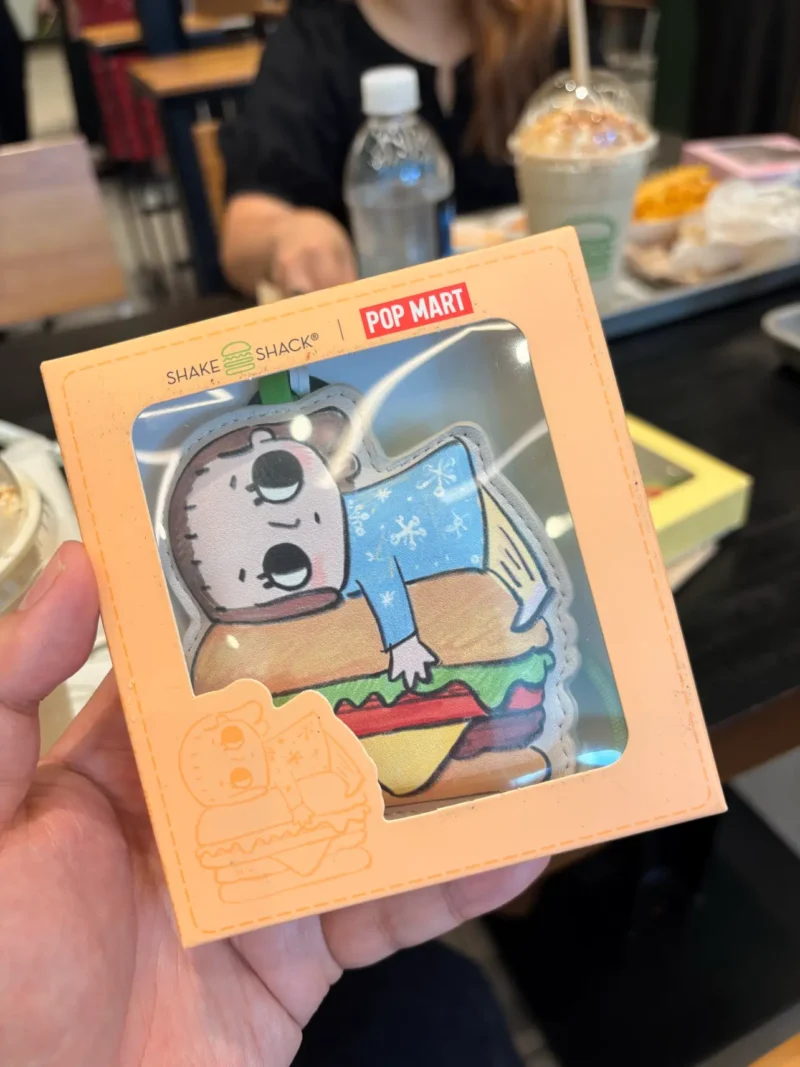
Guests receive the design scheduled for that week with an eligible meal purchase at participating restaurants, subject to availability. The incentive for someone interested in the full collection is therefore spread out over the holiday period instead of concentrated into one purchase.
The objects also carry cues from the restaurant rather than simply placing Nyota on a generic piece of merchandise. Someone who knows the character can recognize her, while the burger and fries establish why this particular version belongs in a Shake Shack collaboration. That specificity is what distinguishes a crossover design from a standard logo-bearing giveaway.
One character with different local flavors
The partnership extends to participating locations in mainland China, Hong Kong, Macau, Thailand, the Philippines, Canada, Mexico and parts of the Middle East. The same character and five-release concept provide a consistent identity, but the food is not necessarily identical everywhere.
In the Philippines, the combo includes a ShackBurger, crinkle-cut fries and a Sesame Caramel Shake. The latter brings miso, sesame and caramel into the dessert. In Thailand, local coverage describes a Cosmic Ube Cookie Shake alongside the burger and fries, with a purple-toned dessert and star-themed decoration. Both local programs run through January 4.
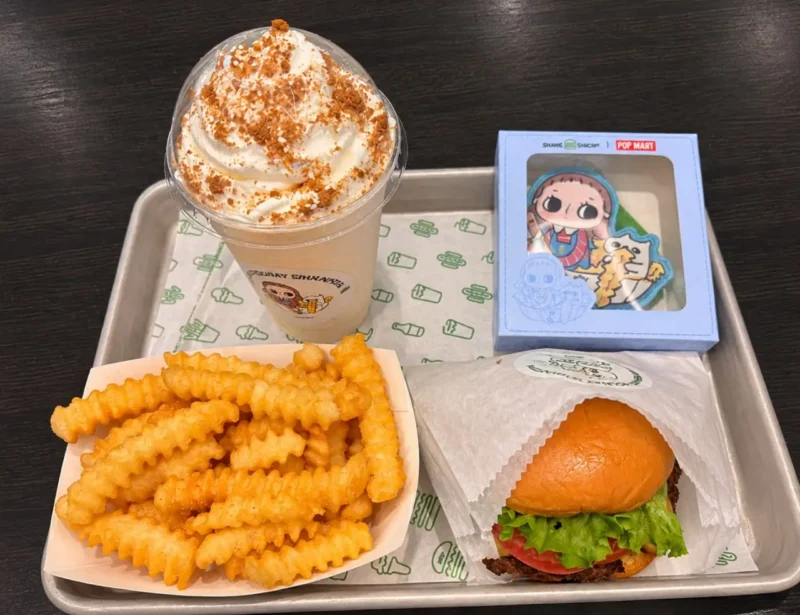
The visual character is a shared language across markets; the menu gives customers a different reason to experience the partnership where they live. That matters for a restaurant chain whose core menu travels across borders but whose local teams have to make seasonal products work in distinct dining environments.
A Shake Shack spokesperson told MARKETING-INTERACTIVE that global brand and international marketing teams worked with POP MART’s brand and IP teams, with local agencies supporting execution. Planned promotion spans the brands’ digital and restaurant channels, including social content, the Shake Shack app, email, menu boards and themed installations. The spokesperson also identified toy creators and lifestyle opinion leaders as part of the campaign’s outreach.
It is an unusually tangible narrative for a restaurant’s seasonal calendar: customers can see the character in a restaurant, order food inspired by her aesthetic and leave with a physical reminder of their visit.
A calendar instead of a blind box
For many designer-toy releases, the suspense comes from opening a package without knowing which design is inside. In this collaboration, the published weekly schedule creates a different kind of anticipation. A customer who wants a particular design can plan a visit around that release window, although stock is still limited.
That is an important distinction. Random assortment can reward the surprise of discovery. Scheduled assortment offers a more predictable route to a collection while keeping a deadline attached to each design. The difficulty shifts from guessing which character will appear to finding time to return.
POP MART has worked with food and drink brands before. Its Hacipupu collaboration with CHAGEE used grape tea, themed merchandise and pop-up activities to connect the toy with a different consumer ritual. The Shake Shack partnership gives the collecting mechanic a more regular rhythm through a five-week calendar.
Neither approach guarantees repeat business. A person might collect one favorite design, skip weeks or visit primarily for the meal. But the scheduled drops give the restaurant a reason to tell a new chapter of the same story without needing a new campaign concept every Monday.
The trade-off is operational. The brand has to communicate the schedule clearly, distribute enough stock and manage the expectations of people who plan around a release. For fans, knowing that a particular design belongs to a particular week may make an unavailable item more disappointing, not less.
What marketers should know about collectible campaigns
The interesting part of this campaign is how a meal becomes a potential collecting occasion. It also illustrates where a collaboration can create value beyond a seasonal visual refresh.
- Build a reason for the next visit into the first one.A collectible that changes weekly gives the first purchase a relationship to a future purchase. Brands can test whether customers return for later designs rather than treating total giveaway volume as a measure of loyalty.
- Let the object tell the partnership story.A Nyota figure associated with fries or a shake expresses both partners’ identities. For marketers assessing IP collaborations, the question is whether the design would still make sense if the brand logos were removed.
- Keep the core concept portable.The five-release structure travels across markets while local menu choices can adapt. This makes it possible to give regional teams a common visual vocabulary without requiring identical products.
- Measure the relationship, not just the rush.Useful measures would include repeat purchases across release weeks, combo uptake, out-of-stock complaints and whether guests continue visiting after the promotion. No results of that kind have been disclosed for this campaign.
There is a natural tension between the comfort Nyota represents and the urgency created by a limited weekly drop. The promotion invites consumers to enjoy an ordinary meal, but collecting the whole series requires attention to a timetable. That combination could make the character a familiar presence throughout the holidays rather than only a one-day novelty.
For a brand working with collectible IP, the question is not merely whether a recognizable character will draw interest. It is whether the partnership gives people a new way to incorporate the character into their everyday lives. Shake Shack and POP MART have designed five small occasions around that idea. The next question is how customers actually use them when the campaign begins.