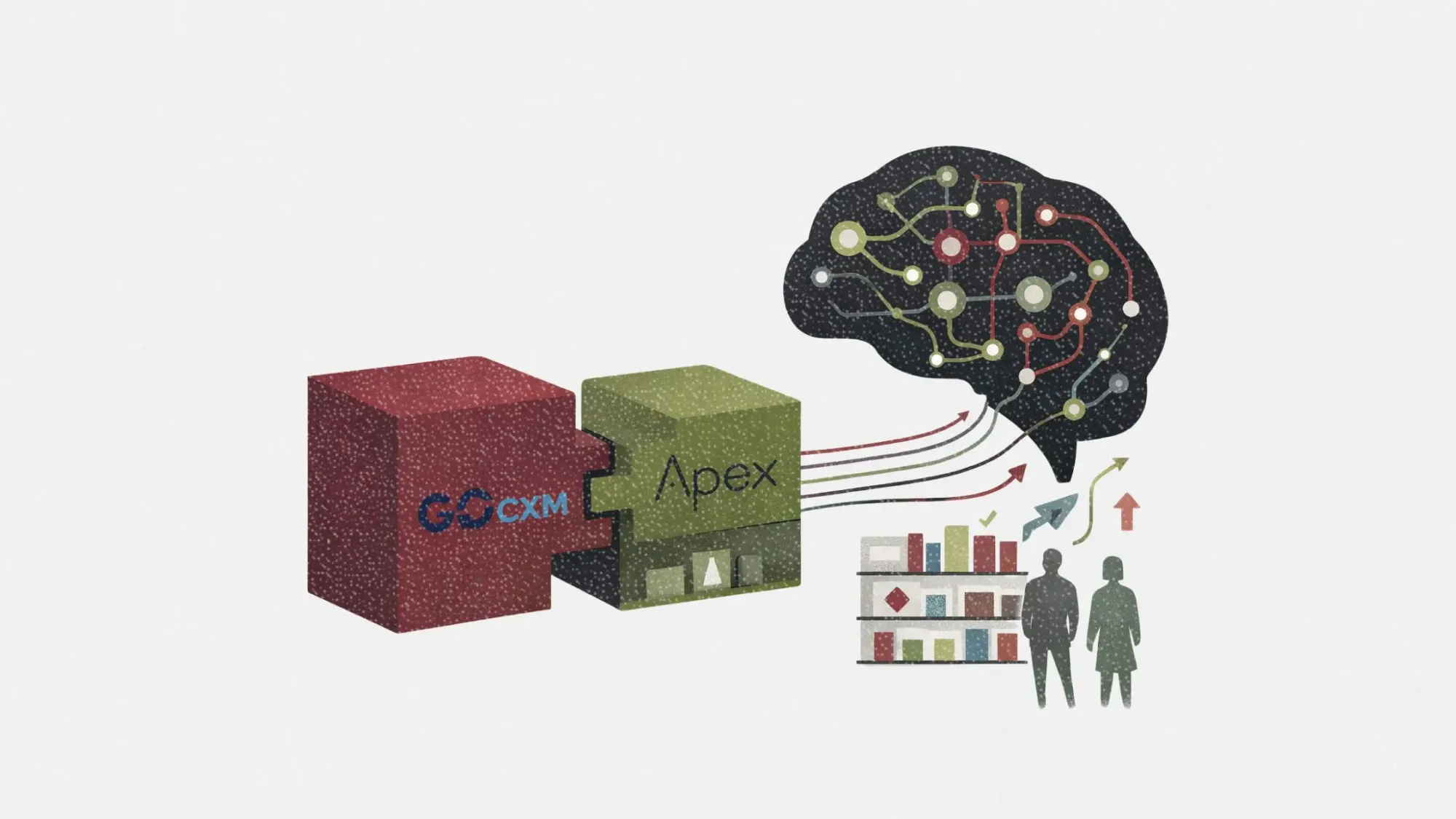
GOcxm, a provider of retail execution and consumer engagement solutions for global CPG brands, has acquired Emotive Technologies, the company behind the Apex AI-powered consumer insights and decision intelligence platform. The move brings predictive modeling, simulation, and behavioral-science-trained AI directly into GOcxm’s Shopper Engagement and Execution Platform, aiming to help brands turn data into actionable decisions before and during retail execution.
The acquisition is positioned as a step toward unifying insight, activation, and measurement within a single system, allowing brands to design, test, and optimize marketing and commerce initiatives in real time. Apex’s technology and team will be integrated into GOcxm’s product roadmap, with continued investment in AI and data science.
Short on time?
Here’s a quick look at what’s inside:
- Who are GOcxm and Emotive Technologies, and what’s the angle here?
- How Apex changes what marketers can do with GOcxm
- Why this matters for CPG and retail marketers
- A closer look: Predictive intelligence meets retail execution
- What’s next for unified retail intelligence
Who are GOcxm and Emotive Technologies, and what’s the angle here?
GOcxm is known for its platform that helps global CPG brands activate consumers, capture zero- and first-party data, validate initiatives, gather shopper sentiment, and verify proof of purchase. The company is trusted by leading brands to turn in-market activity into measurable performance.
Emotive Technologies, through its Apex platform, specializes in AI-powered consumer insights and decision intelligence. Apex uses proprietary datasets and behavioral science-trained AI to simulate outcomes and generate predictive recommendations, helping organizations make better decisions with greater confidence.
The acquisition is not about creating a new category, but about strengthening GOcxm’s existing platform with a deeper intelligence layer. This move fits into a broader trend of martech consolidation, as brands seek unified solutions that connect data, activation, and measurement.
 Patrecia Meliana
How Apex changes what marketers can do with GOcxm
With Apex integrated, GOcxm’s platform now offers predictive intelligence and simulation capabilities. Marketers can:
- Model outcomes and validate strategies before campaigns go live
- Simulate different scenarios and trade-offs to inform decision-making
- Optimize execution in real time, not just after the fact
- Tie campaign outcomes directly to consumer behavior and in-market activity
This means teams can move from simply reporting on what happened to actively shaping what is likely to happen, all within a single system.
Why this matters for CPG and retail marketers
For CPG and retail marketers, the challenge is rarely a lack of data. The real issue is turning that data into clear, confident actions that drive performance at the shelf and across channels. By embedding predictive AI and behavioral science into the execution layer, GOcxm aims to help marketers:
- Predict outcomes before committing budget
- Adjust programs while campaigns are live
- Treat retail touchpoints as ongoing sources of insight, not just points of sale
- Align teams around a single, actionable source of truth
This approach is especially relevant as brands face tighter margins and greater pressure to prove ROI.
A closer look: Predictive intelligence meets retail execution
Apex’s integration is notable for how closely it ties intelligence to execution. In many organizations, insights and activation are separated by time and tools, which can dilute the value of even the best data. GOcxm’s strategy is to close that gap, allowing teams to:
- Validate strategies before rollout
- Adjust campaigns during execution
- Continuously optimize based on real-time feedback
Apex’s behavioral-science-trained AI is designed to account for how consumers actually make decisions in retail environments, factoring in context, incentives, and timing.
What’s next for unified retail intelligence
GOcxm plans to fully integrate Apex’s technology and team, with ongoing investment in AI and data science. The goal is to ensure that insight, activation, and measurement operate as one connected system, rather than as separate functions.
For marketers, this signals a continued shift toward platforms that not only report on performance but also drive smarter, faster decisions. As data volumes grow and execution windows shrink, the ability to simulate, predict, and adapt in real time is becoming a key differentiator.