Klook’s latest Travel Pulse 2026 report suggests global travel demand is not slowing down despite economic uncertainty. In fact, Millennials and Gen Z appear ready to spend more, explore more destinations, and prioritize meaningful experiences over traditional tourism checklists.
This article explores the key trends from the report, including rising travel budgets, experience-first spending, multi-destination itineraries, and the growing role of AI and social media in shaping travel decisions.
For marketers and travel brands, the findings highlight a clear shift in how younger travelers discover, plan, and spend on trips.
Short on time?
Here’s a table of contents for quick access:
- Why travel budgets remain strong in 2026
- Why experiences are replacing traditional travel spending
- How multi-destination travel is reshaping itineraries
- How social media and AI now drive travel discovery
- What marketers should know about the next wave of travel behavior
 Patrecia Meliana
Why travel budgets remain strong in 2026
Klook’s Travel Pulse 2026 report indicates that travel spending is holding steady globally, particularly among Millennials and Gen Z. According to the study, 88% of travelers plan to increase or maintain their travel budgets in 2026, showing strong demand despite broader economic pressures.
International travel intent also remains high. Nine in ten global travelers plan to take an international trip in 2026, with 61% expecting to travel in the first half of the year, up from 50% the year before. Asia Pacific travelers stand out as a major growth driver. Travelers in the region show 50% higher intention to increase travel spending compared with those in Europe and the United States.
Marcus Yong, Vice President of Global Marketing at Klook, notes that travelers are not simply spending more. Instead, they are becoming more selective about what delivers meaningful value during their trips.
Rather than cutting travel altogether, many travelers are prioritizing experiences, flexibility, and deeper exploration when deciding where to allocate their budgets.
Why experiences are replacing traditional travel spending
A key finding from the report is the shift toward experience-led travel spending.
When faced with rising costs, travelers are more likely to reduce spending on shopping or material purchases than on activities or experiences. This trend is particularly strong in Asia Pacific, where travelers are nearly twice as likely as Western travelers to increase spending on experiences.
The types of experiences travelers are most likely to travel for include:
- Food and drink experiences (51.6%)
- Local tours or guided walks (42.1%)
- Time-limited natural sights (41.2%)
- Cultural and art festivals (38.7%)
- Wellness and relaxation retreats (31.4%)
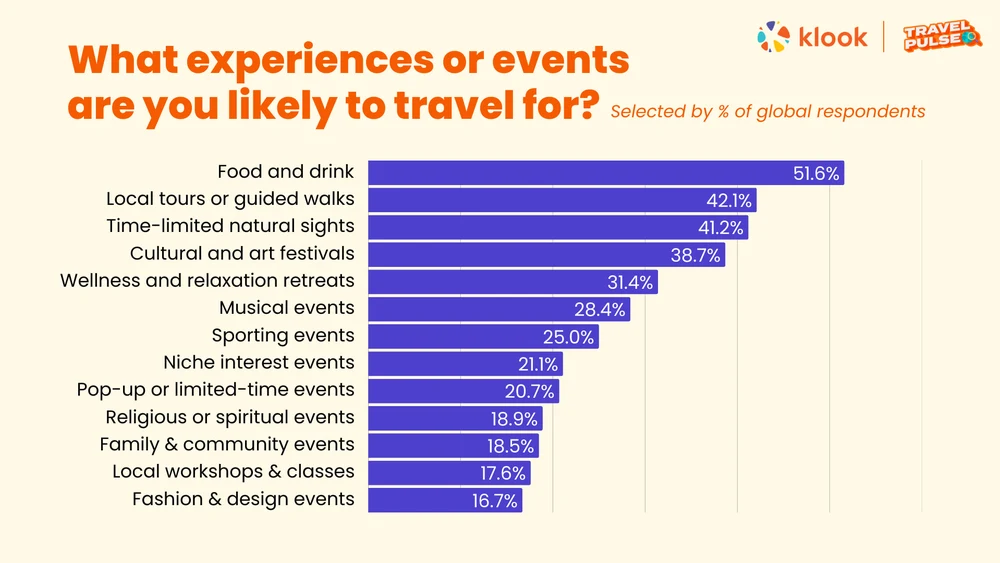
These preferences signal a shift toward travel that emphasizes cultural immersion, local discovery, and memorable moments rather than traditional sightseeing alone. For travel companies, this reinforces the growing importance of curated experiences, local partnerships, and event-based tourism.
How multi-destination travel is reshaping itineraries
Another major shift is how travelers structure their trips. According to the report, two-thirds of travelers plan to visit multiple destinations during a single trip. Rather than choosing between popular and lesser-known destinations, travelers increasingly combine both.
Major cities now serve as starting points rather than final destinations. From these hubs, travelers extend their journeys to smaller cities and less crowded regions.
Examples of emerging secondary destinations gaining attention include:
- Japan: Yokohama, Hiroshima, Nagoya
- Australia: Cairns, Hobart
- Europe: Baix Llobregat, Tromsø
- Middle East: Sharjah, Hurghada
Travelers cite three main motivations for exploring lesser-known locations:
- Authentic local experiences (42%)
- Discovering hidden gems (39%)
- Affordability (37%)
This suggests discovery is becoming more intentional, with travelers actively searching for destinations that offer depth and uniqueness rather than just popularity.
How social media and AI now drive travel discovery
Travel inspiration and travel planning are now powered by a combination of social media discovery and AI-powered tools.
Social media continues to play a dominant role in travel inspiration. According to the report, 80% of travelers say social media influences the destinations or experiences they book. User-generated content and creator recommendations help travelers evaluate destinations and build trust before committing to a trip.
At the same time, AI is becoming a practical travel planning assistant. The report notes that 91% of global travelers now use AI tools during trip planning, mainly for functional tasks such as:
- Travel research (51%)
- Organizing itineraries (49%)
- Translation support (44%)
- Budget management (35%)
Together, social media and AI form a discovery loop. Social platforms spark travel ideas, while AI tools help travelers validate those ideas based on logistics, affordability, and time.
What marketers should know about the next wave of travel behavior
For travel brands, tourism boards, and experience platforms, these trends signal several strategic shifts.
1. Experience-led travel is the new competitive battleground
Brands that focus on unique, bookable experiences rather than generic attractions are more likely to capture traveler attention.
2. Secondary destinations are gaining marketing value
Cities outside traditional tourism hubs are increasingly attractive for travelers seeking authenticity and affordability.
3. Social-first discovery is still critical
Influencer content, travel creators, and user-generated content continue to shape travel decisions.
4. AI-assisted planning will influence booking behavior
Travel companies that structure their content and listings for AI search and recommendation systems may gain a competitive advantage.
Klook’s Travel Pulse 2026 findings highlight a travel industry that is evolving rather than slowing down. Younger travelers are spending strategically, prioritizing experiences, exploring multiple destinations, and relying on a mix of social inspiration and AI tools to plan their trips.
For marketers and travel platforms, the message is clear: the future of travel discovery will be shaped by experiential value, intelligent planning tools, and content that inspires exploration beyond the obvious.