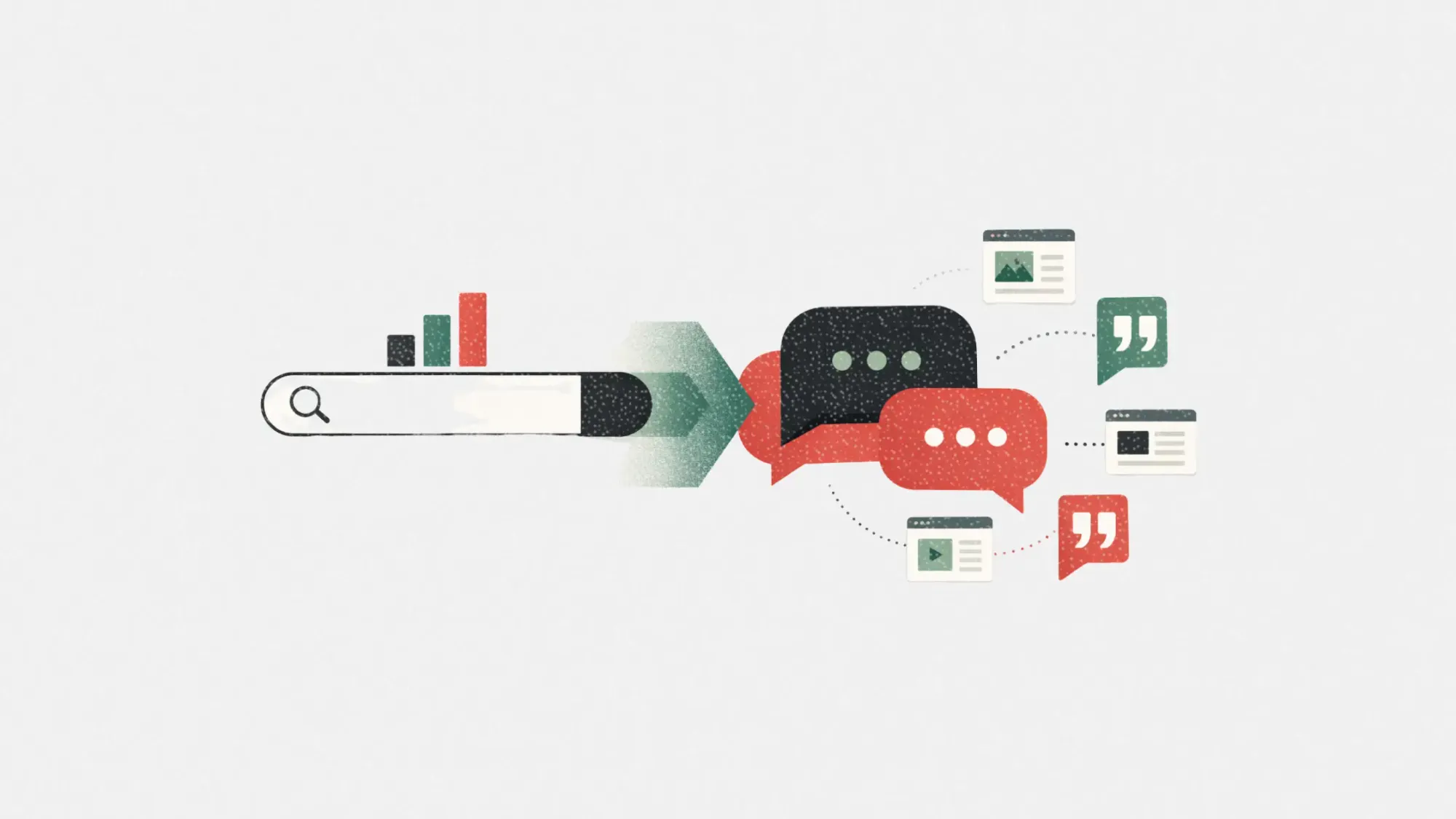
Search is no longer just about blue links. AI tools like ChatGPT, Gemini, and Perplexity are reshaping how users discover information by summarizing answers directly instead of sending traffic to websites.
The shift is already measurable. An analysis of over 10 million keywords between January and November 2025 shows that Google AI Overviews now appear in up to 16% of queries, and that number is still growing.
This introduces a new battleground for marketers because being ranked is no longer the goal, but being cited is. This article explores seven practical ways to increase your chances of showing up inside AI-generated answers and what this means for modern SEO strategies.
Short on time?
Here’s a table of contents for quick access:
- Focus on authority not just keywords
- Get featured on third-party sites not just your own
- Structure your content for machine readability
- Answer specific questions clearly
- Keep content fresh and updated
- Build topical authority not just single articles
- Be cited across multiple platforms
 Patrecia Meliana
Focus on authority not just keywords
AI models prioritize trust over keyword optimization. High-authority domains consistently outperform smaller sites when it comes to citations.
Websites with strong visibility and backlinks are significantly more likely to be cited. This is backed by SE Ranking’s research that finds that sites with over 24K referring domains average nearly 3x more citations than those with minimal authority.
This reinforces a key shift. Traditional SEO tactics still matter, but E-E-A-T signals like expertise, author credibility, and brand reputation now play a larger role in AI visibility.
For marketers, this means investing in thought leadership, expert attribution, and consistent brand presence rather than chasing isolated keyword wins.
Atikah Amalia
Get featured on third-party sites not just your own
AI systems show a strong bias toward earned media. Third-party mentions often carry more weight than brand-owned content.
Research from Muck Rack shows that 37% of AI-cited results reference content not owned by the brand in question.
“What we’re seeing in our own client work is that placements in trusted media outlets are now doing double duty — they build brand credibility AND dramatically increase the chances of being cited in AI-generated answers. Media relations isn’t just a brand play anymore. It’s become infrastructure for AI visibility.” — Tommy Prayoga, Head of Agency, Content Collision
This is where PR makes a comeback. Guest posts, interviews, thought-leadership and media coverage are no longer just brand-building tactics. They are direct inputs into AI citation models.
For Marketing Directors and PR teams, the implication is clear. If your brand is only publishing on its own blog, you are limiting your visibility in AI-driven discovery.
Patrecia Meliana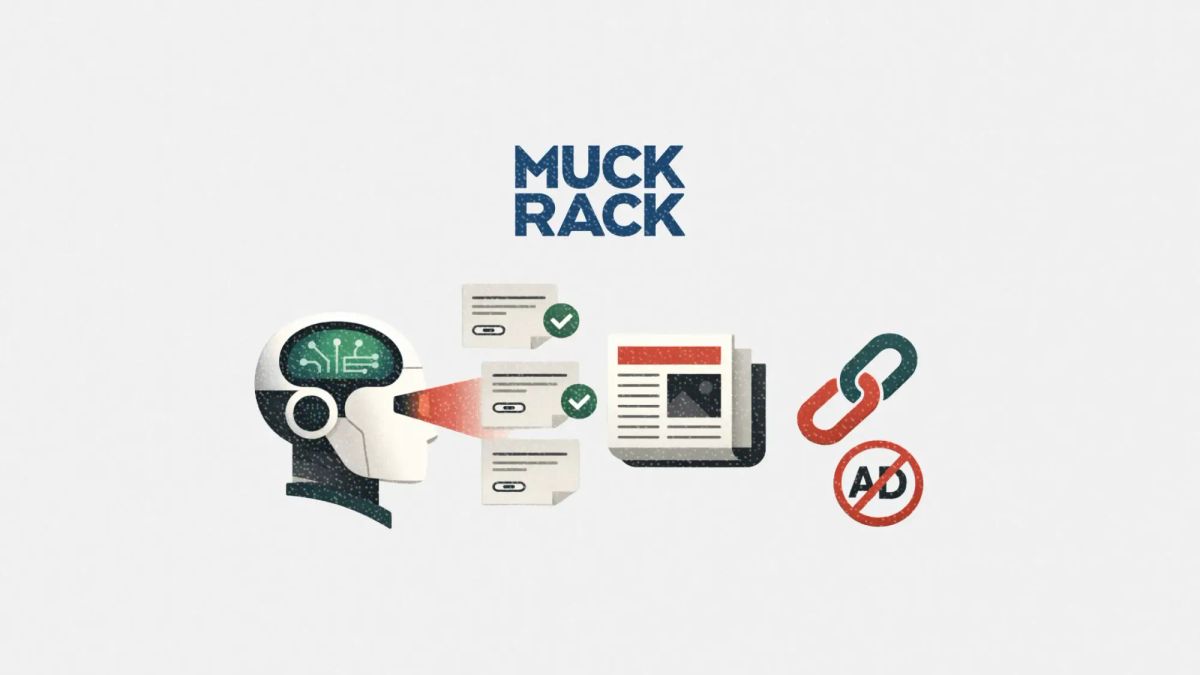
Structure your content for machine readability
AI does not read like a human. It parses content into structured chunks and extracts answers from clean, well-organized sections.
Clear structure directly impacts citation likelihood. SE Ranking research finds that sections between 100 to 150 words earn about 4.7 citations on average, while longer sections see a slight drop, likely because dense blocks are harder for AI to parse.
Readability also plays a role. Content written at a Flesch-Kincaid Grade 6 to 8 level averages around 4.6 citations, compared to just 4.0 for more complex writing above Grade 11.
This reinforces a simple idea. AI favors content that is easy to extract, interpret, and reuse.
Key execution tactics shared by Microsoft include:
- Align titles, descriptions, and H1s
Your page title, meta description, and H1 should clearly reflect the same intent. AI uses these signals to understand what the page is about.
For example:
- Title: “Best Quiet Dishwashers for Open-Concept Kitchens”
- H1: “Quietest Dishwashers for Modern Homes”
- Description: “Explore top-rated dishwashers designed for open kitchens, with low noise levels and energy efficiency.”
- Use clear and descriptive H2 and H3 headings
Headings act like labels for AI. They define content blocks that can be extracted independently.
For example:
- Avoid vague labels like “Learn more.”
- Instead use: “What makes this dishwasher quieter than most models?”
- Structure content in Q&A format where possible
AI tools often lift direct answers. Writing in question-and-answer format increases your chances of being quoted.
For example:
- Q: How loud is the dishwasher?
- A: It operates at 42 dB, which is quieter than most models.
- Break information into lists and tables
Bulleted lists and numbered steps make content easier to parse and reuse. Use them for processes, comparisons, and feature breakdowns.
- Keep sections tight and focused
Aim for one idea per section. Avoid long, dense paragraphs that mix multiple concepts.
Readable, structured content increases the chances that AI can lift your content directly into answers.
Answer specific questions clearly
AI favors direct answers over long-form explanations.
Pages that include question-based headings and FAQ-style content tend to receive more citations. SE Ranking’s research found that pages that include FAQ sections within the main content average about 4.9 citations, compared to 4.4 for pages without them. Question-formatted titles and headings also provide a measurable lift, increasing citations from 4.5 to 4.6.
This happens because AI systems are designed to extract concise answers to specific prompts. When your content mirrors that structure, it becomes easier to reuse.
Instead of writing broadly, structure content around specific queries:
- What is generative engine optimization?
- How does AI choose sources?
- What are the best ways to get cited?
Each section should deliver a clear, direct response with minimal fluff. The goal is simple. Make your content easy for AI to lift, not just easy for humans to read.
Keep content fresh and updated
Freshness matters more in AI search than in traditional SEO.
Pages updated within the last two months average about 5.0 citations, compared to 3.9 for content that has not been updated in over two years. This shows how quickly outdated content can lose visibility in AI search.
This is a noticeable shift from traditional SEO, where older high-ranking pages could remain competitive for long periods. In AI-driven results, recency plays a bigger role in determining what gets cited.
For marketers, this means content is no longer a one-time asset. It needs to be actively maintained.
Practical ways to stay relevant:
- Refresh key articles every 2 to 3 months
- Update statistics and examples
- Re-optimize for evolving search intent
Consistently updated content signals reliability and increases the chances of being cited again.
Build topical authority not just single articles
AI systems evaluate domains holistically. They look for depth, consistency, and authority across a topic, not just isolated high-performing pages.
Semrush study finds that domains with higher Authority Scores are significantly more likely to appear in AI-generated answers. This metric is heavily influenced by backlink quality and referring domain diversity. Interestingly, nofollow links have nearly the same impact on AI visibility as standard follow links, reinforcing that authority is about overall credibility, not just link mechanics.
Publishing multiple articles around a single theme reinforces your site as a trusted source. For example, instead of one article on AI SEO, build a cluster:
- AI search fundamentals
- GEO strategies
- AI citation case studies
- Tool comparisons
This approach signals expertise and increases the likelihood that your domain becomes a go-to reference.
Be cited across multiple platforms
AI visibility compounds across platforms. It is not enough to rank in one place. You need to appear consistently across multiple sources and formats.
Sites that appear across multiple platforms are significantly more likely to be cited in tools like ChatGPT. Research shows that sites cited across four or more AI platforms are 2.8 times more likely to appear in ChatGPT responses. Brand search volume also shows a measurable correlation with LLM citations, while backlinks alone have a weaker or neutral relationship. At the same time, Generative Engine Optimization efforts can increase visibility by 30 to 40%.
This signals a major shift. You are no longer optimizing for a single engine. You are building presence across an ecosystem.
Execution matters just as much as strategy. To increase your surface area Semrush recommends to:
- Repurpose content into videos, social posts, and podcasts
- Distribute insights across LinkedIn and industry platforms
- Turn research into multiple formats
You are no longer optimizing for one engine. You are optimizing for an ecosystem of AI systems.
What marketers should know
To adapt to this shift, marketers need to rethink how they approach content distribution and authority building.
Key actions to consider:
- Invest in PR and third-party visibility, not just owned media
- Build content clusters instead of standalone posts
- Prioritize clarity and structure over length
- Refresh content regularly to maintain relevance
- Repurpose content across formats and platforms
This is not a replacement for SEO. It is an evolution. Generative Engine Optimization sits on top of traditional SEO and changes how success is measured.
Atikah Amalia
AI search is redefining visibility. Rankings still matter, but citations are becoming the new currency of discovery.
Marketers who focus on authority, structure, and distribution will be better positioned to win in this new landscape. Those who rely solely on traditional SEO tactics risk becoming invisible in AI-generated answers.
The shift is already happening. The only question is how quickly you adapt.