Most guides to influencer tiers stop at four. Nano, micro, macro, mega – a clean taxonomy built around follower counts that works well enough for consumer campaigns but consistently misleads B2B marketers.
The problem is not that the four-tier model is wrong. It is that it was designed for the Instagram-era DTC playbook. When a B2B marketer uses that same model to evaluate a 6,000-follower SaaS founder whose weekly LinkedIn posts regularly reach the CFO inboxes of Fortune 500 companies, the framework breaks down. Follower count stops being a meaningful proxy for influence when every follower is a potential buyer.
This guide covers the full five-tier picture: the standard taxonomy with current rate and engagement benchmarks, and the fifth tier that most competitor articles skip entirely. If you are looking to understand what is B2B influencer marketing before diving into tiers, that primer is worth reading first.
Table of contents
Jump to each section:
- The standard four-tier taxonomy
- Nano-influencers: small reach, high trust
- Micro-influencers: the performance sweet spot
- Macro-influencers: scale and visibility
- Mega-influencers: fame over influence
- The fifth tier: the B2B LinkedInfluencer
- How to match the tier to your B2B campaign goal
- Pick tiers like a portfolio, not a lottery
The standard four-tier taxonomy
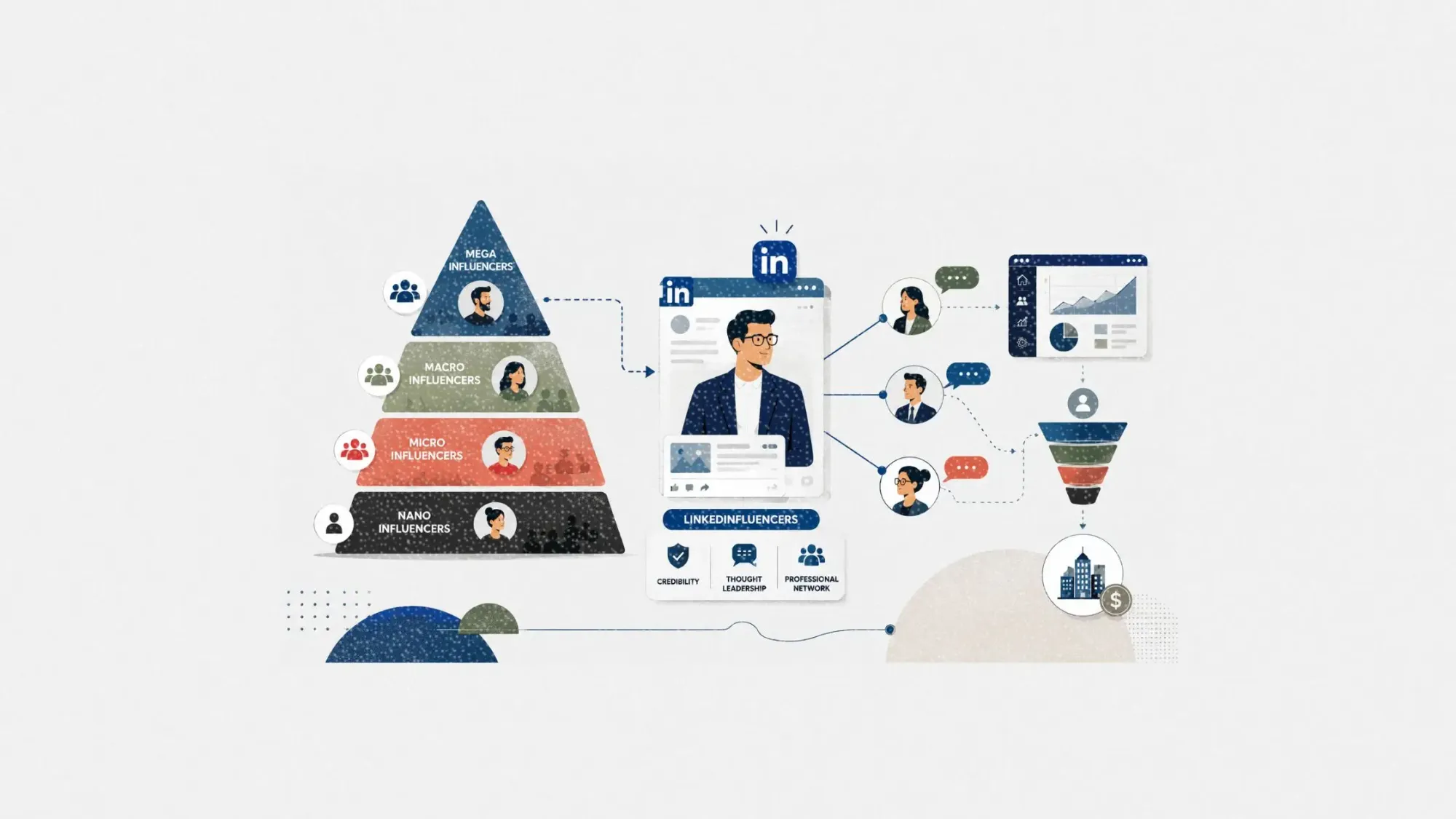
The four-tier model classifies influencers by follower count. While the exact boundaries shift slightly depending on the source, the most common 2026 consensus looks like this:
| Tier | Follower range | Typical engagement rate |
|---|---|---|
| Nano | 1K-10K | 4-8% |
| Micro | 10K-100K | 2-5% |
| Macro | 100K-1M | 1-3% |
| Mega | 1M+ | 0.5-1% |
The inverse relationship between follower count and engagement rate is one of the most consistent findings in influencer marketing research. According to SociaVault’s 2026 benchmark study of 40,000+ profiles, LinkedIn nano creators achieve five times the engagement rate of mega accounts on the same platform, the steepest drop-off of any major platform measured.
For consumer campaigns, this taxonomy gets you far. But it was built around Instagram and TikTok dynamics, where reach and entertainment value drive purchase decisions. B2B buying works differently, and that difference demands an additional lens.
Nano-influencers: small reach, high trust
Nano-influencers typically have between 1,000 and 10,000 followers. Their audiences are small enough that a meaningful share of followers know the creator personally or through direct professional context – which is precisely why their recommendations carry weight.
Engagement rates for nano-influencers consistently sit at 4-8%, compared to the 1-3% range typical for larger tiers. Their hyper-local, tightly knit communities treat creator recommendations more like advice from a trusted colleague than sponsored content. That trust translates: nano-influencer campaigns have been shown to deliver conversion rates two to three times higher than macro campaigns, according to analysis published by digital strategy firm Digital Applied in 2026.
For brands, the main limitation is operational. Running a campaign with reach comparable to a single macro-influencer requires coordinating dozens of nano-influencers simultaneously, which multiplies briefing, approval, and tracking complexity.
Typical rates (Instagram, US market, 2025-2026): US$50-US$500 per post. LinkedIn nano-influencers with professional audiences can command significantly more.
Best for: Hyper-niche campaigns, community-level authenticity, product categories where peer trust matters more than mass awareness. In B2B, think: niche SaaS tools, regional events, highly targeted account-based campaigns.
Micro-influencers: the performance sweet spot
Micro-influencers, with 10,000 to 100,000 followers, are consistently cited as the most efficient tier for performance-oriented campaigns. They combine high engagement rates of 2-5% with enough reach to produce measurable results – and at costs that remain significantly lower than macro or mega-tier partners.
Their thematic focus is a key differentiator. A micro-influencer who has spent years writing about SaaS pricing strategy, enterprise procurement, or B2B go-to-market has built an audience that is actively seeking exactly that content. This coherence between creator content and audience interest makes their recommendations credible and actionable.
Research from Digital Applied’s 2026 analysis shows micro-influencers deliver 60% higher engagement rates than mega-influencers at roughly one-tenth the cost per post. A network of micro-influencers reaching 800,000 people combined typically outperforms a single macro-influencer post to the same total audience on engagement volume, content asset output, and conversion.
Typical rates (Instagram, US market, 2025-2026): US$500-US$5,000 per post. Tech and B2B micro-influencers with targeted professional audiences often charge a 30-50% premium above general lifestyle rates, according to InfluenceFlow’s 2025 pricing data.
Best for: Performance-driven goals such as trial sign-ups, demo requests, content downloads, and lead generation. In B2B, micro-influencers are often the workhorse tier, particularly when ICP density within their audience is high.
Macro-influencers: scale and visibility
Macro-influencers sit in the 100,000 to 1 million follower range. They typically gained their following through sustained platform-native content rather than offline celebrity, which means their audiences tend to be more topically aligned than mega-influencers – though less niche than micro.
According to 2026 benchmark data from Influencer Marketing Hub, macro-influencers average around 2.05% engagement. That percentage is lower than smaller tiers, but the absolute interaction volume can be substantial: a macro-influencer generating 1% engagement on 500,000 followers still produces more total interactions than a micro-influencer at 3% on 50,000.
The macro tier is where campaign costs begin to escalate meaningfully. Expect to budget for content production coordination, legal review, longer approval cycles, and usage rights discussions. The ROI calculation shifts from pure performance metrics toward brand visibility and share-of-voice indicators.
Typical rates (Instagram, US market, 2025-2026): US$5,000-US$20,000 per post. Rates vary considerably by niche, engagement quality, and content format.
Best for: Product launches, category-level awareness campaigns, and initiatives where broad reach within a demographic matters more than granular conversion tracking. B2B macro-influencers exist, but they are rare. When you find one whose audience overlaps tightly with your ICP, the premium is usually worth it.
Mega-influencers: fame over influence
Mega-influencers have more than one million followers. This tier includes celebrities who transitioned to social media, creators who scaled to celebrity-level reach, and public figures whose follower counts reflect mass cultural relevance rather than topical expertise.
As Gil Eyal, head of marketing and innovation at Inspire, described the tier: mega-influencers are “often more famous than influential.” Their audiences are demographically diverse, their engagement rates are the lowest of any tier at 0.5-1%, and their relationship with individual followers is necessarily more distant.
For most B2B marketers, the mega tier makes little strategic sense. The audience is too diffuse, the targeting too blunt, and the pricing too steep to justify against a conversion metric. The exception is brand-image work at enterprise scale – think a Fortune 500 announcing a platform partnership or a major industry event seeking broad awareness.
Typical rates: US$25,000 to US$100,000+ per post. Major celebrity partnerships run into seven figures including production costs and usage rights.
Best for: Mass brand awareness and cultural positioning, not B2B lead generation or account-based campaigns.
The fifth tier: the B2B LinkedInfluencer
This is the tier the standard taxonomy misses.
The LinkedInfluencer – sometimes called the operator-creator – is a professional with a relatively modest follower count (often 3,000 to 50,000 on LinkedIn) who has built a highly engaged audience of decision-makers within a specific industry vertical. They typically operate at the intersection of practitioner and creator: a CFO who writes about SaaS procurement, a VP of Sales who dissects B2B go-to-market strategy, a CTO who posts regular commentary on engineering hiring.
What makes this tier structurally different from the standard nano or micro classification is not the follower count. It is the audience composition and the decision-making density within that audience. A LinkedInfluencer with 8,000 followers where 60% are VP-level or above in a target industry delivers something categorically different from a consumer nano-influencer with the same count. The pipeline potential per follower is not even in the same order of magnitude.
LinkedIn’s “Working with B2B Creators” guide confirms the platform’s unique commercial weight: 79% of B2B buyers engage with creator content on LinkedIn monthly, and 82% say it influences their purchase decisions. That is the environment LinkedInfluencers operate in, and it shapes their pricing accordingly.
Dinda Anandita, Account Director at Content Collision, a content-led comms agency, puts it plainly: “The tier debate misses the point for B2B. A 5,000-follower SaaS founder posting weekly product teardowns for an audience of CTOs is not a nano-influencer in any useful sense. The audience density and purchase intent are completely different from a lifestyle nano creator. That is the LinkedInfluencer tier, and it needs its own evaluation rubric, its own rate card, and its own brief format.”
That rate card looks different from the standard model. According to 2025-2026 pricing data from InfluenceFlow and ClickAnalytic, B2B thought leaders on LinkedIn charge US$2,000 to US$15,000 per post, with the premium driven by audience seniority, topical authority, and lead generation potential rather than raw follower count.
A LinkedIn influencer with 50,000 followers can command US$3,000-US$8,000 per post, while the same follower count on Instagram might yield US$1,500-US$3,000. LinkedIn’s professional positioning commands a 15-40% premium over equivalent follower counts on other platforms, and in B2B SaaS, minimum rates regardless of following typically start at US$2,000-US$5,000.
Engagement benchmarks on LinkedIn: SociaVault’s 2026 study measuring 40,000+ profiles found a median engagement rate of 2.94% across LinkedIn, with micro-level creators (approximately 10K-50K connections) achieving 3.83% – higher than Instagram and X/Twitter benchmarks at comparable tier sizes. For B2B brands, this makes even smaller LinkedIn audiences commercially viable in ways that the standard tier model does not capture.
How to identify LinkedInfluencers: Look beyond follower count to audience seniority data (available through tools like Favikon and IMAI), comment quality (are followers asking substantive questions or dropping fire emojis?), post frequency, and whether the creator’s content regularly shows up in your ICP’s feeds organically. An active Favikon score and a LinkedIn newsletter with high open rates are both positive signals.
How to match the tier to your B2B campaign goal
Tier selection should follow campaign objectives, not budget convenience. A few practical mappings:
When the goal is broad category awareness among a general professional audience, a combination of macro-influencers and LinkedInfluencers with sector-wide reach is often the right call. Macro brings volume; LinkedInfluencers bring credibility with the buyers who matter.
When the goal is lead generation – demo requests, free trial sign-ups, gated content downloads – micro-influencers with a high ICP-density audience consistently outperform on cost per qualified lead. Their trust relationship with followers reduces friction at the conversion point.
When the goal is account-based marketing and you are targeting a short list of named enterprise accounts, LinkedInfluencers are frequently the only tier that makes sense. A targeted post from a CFO peer with deep credibility in your prospect’s community can accelerate deals in ways that a standard awareness campaign cannot replicate.
Regardless of which tier you activate, budget allocation deserves rigorous planning before outreach begins. The influencer marketing cost breakdown covers current rate benchmarks across tiers and platforms, including global vs APAC pricing differences that affect regional campaign budgeting.
Pick tiers like a portfolio, not a lottery
The instinct to pick one tier and commit fully to it is understandable but usually wrong. The most effective B2B influencer programs in 2026 run multi-tier architectures: a LinkedInfluencer or two for credibility signaling within the target ICP, a cohort of micro-influencers for performance and lead generation, and occasional macro activations for category moments like product launches or major industry events.
Think of it less as a binary choice between reach and trust, and more as a portfolio allocation question. What proportion of your budget should generate attention, and what proportion should convert that attention into pipeline? The answer will almost certainly require more than one tier, and it will almost certainly require the LinkedInfluencer tier that the four-tier model leaves out entirely.