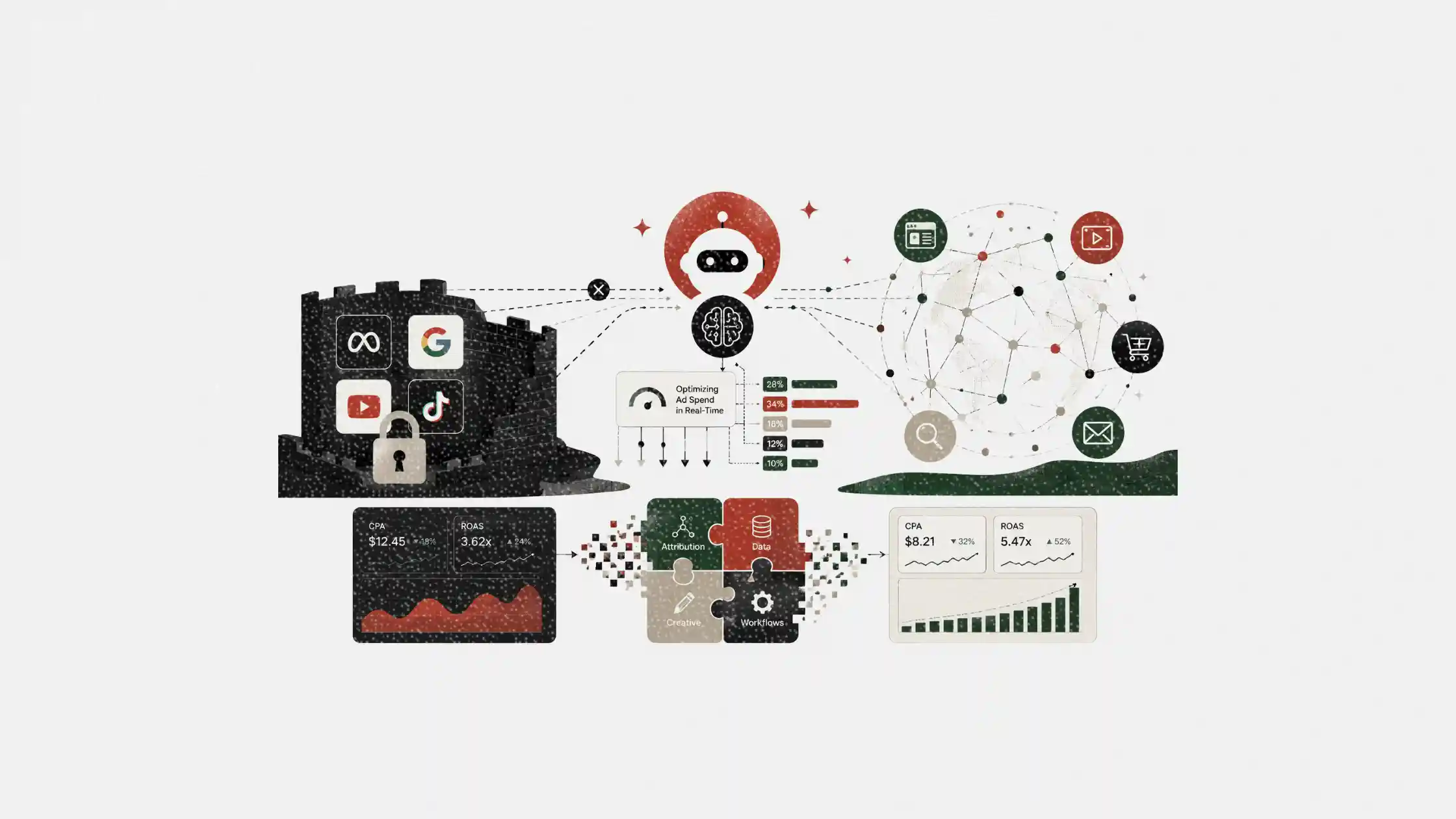
Taboola’s new research argues that performance marketers are hitting a familiar wall: AI automation is working, but mostly inside walled gardens.
The study found 76% of advertisers report performance gains from AI-powered campaign tools, while 80% said they would increase open web spend if comparable agentic AI solutions existed. It explores whether the open web can become a serious performance channel again, not just a reach play.
Table of contents
Jump to each section:
- What Taboola’s study says about agentic AI adoption
- Why advertisers want open web performance beyond search and social
- What Realize+ is trying to solve
- What marketers should know before shifting budget
 Patrecia Meliana
What Taboola’s study says about agentic AI adoption
Taboola’s report, The Agentic Advantage in Performance Marketing, surveyed 200 senior performance marketers across the US and UK. The data shows agentic AI is no longer a fringe experiment for performance teams. Google Performance Max is already used at scale by 91% of respondents, while Meta Advantage+ is used at scale by 88%.
That adoption is showing results. About 76% of advertisers said their best-performing AI-powered campaign solution has produced moderate to significant performance uplift. The clearest value driver is still performance discipline: 41% of respondents named real-time optimization toward CPA or ROAS goals as the biggest perceived benefit of agentic AI-driven advertising.
But the same sophistication has not fully reached the open web. Only 36% of respondents said they currently use open web campaign management solutions at scale, even though 44% are testing or piloting them. That gap is the tension Taboola is trying to spotlight: advertisers like agentic AI, but most of its proven value still sits inside search and social.
Why advertisers want open web performance beyond search and social
Advertisers are not exactly abandoning walled gardens. They are trying to reduce dependency.
According to the report, 75% of marketers said finding a performance channel that delivers incremental outcomes beyond search and social is very or extremely important. The urgency rises with scale: 70% of US$5M-plus monthly spenders called it extremely important.
The open web is the obvious candidate, but it still has baggage. Taboola’s study found that 74% of respondents cite too many vendors or partner complexity as a barrier to further open web investment, while 71% cite lack of unified attribution and measurement. Brand safety is another major concern, named by 54% of respondents.
The issue is not that marketers have written off the open web. It is that the operating model still feels too fragmented compared with the cleaner automation of walled gardens.
What Realize+ is trying to solve
Taboola is positioning Realize+ as its answer to that gap.
Announced in April 2026, Realize+ is an agentic advertising solution that uses Taboola’s supply, first-party data, and AI to optimize performance across the open web. It includes a Decision Engine that reallocates spend in real time and an Element Generator for creative and targeting automation.
The demand signal is strong. The report found that 81% of respondents agree they would increase open web investment if it offered automated AI-powered campaign solutions comparable to search and social. Nearly all respondents, 99%, said they would allocate some performance budget to the open web if such tools existed, with an average expected allocation of 24%.
That is why Realize+ is not just being framed as another optimization tool. It is being pitched as infrastructure for moving performance budgets into environments that have historically been harder to manage, measure, and scale.
What marketers should know before shifting budget
Marketers should treat this less as a shiny AI launch and more as a media allocation test.
The biggest adoption barrier is operational, not philosophical. Taboola found that 54% of respondents cite difficulty integrating agentic AI into existing workflows as the top internal barrier to broader adoption. Among companies spending US$1M to US$4.9M per month, that figure jumps to 74%.
That matters because larger advertisers are often the ones most eager to diversify, but also the least able to casually bolt on another platform. For them, the winning solution will not just promise better CPA or ROAS. It will need to fit into existing workflows, reporting systems, governance processes, and creative operations.
Three questions matter:
- Can open web campaigns prove incremental reach, not just cheaper impressions?
- Can attribution hold up against search and social benchmarks?
- Can agentic optimization improve CPA or ROAS without turning into another black box?
Taboola’s study shows a clear market mood: advertisers like agentic AI, but they do not want its benefits trapped inside two or three platforms.
For performance teams, the next fight is not just automation. It is where automation can create new growth without surrendering transparency, control, or measurement discipline.