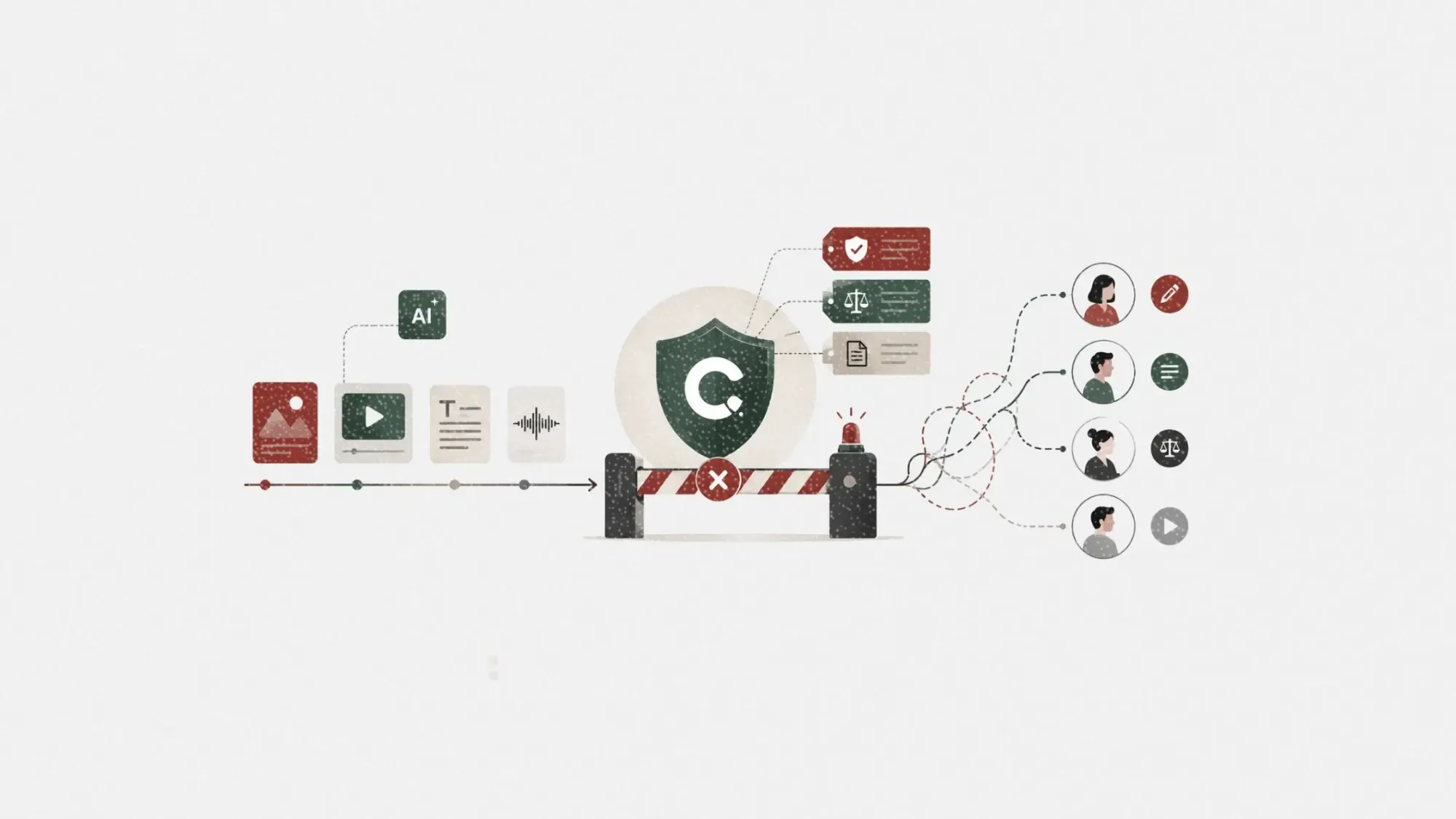
Marketing teams no longer struggle to generate enough assets. They struggle to keep control of what those assets are, who can reuse them, and whether they still represent the brand after AI tools, creator partners, paid media teams, and platform automation have each touched them.
That is the harder operator problem now. The pressure shows up in creator contracts, image-rights disputes, AI-assisted content workflows, and social platforms that increasingly combine creative generation, creator discovery, and paid distribution inside one system. Once content becomes cheap, governance becomes the scarce capability.
Table of contents
Jump to section:
- The content bottleneck has moved from production to governance
- Why rights voice and disclosure now break in the same workflow
- The legal and reputational cost of loose asset control
- Why transparency is becoming part of the creative system
- What teams should do next
The content bottleneck has moved from production to governance
AI removed scarcity around first drafts, format adaptation, and versioning. It did not remove review, rights clearance, or channel-specific risk. Adobe’s 2025 content demand research found these data:
- 96% of marketers have seen content demand increase at least 2x over the last two years
- 71% expect demand to grow 5x or more by 2027
- 47% say creating, reviewing, approving, and activating a single piece of content can involve between 51 and 200 people
That is not mainly a production problem. It is a coordination problem.
Recent launches make that coordination burden heavier. TikTok World 2026 introduces AI ad tools, creator search, and in-app travel booking for marketers compresses creator matching, AI video generation, automated asset selection, search visibility, and commerce into one workflow.
That kind of stack is useful because it speeds up execution. It also means one asset can move from brief to synthetic variant to creator-led distribution to paid amplification without a clean chain of ownership unless a team builds one deliberately.
 Patrecia Meliana
Why rights voice and disclosure now break in the same workflow
The old way of dividing responsibilities no longer holds. Brand voice used to sit with editorial. Usage rights sat with legal. Disclosure sat with compliance or creator marketing. In practice, those three issues now fail in the same place: the content supply chain.
Adobe’s 2025 report on content creation and management found that 78% of consumers expect a seamless experience at every touchpoint, yet only 45% say brands create a consistent experience across channels. When output multiplies faster than the review system, inconsistency stops being a copy-editing issue and becomes an operating risk.
That is why guidance like How to use AI-assisted content marketing without losing your brand voice matters, and why the more contractual reality in Influencer contract templates: clauses every B2B marketer needs in 2026 matters just as much. AI defaults toward familiar phrasing and safe structure.
Creator programs add reuse, whitelisting, paid amplification, downstream edits, and platform-led transformations. If voice standards, edit permissions, and disclosure obligations are not explicit at the asset level, speed just multiplies ambiguity.
The legal and reputational cost of loose asset control
The legal risk is no longer hypothetical. In the complaint filed by Dua Lipa against Samsung, the singer alleges Samsung used her image on television packaging without authorization and created a false impression of endorsement. Whether a team sees that as packaging, partner content, or retail creative does not change the lesson. If a brand cannot prove who cleared a likeness, who licensed it, and where it was reused, the exposure lands on the brand anyway.
Industry concern already reflects that pressure. WFA’s January 2025 research on IP risk in generative AI marketing found that 77% of brands cite IP and copyright as their main concern, and only 40% of adopting brands are using AI-generated content in user-facing marketing communications. That caution is rational. Once AI tools, agencies, creators, media teams, and distribution partners all touch the same asset, the hard part is no longer generation. It is traceability.
Why transparency is becoming part of the creative system
Transparency is starting to work less like a disclaimer and more like part of the brand promise. RWS research from March 2025 found that more than 80% of consumers think AI-created material should be clearly labelled, and 62% said transparency would increase their trust in a brand.
On the brand side, WFA’s April 2026 guidance on AI labelling found that 78% of global brands are already using AI-generated or AI-enhanced content in consumer-facing marketing, while 82% say transparency is essential for protecting brand reputation.
That combination matters because consumers do not need a legal memo about every workflow. They do care when a synthetic voice sounds human, when a likeness appears manipulated, when a creator endorsement feels fabricated, or when content hides how it was made. Trust breaks faster when the production system looks evasive.
The infrastructure is moving in that direction too. C2PA’s February 2026 update on Content Credentials says more than 6,000 members and affiliates now have live applications of the standard. That does not solve every provenance problem, but it shows authenticity metadata is becoming operating infrastructure rather than a niche experiment.
Ariana Sorensen
What teams should do next
The teams that handle this well will treat governance as a creative capability, not as a final legal checkpoint.
- Assign one owner for the asset chain. Creative ops, brand systems, or content operations should own the record of where an asset came from, what AI tools touched it, and which teams can reuse it.
- Separate brand voice review from factual review. A piece can be compliant and still sound interchangeable. Voice governance needs its own checklist and approver.
- Write reuse and editing rights into creator agreements. Paid amplification, whitelisting, synthetic edits, and downstream repurposing all need explicit permission windows.
- Set disclosure rules by scenario, not by platform. Synthetic voices, AI-altered likenesses, and decorative background generation do not create the same trust risk and should not be governed the same way.
- Give PR, legal, content, and paid media one shared escalation path. The same issue can surface as a creator complaint, a customer trust issue, a moderation problem, or a performance media risk.
The strategic shift is simple. When content creation becomes abundant, the differentiator is not who can publish the most. It is who can preserve meaning, permission, and trust while publishing at speed. That is the operating advantage senior marketing teams should be building now.