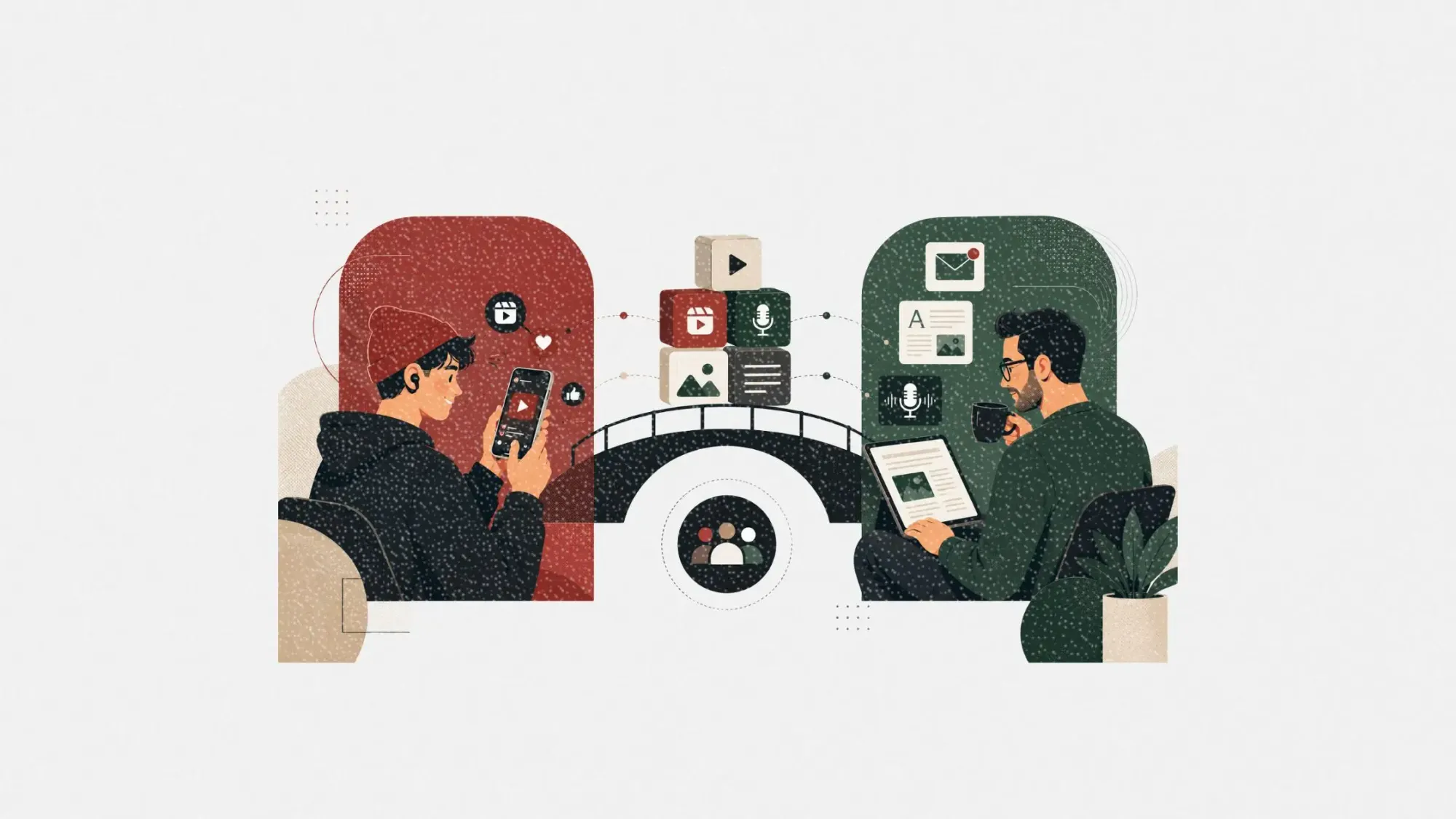
Marketers running campaigns for two different audiences often end up with two different problems. Content built for Gen Z feels too chaotic for millennial buyers. Content built for millennials reads too dry for Gen Z feeds.
The good news: you do not need two separate content operations. You need a clearer map of what each generation expects from each format, and where those expectations overlap enough to share infrastructure.
This guide breaks down the content preferences of Gen Z (born 1997-2012) and millennials (born 1981-1996) by format, platform, and funnel stage, and shows how to build one flexible content system that reaches both without running two editorial calendars in parallel.
Table of contents
Jump to each section:
- Quick comparison: Gen Z and millennial content preferences
- Short-form vs long-form: when each format works
- Interactive, creator-led, and meme-driven content
- Educational and trust-building formats for millennials
- How marketers can build one content system for both groups
- FAQs about Gen Z and millennial content formats
Quick comparison: Gen Z and millennial content preferences
Before getting into strategy, here is a side-by-side look at how each generation approaches content.
| Dimension | Gen Z (born 1997-2012) | Millennials (born 1981-1996) |
|---|---|---|
| Primary content format | Short-form video, memes, reels | Long-form video, articles, email newsletters |
| Platform preference | TikTok, Instagram, YouTube Shorts | YouTube, LinkedIn, Instagram, podcasts |
| Trust signal | Creator authenticity, peer recommendations | Expert opinion, in-depth reviews, brand transparency |
| Interactive content appetite | High (polls, challenges, comment-driven formats) | Moderate (prefers utility over novelty) |
| Podcast preference | Short episodes under 30 minutes, lifestyle-focused | Long-form deep-dives on professional topics |
| Purchase decision trigger | Social discovery, creator endorsement | Research, comparisons, expert-sourced content |
| Attention pattern | Fast hook required; depth possible when topic earns it | Willing to research, read, and compare before deciding |
These are population-level patterns, not rules for every individual. A 23-year-old Gen Z product manager and a 38-year-old millennial startup founder may consume very different content depending on context. But at a campaign planning level, these tendencies are consistent enough to shape format and channel decisions.
Short-form vs long-form: when each format works
The short-form vs long-form debate is frequently misframed. It is not that Gen Z dislikes depth. It is that they need a reason to go deeper before committing time to it.
According to Deloitte’s fall 2025 Digital Media Trends update, 58% of Gen Z spend more time watching social media videos than streaming services, compared to 44% of millennials. Gen Z’s social-first media diet is well-established, and short-form content sits at the center of it.
But the same generation also consumes long-form when the content earns that time. According to eMarketer’s 2026 Gen Z profile, 96.3% of Gen Z are digital video viewers, a figure that spans everything from 15-second TikToks to multi-hour YouTube series. The pattern is not short-only. It is short-first. For a detailed breakdown of how Gen Z switches between short and long depending on context and platform, see ContentGrip’s analysis of Gen Z content behavior.
For millennials, the dynamic tilts the other way. They are comfortable with extended formats because they grew up moving from magazine features and DVD box sets to long-form YouTube, in-depth blog posts, and professional newsletters. Millennials do engage with short-form video, but they are more likely to click through, save for later, or read the full piece.
Short-form content (under 60 seconds) is best used for Gen Z discovery and top-of-funnel awareness. Millennials can be reached with short-form too, but it should signal quickly that depth is available. Long-form content (tutorials, case studies, detailed guides) reaches both generations when the topic is relevant enough, with the hook doing heavier lifting for Gen Z and the credibility of the source doing it for millennials.
Interactive, creator-led, and meme-driven content
Gen Z expects content to invite participation, not just consumption. Polls, challenges, duets, and comment-driven formats signal that a brand understands the culture of the platforms they are using. Static broadcast content tends to underperform with this audience unless it is highly relevant or visually arresting from the first frame.
Creator-led content is the clearest illustration of this. According to Deloitte’s spring 2025 Digital Media Trends, 56% of Gen Z say social media content is more relevant to them than traditional content like TV shows and movies. Nearly half of Gen Z respondents also say they feel closer to creators than to actors, which is a significant trust signal for marketers. Branded content that mimics the creative style of native creators consistently outperforms polished advertising on the platforms where Gen Z is most active.
Meme-driven content occupies a specific niche in Gen Z’s diet. Memes are cultural shorthand, and brands that deploy them well signal that they understand the audience rather than just targeting it. The risk is that memes have short shelf lives, and brands that use outdated references lose credibility quickly. The format rewards genuine platform fluency over deliberate strategy.
For millennials, interactive content works best when it has clear utility. A quiz that helps a user identify the right marketing tool for their budget, or a LinkedIn poll on industry preferences, performs better than a trend-chasing format with no practical takeaway. Millennials engage when the interaction has a point.
 Patrecia Meliana
Educational and trust-building formats for millennials
Millennials approach content with a research mindset. This is a generation that moved from reading product review blogs and comparison sites to consuming long YouTube tutorials and professional newsletters. They use content to build a point of view before making decisions, whether that is a purchase, a vendor evaluation, or a campaign strategy.
Long-form articles, in-depth guides, expert-sourced posts, and detailed explainer videos are not just tolerated by millennials. They are expected. Content that skips nuance in favor of quick takeaways often feels incomplete to a millennial reader who has already done preliminary research before arriving.
That said, Deloitte’s spring 2025 data also shows that 43% of millennials say social media content is more relevant to them than traditional entertainment. Millennials are not video-averse. They are selective. A well-produced YouTube tutorial, a substantive LinkedIn carousel, or a newsletter that offers genuine analysis can outperform a generic ad in reach and trust-building.
Email remains particularly strong with this audience. Newsletters that offer curated insight rather than promotional copy tend to build sustained readership among millennial professionals. Longer-format podcasts that go deep on industry topics also align well with how millennials use audio, fitting naturally into commutes, gym sessions, and other passive listening contexts.
The core trust signal for millennials is demonstrated expertise. Content that cites credible sources, quotes named experts, and acknowledges complexity earns more credibility than content that oversimplifies. This extends to branded content: a millennial is more likely to share an article that taught them something useful than one that simply entertained them.
How marketers can build one content system for both groups
The practical challenge is not understanding the differences between these two audiences. It is building a content operation that handles both without doubling the workload or fragmenting the brand voice.
Patrecia Meliana, Gen Z Journalist and Campaigns Manager at content-led PR agency Content Collision, puts it directly: “The brands that struggle to reach both Gen Z and millennials are usually trying to make the same piece of content perform on every platform. What actually works is modular design: start with a core idea that has real depth, then build platform-specific outputs from it. The long guide becomes the podcast script, the hook clip, the carousel, and the reference post. You are not producing more content. You are distributing the same thinking differently.”
This modular approach has a clear structure in practice.
Start with a core piece that has genuine depth: a guide, a case study, or a strategic analysis. This serves millennials directly and provides the intellectual foundation for everything else derived from it.
Then strip it into format-specific outputs. A 60 to 90-second hook video for TikTok or Reels hits Gen Z at the awareness stage. A LinkedIn carousel with five key points reaches millennial professionals in their work context. A short clip with a deliberate hook can route both audiences back to the longer content when they want more.
Matching funnel stage to format clarifies which formats belong where. At the top of the funnel, short-form video and platform-native content work for Gen Z; educational social posts and search-optimized articles reach millennials. In the middle of the funnel, interactive content (quizzes, polls, live Q&As) moves Gen Z forward, while webinars, detailed guides, and email sequences serve millennials. At the bottom of the funnel, creator testimonials and social proof close Gen Z; case studies, detailed comparisons, and expert-authored content close millennials.
Before launching a campaign targeting both generations, these questions act as a practical filter. Does the creative hook land in under three seconds? (Gen Z check.) Does the message have enough depth to satisfy a millennial who is actively researching? (Millennial check.) Is the format appropriate for the platform where each audience is most active? Does the creator or expert voice feel genuinely relevant, not just inserted? Is there a path from the short-form entry point to deeper content for audiences who want to go further?
 Patrecia Meliana
FAQs about Gen Z and millennial content formats
1. What is the biggest content format difference between Gen Z and millennials?
Gen Z is social-first and short-form dominant: according to Deloitte’s fall 2025 Digital Media Trends research, 58% of Gen Z spend more time on social media video than streaming services. Millennials are more research-oriented, preferring formats that offer depth, expert perspective, and enough detail to inform a decision.
2. Can the same content reach both Gen Z and millennials?
Yes, but not as a single format delivered identically across all channels. A modular approach works better. Build core content with genuine depth, then adapt it into shorter, platform-specific outputs that match each generation’s consumption habits. The content idea is shared; the packaging is not.
3. Which platforms work best for reaching Gen Z vs millennials?
Gen Z is most active on TikTok, Instagram, and YouTube Shorts. Millennials index strongly on YouTube (longer content), LinkedIn, and email newsletters, though they are present on Instagram as well. LinkedIn in particular is a millennial-dominant professional channel with significantly lower Gen Z usage.
4. Do millennials engage with short-form video?
Yes. Deloitte’s 2025 data shows 44% of millennials spend more time on social media video than streaming services. But they are more likely to engage with short-form that signals depth is available: a teaser that links out, a clip that introduces a detailed guide, or a well-framed 60-second take on a topic they care about.
5. Should brands use memes to reach Gen Z?
Memes can work for Gen Z when they are timely, native to the platform, and feel authentic rather than deliberate. Brands that treat meme formats as a scheduled tactic rather than a cultural response often miss the mark. When they land, the payoff in engagement and brand warmth is real. When they do not, the credibility cost is immediate.