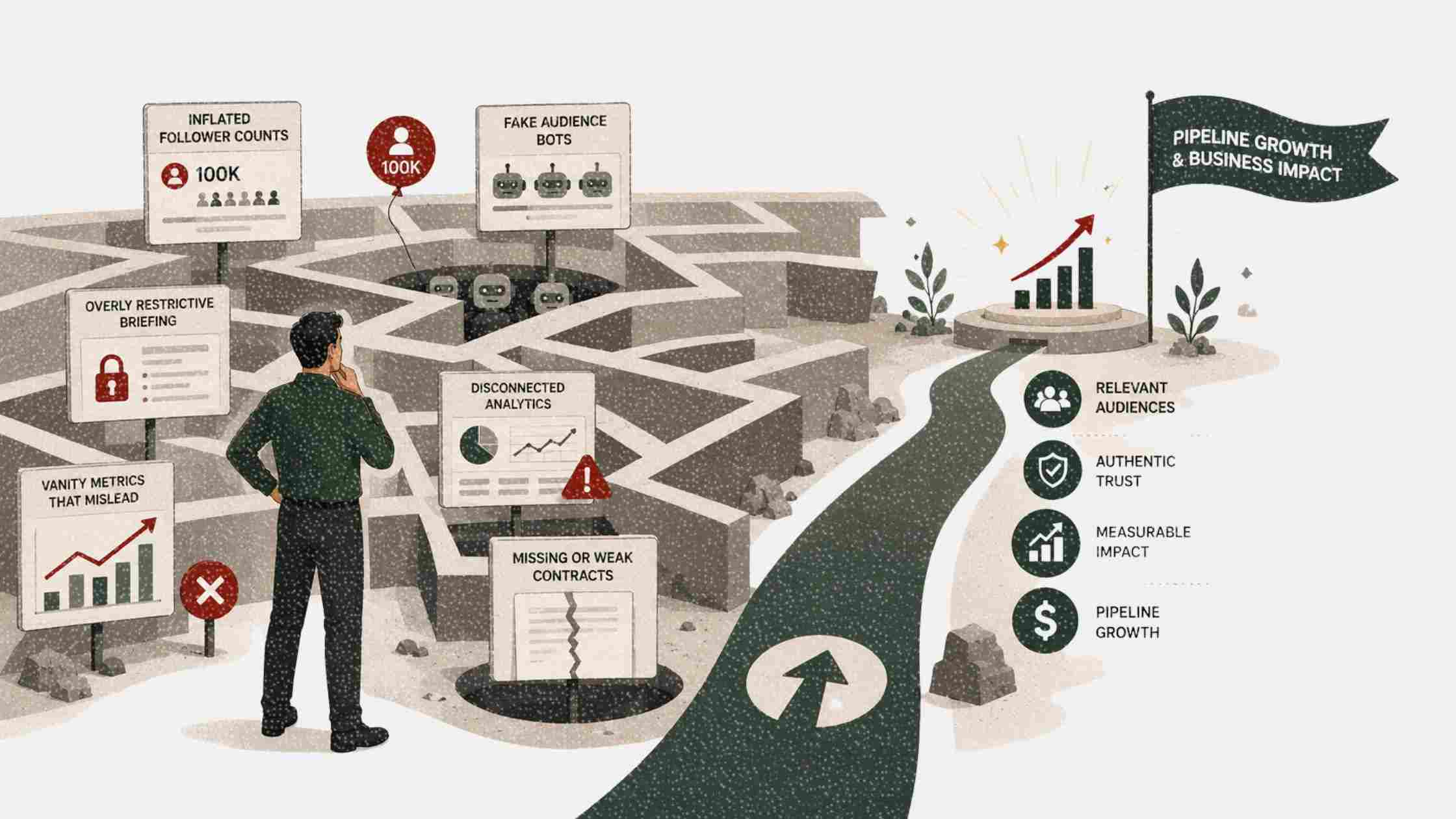
B2B budgets for influencer marketing keep climbing, and so does the list of campaigns that quietly underdeliver. The pattern is rarely a bad creator or a weak product. It is the same handful of operational mistakes, repeated across industries, that turn a promising program into a reporting headache. None of them are exotic. All of them are preventable.
This list pulls from the errors that show up most often once a B2B influencer program moves past its first campaign: vanity-metric thinking, contracts with gaps a lawyer would catch in five minutes, briefs that suffocate the creator’s voice, and measurement built for a 48-hour purchase decision instead of a 90-day sales cycle. Fix these and the channel starts behaving like the rest of your marketing stack. Ignore them and you will keep re-learning the same lessons every quarter.
Table of contents
Jump to each section:
- Chasing follower count instead of buyer relevance
- Skipping fraud and audience vetting before signing
- Treating the creator brief as a script
- Borrowing B2C attribution windows for B2B sales cycles
- Treating influencer marketing as a one-off campaign
- Defaulting to consumer platforms over LinkedIn
- Measuring vanity metrics instead of pipeline KPIs
- Skipping FTC compliance until something goes wrong
- No dedicated budget for briefs, reviews, or amplification
- Leaving usage rights and disclosure out of the contract
- Turning this list into a working checklist
Chasing follower count instead of buyer relevance
Follower count is the easiest number to see and the worst number to buy on. A creator with 200,000 followers in a general business niche tells you almost nothing about whether five of those followers sit on the buying committee you are trying to reach.
The risk compounds at exactly the tier most B2B brands gravitate toward for credibility. SociaVault Labs’ 2026 analysis of 100,000 Instagram and TikTok accounts found that creators in the 100,000 to 500,000 follower range carry the highest fraud rate of any tier, at 48.3 percent, nearly half of accounts in that range show signs of artificial inflation.
Paying a premium for reach that does not exist is bad enough in B2C. In B2B, where a single qualified lead can be worth more than an entire campaign budget, it is a direct hit to pipeline.
The fix: build creator shortlists around audience composition, not headline size. Job titles, company size, and industry overlap with your ICP matter more than total follower count, and a 12,000-follower operator whose audience is mostly procurement leads will outperform a 200,000-follower generalist every time.
Skipping fraud and audience vetting before signing
This mistake is a close cousin of the first, but it is procedural rather than strategic: brands know follower count is unreliable, then skip the vetting step anyway because of time pressure or a tight campaign window.
The same SociaVault study that flagged macro-tier fraud also classified 14.8 percent of all sampled accounts as likely fraudulent outright, with another 22.4 percent flagged as suspicious. That means roughly a third of the creators in a typical sourcing pool carry a real authenticity question mark before a single dollar changes hands. For B2B programs running on a handful of creator relationships rather than hundreds of micro-influencers, one bad sign-off does outsized damage to both budget and reporting integrity.
The fix: make vetting a gate, not an afterthought. A quick three-signal check (engagement rate against tier benchmarks, comment quality, and follower growth pattern) catches most red flags without requiring a full audit on every prospect, and it should happen before outreach, not after a proposal lands on your desk.
Treating the creator brief as a script
B2B marketers coming from a brand or agency background often over-correct on message control. The brief becomes a script: exact phrasing, mandatory talking points, pre-approved adjectives. The content that results reads like an ad because it is structured like one, and B2B audiences, who are professionally trained to spot a sales pitch, disengage immediately.
The instinct is understandable. Compliance, legal, and brand teams all want predictability. But a prescriptive brief that removes the creator’s voice produces content their audience recognizes as inauthentic on sight, which defeats the entire reason a brand pays for influencer access in the first place rather than running another paid ad.
The fix: brief on context, not copy. Give creators the data points, the customer problem, and the angle you want covered, then let them translate it into their own format and voice. Reserve hard requirements for things that actually need to be fixed, disclosure language, factual claims, and legal constraints, and leave everything else open.
Borrowing B2C attribution windows for B2B sales cycles
A consumer influencer campaign can be measured almost in real time: post goes live, promo code gets used, sale closes within 48 hours. A B2B SaaS deal does not work that way. A creator’s LinkedIn post might be the third touchpoint in a 90-day, six-stakeholder buying process, and a 30-day attribution window will simply miss it.
This is one of the most common reasons B2B teams report that influencer marketing “isn’t working” when the real problem is that they are measuring it with a B2C ruler.
The fix: set your attribution window to match your actual sales cycle length, not a default platform setting, and tag creator-influenced contacts in the CRM from day one so the data exists when someone finally asks for it.
Treating influencer marketing as a one-off campaign
Many B2B teams run influencer marketing the way they would run a single paid placement: pick a creator, brief a deliverable, post, measure, move on. That structure caps the channel’s actual value, which compounds through repeated exposure and accumulated trust rather than a single impression.
“B2B brands that treat influencer marketing as a single push, brief, post, done, are working against the channel’s whole logic,” says Dinda Anandita, Account Director at content-led comms agency Content Collision.
“The trust that moves a buying committee builds across many touchpoints with the same handful of voices over time. You cannot manufacture that compounding effect inside a single transaction, no matter how well the post performs.”
The fix: budget and structure programs as ongoing relationships with a small roster of creators rather than a rotating cast of one-off deals. Always-on programs also give creators time to understand your product deeply enough to talk about it credibly, which is the entire point of using a creator instead of a media buy.
Defaulting to consumer platforms over LinkedIn
Instagram and TikTok dominate the influencer marketing conversation because that is where consumer campaigns live, and B2B teams often default to the same platforms out of habit rather than strategy. The result is content optimized for a feed your actual buyers barely open during working hours.
This does not mean abandoning Instagram or TikTok where they genuinely fit, YouTube product walkthroughs and TikTok founder content both have real B2B use cases. But it does mean LinkedIn deserves first consideration for most B2B creator programs, since it is the one platform where the audience’s professional identity, job title, and industry are visible and verifiable before you ever sign a contract.
The fix: choose platforms based on where your buying committee already spends professional attention, not where your social team has existing workflows. For most B2B categories, that starts with LinkedIn and expands outward only when a specific audience or content format justifies it.
Measuring vanity metrics instead of pipeline KPIs
Reach, likes, and follower growth are easy to put on a slide and nearly impossible to defend in a budget conversation with a CFO. Yet they remain the default reporting metric for a large share of B2B influencer programs, mostly because they are the metrics platforms surface by default.
The deeper problem is that vanity metrics actively obscure whether the program is working. A campaign can generate strong impressions and zero pipeline influence, or modest reach with outsized conversion among exactly the accounts that matter, and a reach-only report cannot tell the difference.
We cover the operations, performance, and authority-tier metrics that replace vanity reporting in detail elsewhere in this guide, but the principle holds regardless of which specific KPIs you choose: every metric on the report should connect, even loosely, to a business outcome someone in the room actually cares about.
The fix: replace the default platform dashboard with a short list of metrics tied to pipeline, conversion quality, or brand search lift, and stop reporting numbers that cannot answer the question “so what happened to revenue.”
Skipping FTC compliance until something goes wrong
B2B marketers sometimes assume disclosure rules are a consumer-marketing problem, the territory of beauty hauls and discount codes, not LinkedIn thought leadership. The FTC does not draw that distinction. Any post connected to a payment, free product, or other material relationship requires clear disclosure, regardless of platform or audience sophistication, and the FTC’s own endorsement guidance makes that standard explicit.
Brands carry liability alongside creators here. A sponsored LinkedIn carousel without a visible disclosure is exposed the same way a sponsored Instagram Reel is, and “the creator forgot” is not a defense the FTC accepts from the brand that paid for the post.
The fix: put disclosure requirements in writing in both the brief and the contract, specify exact language rather than leaving interpretation to the creator, and check for it during content approval rather than assuming it happened.
No dedicated budget for briefs, reviews, or amplification
Most B2B influencer budgets get built around a single line item: the creator fee. What gets left out is everything around it, the time spent developing a proper brief, the review cycles with legal or compliance, and any paid amplification once the organic content goes live.
That gap shows up later as either a rushed brief that produces weak content, or a missed opportunity to extend a strong post’s reach through paid distribution because nobody allocated for it. Neither failure is the creator’s fault, and both are preventable with better budget planning upfront.
The fix: build brief development time, review cycles, and an amplification reserve into the program budget from the start, not as an afterthought once the creator fee is already spent. A program that treats these as core costs, not nice-to-haves, produces measurably stronger content with the same total spend.
Leaving usage rights and disclosure out of the contract
A handshake agreement and a verbal “sure, you can repost that” is not a usage rights clause. Without a written term covering how long a brand can use creator content, on which channels, and in which formats, brands either overuse content they never licensed or lose access to strong assets the moment informal goodwill runs out.
This gap shows up most painfully when a B2B team wants to repurpose a creator’s LinkedIn carousel into a paid Thought Leader Ad months after the original post, only to discover the contract never granted that right.
The fix: treat the contract as part of the campaign deliverable, not paperwork to rush through after creative is approved. A defined usage window, explicit channel rights, and disclosure obligations cost nothing to add upfront and save real money and legal exposure later.
Turning this list into a working checklist
None of these mistakes require a bigger budget to fix. They require treating influencer marketing with the same operational discipline B2B teams already apply to paid media and email: clear briefs, real contracts, attribution that matches the sales cycle, and reporting tied to pipeline rather than reach.
The brands getting this right in 2026 are not necessarily the ones spending the most. They are the ones who fixed the basics on this list before scaling the program, which is a far cheaper lesson to learn now than after a budget review where nobody can explain what the influencer line item actually returned.