A journalist is on deadline. They have seen your announcement, found it interesting, and now they need your logo, a founder bio they can cite, and a high-resolution product image. If those assets are nowhere on your site, they move on to the next pitch. Your story does not get told, not because it was weak, but because you made their research harder than it needed to be.
A press kit is the self-serve resource that solves this. It lives on your website, permanently accessible, so any journalist who wants to write about your company can find everything they need without sending you an email. You still send a brief, focused pitch and a press release to initiate coverage. But once a journalist decides your story is worth pursuing, they research independently. The press kit is what they find, or fail to find, during that phase.
This guide covers what a press kit is, what to include, real-world examples organized by hosting approach, how to build yours, and the mistakes that quietly kill coverage opportunities.
Table of contents
Jump to each section:
- What is a press kit?
- Press kit vs media kit: what is the difference?
- What to include in a press kit
- Press kit examples by hosting approach
- How to build and host your press kit
- Press kit mistakes that make journalists move on
What is a press kit?
A press kit is a centralized collection of materials that gives journalists, editors, and media professionals everything they need to cover your company accurately. Think of it as a standing reference resource: always online, always current, always available without anyone on your team having to respond first.
It is not what you send to journalists. The standard outreach workflow is a brief, personalized email with a press release attached or linked. The press kit is what journalists turn to on their own once they decide a story is worth pursuing. According to the Muck Rack State of Journalism 2026, 86% of journalists say at least some of their work began with a PR pitch. The pitch opens the door. The press kit handles everything journalists need after they walk through it.
A press kit is also different in scope from a press release. A press release announces a single development. A press kit is the asset layer behind all your announcements, updated continually as your company grows. ContentGrip’s press release examples guide covers how to structure each announcement; this guide covers the resources that support every announcement you ever make.
Press kit vs media kit: what is the difference?
The terms are used interchangeably today, and for most practical purposes they mean the same thing. But the original distinction is worth understanding.
A press kit was historically tied to a specific announcement: a physical or PDF package containing the 5 Ws (who, what, when, where, why) and enough supporting material to help a journalist write one story.
A media kit was a broader, ongoing brand resource, covering company history, leadership bios, multiple visual asset sets, and richer multimedia. It was less tied to a single event and more of a permanent brand profile.
In practice, that line has collapsed. Most brands maintain one online press or media page that handles both functions. A journalist writing about your funding round, your product launch, or your CEO should be able to find everything they need in the same place.
For startups and marketing teams, the most practical approach is to build one page, keep it current, and link to it consistently.
What to include in a press kit
The exact contents depend on your stage and what journalists are most likely to need. That said, most effective press kits cover these elements.
- Company overview. A short, plain-language description of what your company does, who it serves, and what makes it different. Three to four sentences is enough. Avoid superlatives. Journalists will quote this directly, so accuracy and neutral tone matter more than marketing polish.
- Founder and leadership bios. Brief profiles covering role, background, and one or two specific credentials. Include professional headshots. For founders, link to past press coverage, conference appearances, or published work journalists can cite independently.
- Logos. Multiple versions: horizontal and vertical layouts, full color, monochrome, and white on dark background. PNG with a transparent background is the standard format journalists and editors need for publication. SVG is useful for design teams who need to resize for print or web; include it if you can, but PNG is the priority.
- Product or service visuals. High-resolution images of your product, platform screenshots, or service in use. Avoid stock images. Name files clearly (company-product-v1.png). Journalists and editors need images they can publish without licensing questions.
- Company fact sheet. Key numbers in one place: founding date, employee count, funding to date, markets served, customer count or growth rate. Keep these dateable and accurate. A fact sheet with two-year-old figures creates factual risk for the journalist and a credibility problem for your brand.
- Recent press releases. Link to or embed your last two or three major announcements. These give journalists a factual trail and context for your current news.
- Boilerplate. Your standing company summary, roughly 75 to 100 words. ContentGrip’s boilerplate guide explains how to write one that also serves AI search contexts, since generative tools including ChatGPT and Perplexity now use boilerplates as primary source material when summarizing companies in response to queries.
- Prior coverage. A list or logo set of outlets that have covered you. This helps journalists position your company within a media context they already recognize.
- Media contact. A direct email address with a real name. Not a generic contact form. Journalists on deadline do not fill out forms.
Tommy Prayoga, Head of Agency at digital PR service provider Content Collision, puts the journalist-first standard clearly: “A press kit is not about looking polished. It is about making the journalist’s job effortless. At Content Collision, our benchmark for any client press kit is this: if a reporter can write an accurate story from what is in the kit without emailing anyone on the team, we have done our job.”
Press kit examples by hosting approach
Press kit examples: three approaches
There is no single right format. The best press kit is the one journalists can find and use without friction. What is useful to look at is not just where companies host their kits, but how they have organized them and what they are optimized for.
1. Airbnb: story first, assets second
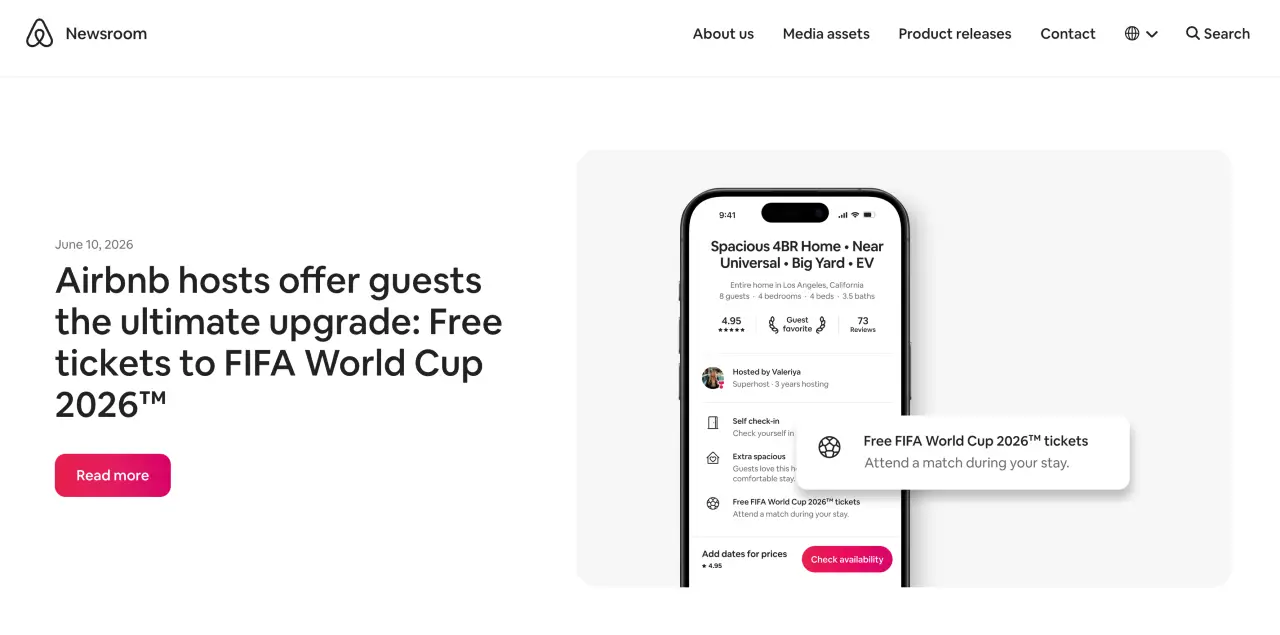
Airbnb’s newsroom is organized around narrative. The “About us” page leads with a company overview, then a “Fast facts” block of quantified metrics (5.5 million hosts, 2.5 billion guest arrivals, $380 billion earned by hosts), then clickable founder profiles, then a year-by-year company timeline.
Assets live on a separate “Media assets” page. The newsroom is available in over 20 language editions. The underlying logic is that a journalist needs to understand the company before they look for a logo or a quote, so the story comes first and assets come after.
2. Spotify: organized by campaign angle, not company overview
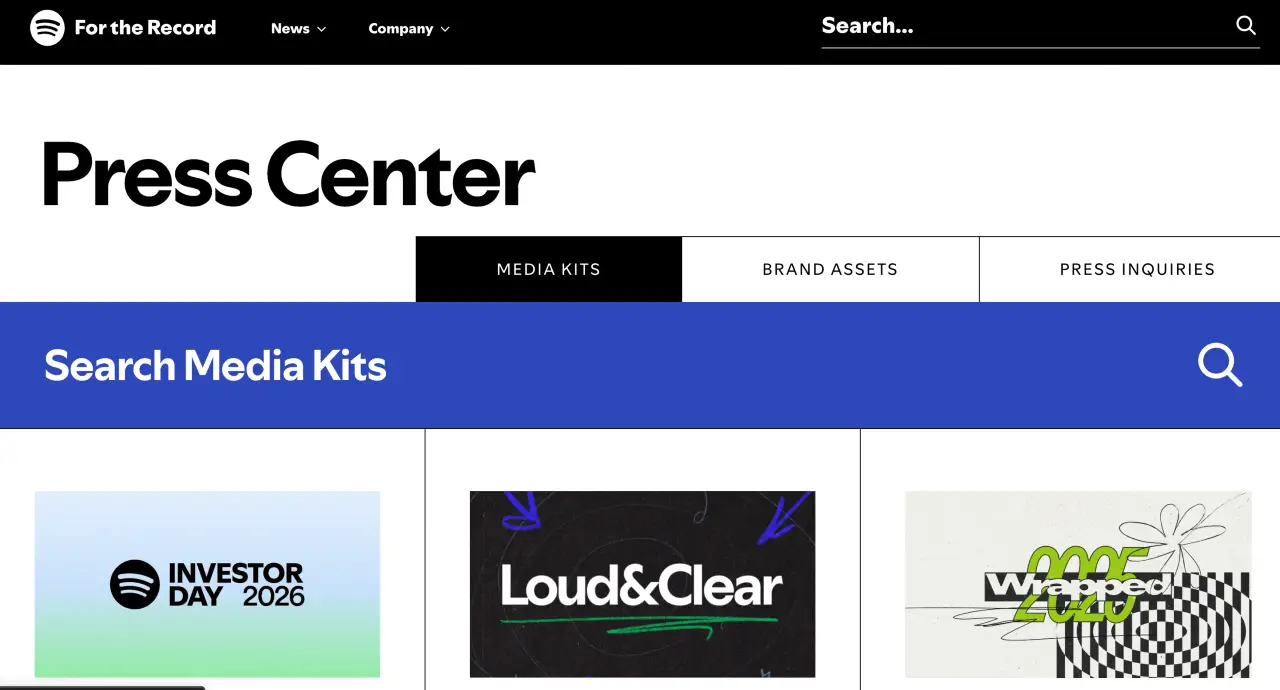
Spotify’s press center does not lead with a generic company description. It opens with topic-specific media kit packages, each built for a particular story angle a journalist might be covering: Loud and Clear 2026 (23 files), 2025 Wrapped (149 files), Afrobeats (11 files), each available as a downloadable zip.
Brand assets (logos, product imagery) sit in a separate section. Spotify’s approach assumes journalists arrive with a story in mind, so it organizes assets around the stories they are most likely to tell, rather than asking them to dig through a generic company kit.
3. Slack: brand governance as the organizing principle
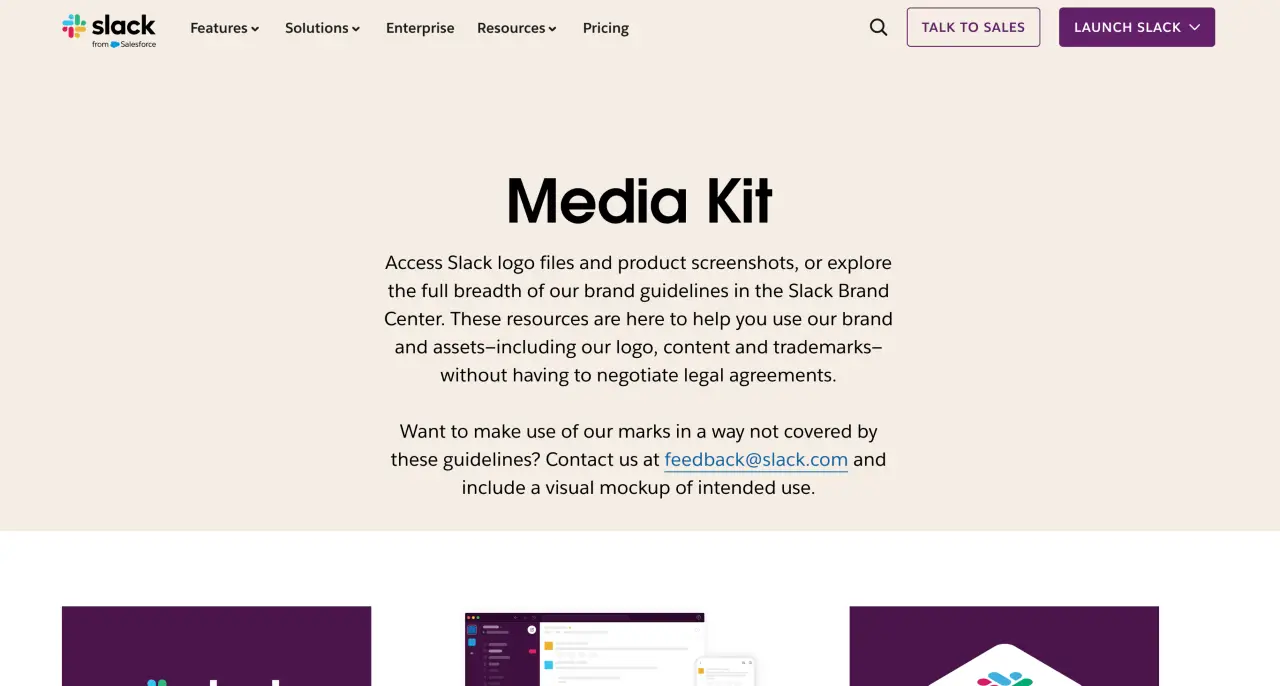
Slack’s media kit is built primarily around correct usage of their brand, not the company’s story. It provides logo files with explicit usage guidelines, product screenshots available in multiple languages and device formats, and a Brand Center covering typography, color, illustration, and writing standards.
There is a contact address for any usage not covered by the guidelines. This approach is useful for a product brand that appears constantly in third-party content: partners, publishers, and journalists writing about productivity tools all need to know how to render the Slack name and logo correctly.
The right structure depends on what journalists are most likely to need when they come to your page. Most startups should start with Airbnb’s logic: tell the story clearly first, then surface the assets. As you run more distinct campaigns or product launches, Spotify’s campaign-angle approach becomes more useful. If brand consistency is a major risk because your name or logo appears in many external contexts, Slack’s governance model is worth borrowing from.
How to build and host your press kit
Regardless of organizational approach, the baseline is the same: a dedicated page on your website, typically at yoursite.com/press or yoursite.com/newsroom. A website page is indexable by search engines, always accessible without login, and easy to update when facts change. Link to it from your footer, your about page, and your contact page so journalists can reach it in two clicks from anywhere on your site.
Once the page exists, the single most effective thing you can do is reference it in every pitch email you send. One sentence at the bottom of your outreach, such as “Full press assets are at [URL],” removes the most common follow-up question journalists have.
The harder discipline is keeping the kit current. A press page with last year’s logo or a headcount figure from two funding rounds ago signals to a journalist that no one on your team is paying attention to it. Set a quarterly reminder to review every number, every headshot, and every downloadable file.
Press kit mistakes that make journalists move on
- Gating assets. If a journalist has to fill out a form to download a logo or product image, most will not. Assets should be immediately downloadable with no registration required.
- Only one logo format. Providing a single white-background JPEG forces journalists and editors to work around your brand guidelines. Supply multiple file types, multiple layouts, multiple backgrounds.
- Stale data. A fact sheet showing headcount or funding figures from two years ago creates factual risk for the journalist and a credibility problem for your brand. Set a quarterly reminder to review and update every number.
- No real name on media contact. A generic press@company.com inbox with no name attached slows response time. Journalists prefer a real name, even if a shared inbox handles the actual responses.
- Marketing language in the company overview. Phrases like “industry-leading” and “world-class” give journalists nothing usable. Neutral, factual language gets quoted. Marketing copy gets paraphrased into something shorter and less precise.
- Burying the press kit. If a journalist cannot reach your press kit from your homepage in two clicks, you have lost some of them. Link to it from your footer, your about page, and your contact page.
A press kit is one of the lowest-effort, highest-return investments a startup or marketing team can make in its media program. Build it once, keep it current, and it reduces friction for every journalist who looks you up, for every announcement you make from here forward.