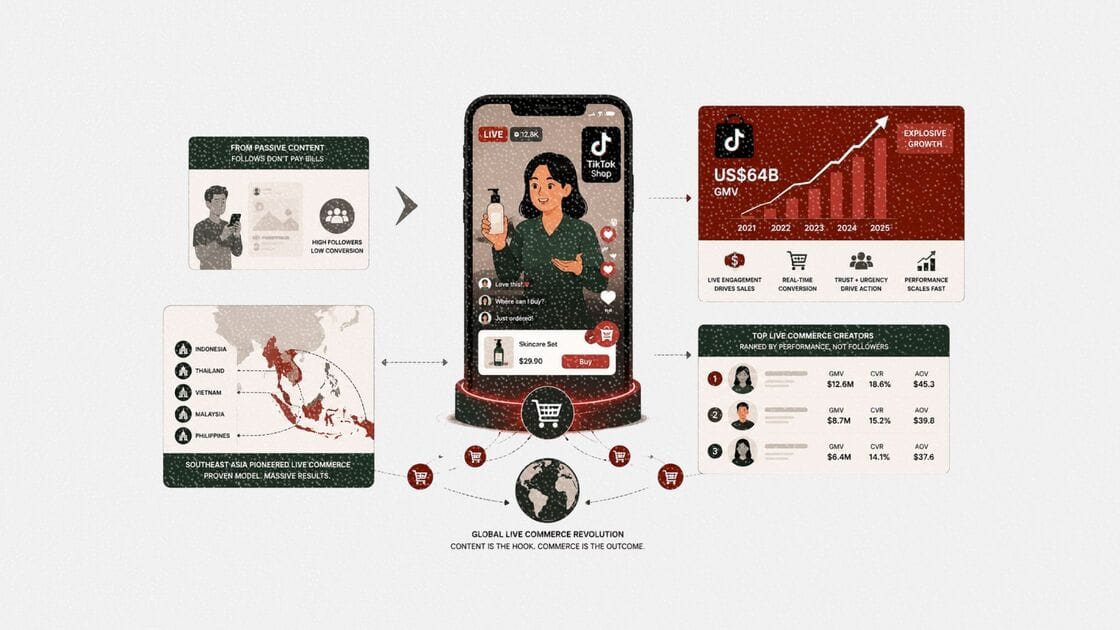
Momentum Works released its annual TikTok Shop report in February 2026. The 2025 numbers confirm the platform is scaling faster than most marketers expected, and the creator mechanics driving that growth are shifting in ways that have direct implications for how influencer programs are structured. The headline GMV matters less than what sits underneath it.
Table of contents
Jump to each section:
- What the Momentum Works 2025 data shows
- Why Southeast Asia still runs the platform
- The live commerce shift and what it means for creator strategy
- What marketers should do differently now
What the Momentum Works 2025 data shows
According to Momentum Works, TikTok Shop’s global GMV reached US$64.3 billion in 2025, a 94% year-on-year increase across 16 markets. The US market contributed US$15.1 billion, representing 68% YoY growth. Southeast Asia more than doubled to US$45.6 billion.
The US channel mix tells a sharper story. Short-form video remains the dominant GMV driver at 50% of US sales, but live commerce is growing: its share of US GMV climbed from 10% in 2024 to 14% in 2025. The Shop tab now accounts for 36%.
Creator performance data shows the most significant structural shift. The number of US influencers generating over US$1 million in GMV more than tripled to 1,785 in 2025, up from 529 the year prior. At the same time, more than half of all US stores recorded zero sales. TikTok Shop is growing at scale while value concentrates at the top.
Why Southeast Asia still runs the platform
Southeast Asia accounts for 71% of TikTok Shop’s total global GMV. Indonesia alone reached US$13.1 billion in 2025, making it TikTok Shop’s second-largest market globally. Every major SEA market posted strong growth, with Malaysia, Indonesia, and Thailand recording the fastest rates.
The region’s dominance reflects structural advantages: a deeply embedded live-streaming culture, a creator ecosystem that has been optimizing for commerce conversion for years, and consumer comfort with social commerce that Western markets are still building. For brands with APAC operations, TikTok Shop in Southeast Asia is the platform’s commercial center of gravity, and the creator strategies that win there, built around Key Opinion Sellers rather than traditional KOLs, are the model the US market is now following.
The live commerce shift and what it means for creator strategy
The most consequential finding is creator-level: nine of the top ten US TikTok Shop influencers by GMV in 2025 relied primarily on live commerce, not short-form video. That pattern has been standard in Southeast Asia for years. The US is now following the same structural path.
For brand influencer programs, the implications are concrete. A creator with 200,000 followers who runs active live sessions will drive more TikTok Shop GMV than a creator with twice the following who posts only short-form content. The platform rewards conversion behavior and session engagement, not passive reach.
This changes how creator rosters should be evaluated. Completion rate, average live viewership, and session GMV history matter more than follower count when selecting TikTok Shop partners. Brands still using follower-based shortlisting for commerce campaigns are optimizing for the wrong signal.
Dinda Anandita, Account Director at Content Collision, frames the shift this way: “The 2025 data makes the argument for us. Brands that are still running TikTok creator programs on short-form-only rosters are not playing the same game as the brands generating real GMV. Live commerce is no longer a Southeast Asia quirk. It is the performance tier on a global platform, and influencer briefs need to reflect that.”
What marketers should do differently now
Three adjustments follow directly from the 2025 numbers.
First, audit your creator roster for live capability. If every TikTok partner you work with is a short-form video creator with no active live presence, you are not positioned to capture the commerce growth the data shows. The next creator brief should include live performance requirements alongside standard content deliverables.
Second, plan for creator concentration. Over half of all TikTok Shop stores recorded zero sales in 2025. That is not a platform failure. It reflects that consistent volume, genuine community engagement, and optimized conversion mechanics are prerequisites for meaningful performance. Fewer partners with stronger commerce credentials will outperform a long tail of passive collaborations.
Third, if you are entering Southeast Asia, take the regional creator ecosystem seriously. The Indonesia and Thailand numbers confirm that brands without localized, commerce-native creator strategies are not competing on equal footing with operators who have been building TikTok Shop presence since 2022.
The creator strategy required to perform on TikTok Shop is converging globally around the mechanics Southeast Asia established first: live commerce capability, conversion-oriented creator selection, and rosters built for consistent output rather than one-off campaign spikes.