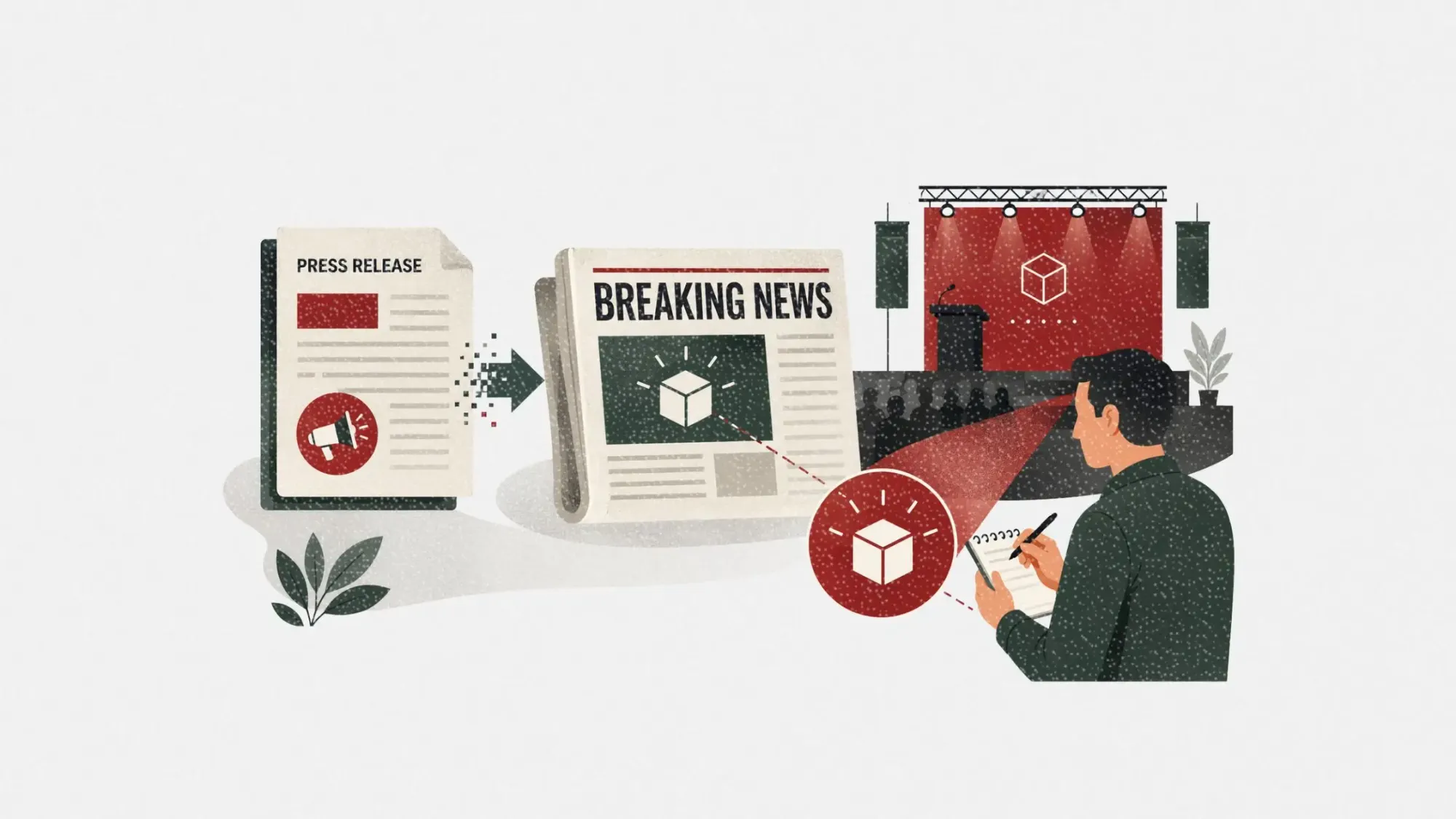
Most people searching for an “event press release template” are thinking about the wrong thing. They want a template for announcing an upcoming conference, summit, or launch event to journalists, something that says “join us at our event on [date] at [venue].” Journalists receive hundreds of these. Almost none result in coverage.
The reason is structural, not executional. An event by itself is rarely news. The announcement made at the event is.
This guide covers how B2B PR professionals actually approach events: a pre-event media invite that gets the right journalists in the room, and a press release tied to the announcement, research, or product revealed at the event. Both are templates you can copy. Both are grounded in how real B2B companies have used events to drive coverage.
Table of contents
Jump to each section:
- Why most event press releases miss the point
- The media invite: getting journalists to the event
- Media invite template
- The announcement press release: what actually earns coverage
- Event announcement press release template
- Real B2B examples
- Event PR mistakes to avoid
Why most event press releases miss the point
A press release works when it gives journalists a story to write. A date, a venue, and a headline speaker are logistics, not a story.
For 99% of B2B events, media outlets will not write about the event itself unless they are a paid or editorial event partner. Covering someone else’s conference is not editorial value; it is free advertising. Journalists and editors know the difference, and their readers do too.
What journalists will cover is the news that came out of the event: a product launch, a piece of original research, a significant partnership or acquisition announced on stage, a regulatory position taken by a major player in the room. The event is the context for that announcement, not the announcement itself.
This distinction changes everything about how PR professionals structure their event communications. It produces two distinct tools, used at two distinct moments.
The first is a media invite, sent before the event to journalists whose beat aligns with what will be announced. It is a short, personal note that gives a journalist enough to decide whether the event is worth their time. It is not a press release.
The second is an announcement press release, issued on the day of or after the event, about the specific news being revealed. The event is mentioned in the dateline or context sentence. The announcement is the headline.
Tommy Prayoga, Head of Agency at digital PR service provider Content Collision: “We rarely pitch events to journalists as a story. What we pitch is the news happening at the event, and the event becomes the news hook. That reframe changes everything: suddenly you are not asking a journalist to write about your conference, you are giving them a product story or a data story with a live moment attached to it.”
The media invite: getting journalists to the event
A media invite is not a press release. It is a short, personalized note sent to a targeted list of journalists two to four weeks before an event, giving them enough information to decide whether to attend, request a briefing, or set aside time to cover the announcement you are planning.
Media invites are appropriate when:
- Your event will include a genuinely newsworthy announcement that a journalist covering your industry would care about
- You are a named event partner or sponsor and media coverage is part of the arrangement
- You are a flagship company hosting a major industry event (a Dreamforce, an INBOUND, a company-organized analyst day)
- You can offer journalists something exclusive: a pre-briefing with your CEO, early access to a report, or a one-on-one demo before the announcement goes public
For small or mid-size companies hosting their own events, invites work best when there is a genuine reason for a journalist to attend. A networking dinner is not that reason. A product demo or research release is.
The media invite itself should be short: four to six sentences in the body of an email, with logistics attached or linked. It is not formatted like a press release. It reads like a journalist-to-journalist note: direct, specific, and clear about what is in it for the reporter.
Media invite template
Subject: [Event name] on [date]: [one-line description of the announcement being made]
Hi [name],
We are hosting [event name] on [date] in [city/format] and I think [specific announcement] might be worth your time.
[One sentence on what the announcement is and why it matters for their audience.]
[One sentence on what access you can offer: an interview with [executive], early access to [research], or a live demo of [product].]
If this sounds relevant to your coverage, I can send over more detail, arrange a pre-briefing, or put you on the press list for [event name].
[Name] [Title] [Direct contact]
What makes this invite structure work: the subject line and opening sentence make the announcement clear enough that a journalist can immediately judge whether it fits their beat. The offer of access is specific rather than a general invitation. It does not attach a press release until the journalist expresses interest.
Before sending, confirm the journalist actually covers this topic. An invite about a retail AI product going to a fintech reporter wastes both parties’ time and damages the relationship.
The announcement press release: what actually earns coverage
The announcement press release goes out on the day of the event, timed to when the news becomes public, or immediately after if distribution is embargoed until a keynote ends.
The structure follows a standard news release format with one difference: the event is referenced as context, not as the headline. The product, research, or announcement is the headline. The event is where it happened.
According to Cision’s 2025 State of the Media Report, which surveyed more than 3,000 journalists across 19 markets, 72% of reporters rank press releases as the most useful content PR teams can provide. The same report found that 86% will immediately reject a pitch that does not match their beat or audience. The release only works if it is built around genuinely reportable news.
Event announcement press release template
FOR IMMEDIATE RELEASE (or state embargo: embargoed until [time] on [date])
Media contact: [Name] [Title] [Email] [Phone]
[Headline: state the announcement, not the event. Treat the event as context only.]
[Subheadline: one sentence adding the most important supporting detail: a number, a partner name, the specific audience served, or a timing hook.]
[City, Date]. [Company name], [brief descriptor], today announced [announcement] at [event name]. [State in one sentence what this means for the people it affects.]
[Second paragraph: why this announcement matters and why it matters now. Connect it to an industry problem, a data point, or a market shift the journalist’s audience already cares about. This is where the story lives.]
[Third paragraph: supporting detail. Key features, partner names, customer proof points, or research findings. Use bullet points if the list is genuinely useful to a journalist rather than a product sheet.]
[Quote: one quote from a named executive or expert. The quote should add perspective or editorial judgment, not restate the facts already in the release. Avoid “We are thrilled to announce” entirely.]
[Closing paragraph: product availability, pricing if relevant, how to get more information, and whether demos or interviews are available at the event.]
About [company]: [75 to 100 words. State what the company does, who it serves, a specific proof point such as customer count, market served, or founding date. Avoid adjectives that carry no information.]
Real B2B examples
1. HubSpot Breeze at INBOUND 2024
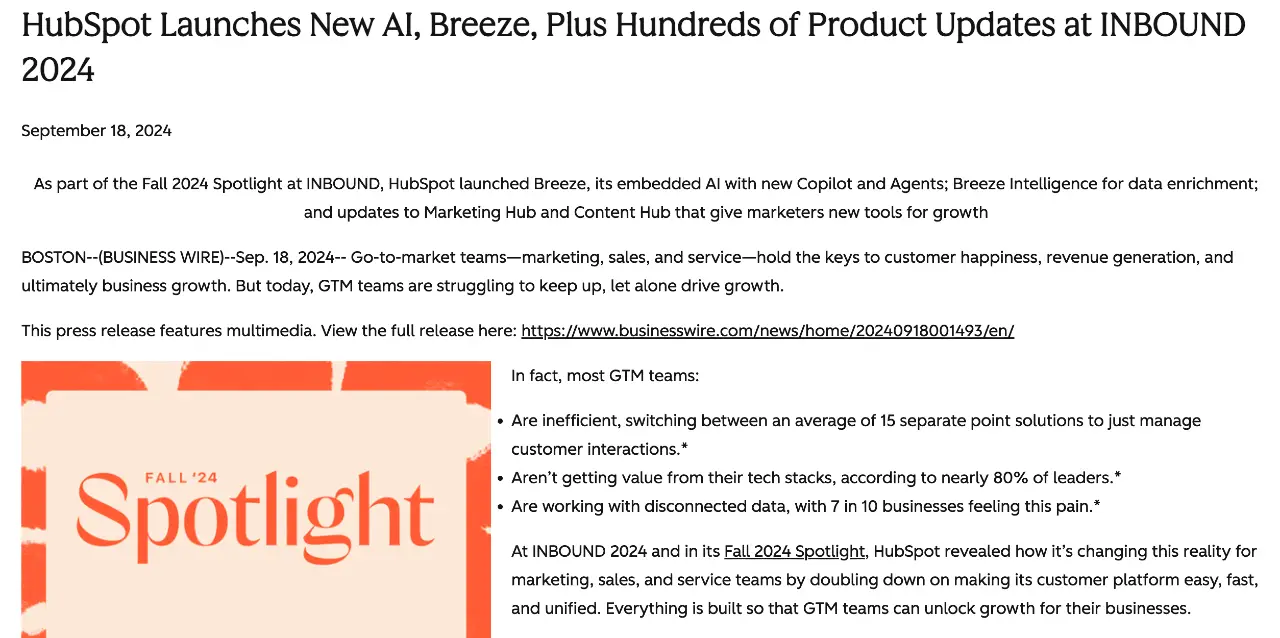
On September 18, 2024, HubSpot issued a press release timed to its annual INBOUND conference in Boston. The headline was “HubSpot Launches New AI, Breeze, Plus Hundreds of Product Updates at INBOUND 2024.”
The release did not write about the conference. It announced Breeze, HubSpot’s new embedded AI platform covering copilot, agents, and data enrichment, alongside over 200 product updates. INBOUND appeared in the headline as the launch context, but every paragraph addressed the product: what it did, who it was for, and how it changed the way GTM teams work. The conference gave the announcement a live moment and a news hook. The product gave journalists a story.
The release was covered by CX Today, trade publications covering CRM and marketing technology, and republished broadly as a product announcement.
2. Diebold Nixdorf at NRF 2024
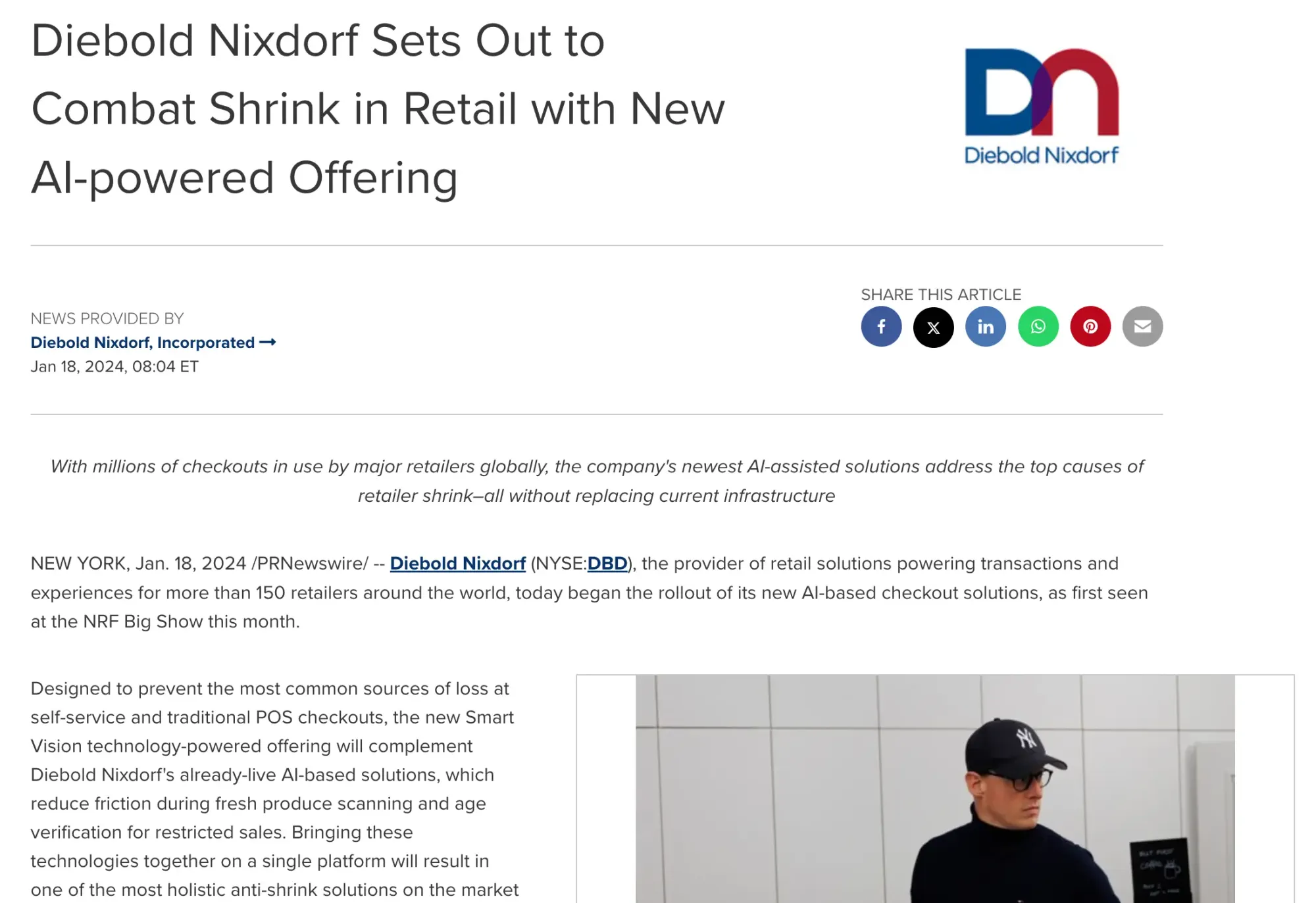
On January 18, 2024, Diebold Nixdorf issued a release titled “Diebold Nixdorf Sets Out to Combat Shrink in Retail with New AI-powered Offering.” The release opened: “…today began the rollout of its new AI-based checkout solutions, as first seen at the NRF Big Show this month.”
The event is a subordinate clause. The news is the AI checkout solution: what it detects, how it deploys, and what problem it solves for retailers facing an average shrink rate of 1.6% of total sales. The release was picked up by Retail Insight Network and Retail Week, both trade publications covering the beat. Neither would have covered “Diebold Nixdorf attends NRF 2024.”
The contrast between the two approaches is useful. Diebold Nixdorf also issued a pre-event release in December 2024 ahead of NRF 2025 titled “Diebold Nixdorf Brings Full-Store AI Capabilities to NRF Retail’s Big Show.” That pre-event release functions as the media invite equivalent in press release form: it signals what journalists should expect to see and gives trade media a reason to set up a booth visit or briefing.
The pattern across both examples is the same: the event gives the announcement a timing hook. The announcement is still the news.
Event PR mistakes to avoid
Sending a release about the event, not the announcement. If your headline says “[Company] to present at [Conference]” without stating what it is presenting and why that matters, the release has no news hook. Journalists will not follow up to find out what your presentation contains.
Treating the media invite as a press release. An invite sent in press release format, with full distribution via a newswire, signals to journalists that you do not understand the difference. A targeted, personal invite to six relevant journalists is more effective than a wire distribution to six thousand media contacts who are not covering your beat.
Waiting too long to issue the announcement release. If the press release goes out 48 hours after the event ends, the moment has passed. Time the release to the announcement going public, whether that is the start of a keynote, the opening of a session, or a pre-arranged embargo lift.
Writing a quote that summarizes the announcement instead of adding perspective. A quote that says “We are proud to launch our new product at this year’s event” gives a journalist nothing they can use. A quote that says something specific about the problem being solved, the customer insight that drove the decision, or the market shift the announcement responds to earns inclusion in a story.
Skipping the media invite entirely. Companies that announce genuinely significant news at conferences but do not invite relevant journalists in advance lose the earned media value of the live moment. A journalist who hears about your Dreamforce announcement through a wire alert on day three will not write a story. One who had a pre-briefing with your CPO the day before might.
The core principle underlying all of this: journalists cover news, not events. Give them a real announcement, give them a reason it matters to their readers, and reference the event as context rather than the story itself.