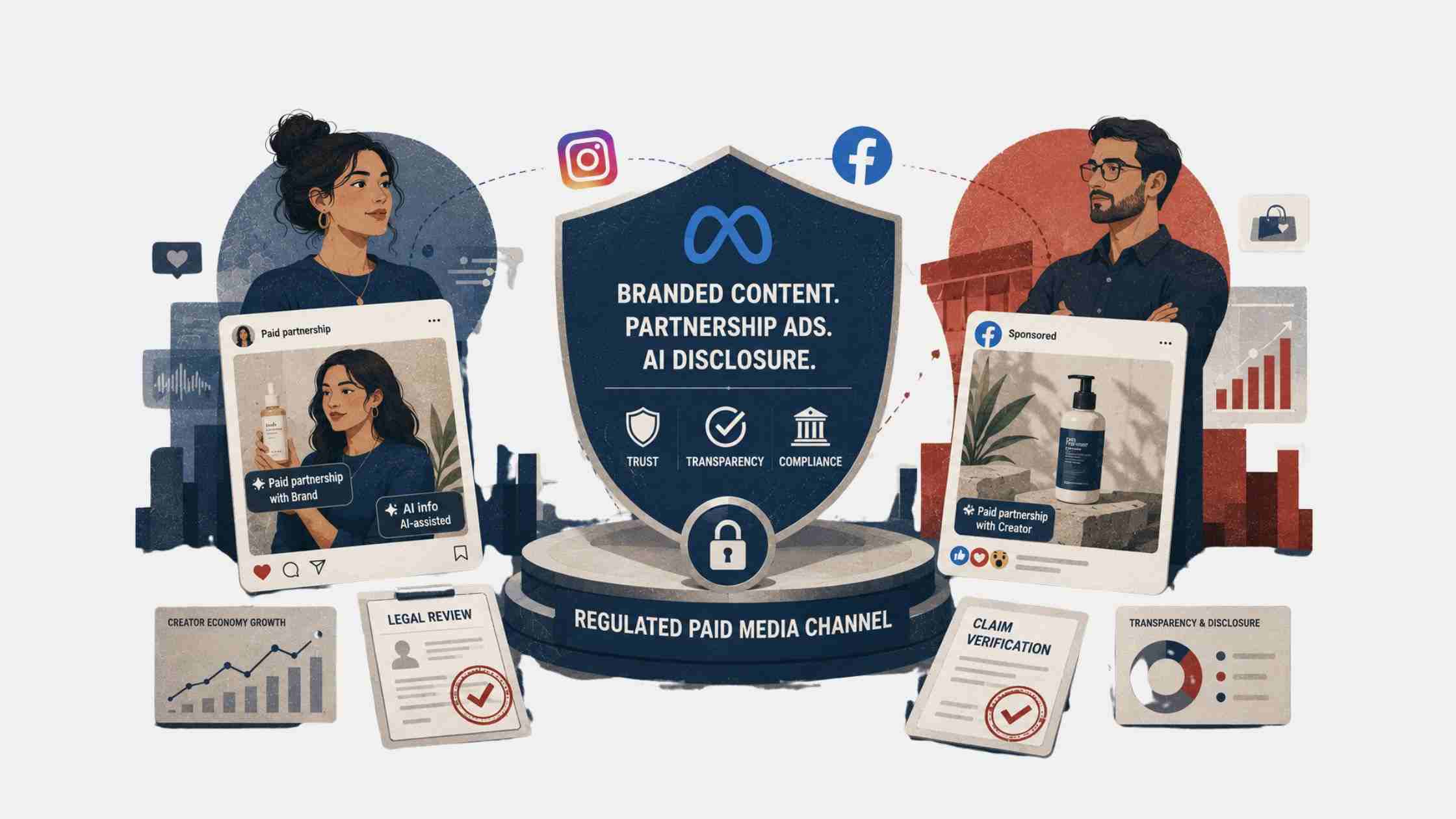
Meta has rolled out a series of updates to its branded content and disclosure framework, with the most compliance-critical change taking effect in 2026: all influencer and creator content promoting a brand on Facebook and Instagram must now use Meta’s Partnership Ads format, or face rejection and an account health penalty.
Combined with new AI disclosure requirements for commercial ads and an expanded Partnership Ads Hub, the changes amount to the most significant overhaul of Meta’s creator-brand content framework since Partnership Ads were introduced.
Table of contents
Jump to each section:
- What just changed with Meta’s branded content rules
- Partnership Ads are now mandatory for all influencer content
- AI disclosure requirements now extend to commercial ads
- What the FTC layer still requires on top of Meta’s own labels
- What marketers should update now
What just changed with Meta’s branded content rules
Two distinct updates have compounded on each other.
On December 11, 2025, Meta significantly expanded the Partnership Ads Hub inside Ads Manager. The hub now surfaces UGC, affiliate content, and organic creator posts that tag or mention your brand in a single feed, with organic performance metrics visible directly inside the hub. A new Facebook Partnership Ads API also launched, allowing agencies and brands to discover and activate creator content programmatically.
According to Marketing Dive, Meta reported that partnership ads deliver 19% lower CPAs and 13% higher click-through rates versus standard brand ads on average, with 71% of consumers making a purchase within days of seeing creator content on Meta.
Then, as part of a broader policy overhaul across March, April, and May 2026, Meta formalized the requirement that all branded creator content used in paid campaigns must run through the Partnership Ads format.
Partnership Ads are now mandatory for all influencer content
The clearest compliance risk in the 2026 update is the mandatory Partnership Ads requirement. According to AuditSocials’ May 2026 policy analysis, Meta now requires that all influencer and creator content promoting a brand, whether through a paid partnership, gifted product, affiliate commission, or any other compensation arrangement, must use the Partnership Ads format.
Running UGC-style ads that simulate organic creator content without the Partnership Ads designation is now classified as a “Deceptive Practice” violation, carrying immediate ad rejection and an account health penalty.
The update also introduced creator claim liability: when a creator makes a product claim in a Partnership Ad, the brand is equally liable under Meta’s misleading claims policy. A creator saying a product achieved a specific result, boosted by the brand, puts the brand’s ad account at risk. Brands must add a claim review step to content approval, not just a tone-and-brand-fit check.
Dinda Anandita, Account Director at content-led comms agency Content Collision, flags this as the change B2B teams are least prepared for: “Most B2B teams review creator content for tone and brand fit. Very few review it the way a legal team would review an ad claim. The mandatory Partnership Ads framework now makes that gap a compliance liability.”
AI disclosure requirements now extend to commercial ads
Meta’s March 2026 policy overhaul extended mandatory AI disclosure requirements to commercial ads. Previously, the obligation to disclose AI-generated or digitally altered content was largely limited to political and social-issue advertising.
For ads created using Meta’s own AI tools, disclosure labels are applied automatically. For ads built with third-party AI creative tools, manual disclosure is required at the campaign setup stage. According to AuditSocials, “undisclosed AI content” now accounts for 14% of all ad rejections on Meta, making it the third-largest rejection category.
For influencer marketing teams, this creates a specific workflow gap. Creator content increasingly includes AI-assisted visuals or AI-generated voiceovers. If that content is boosted as a Partnership Ad, the AI disclosure obligation sits with the brand’s ad account.
What the FTC layer still requires on top of Meta’s own labels
Meta’s Paid Partnership label, automatically applied to partnership ads, satisfies Meta’s own platform-level disclosure requirement. It does not satisfy FTC requirements on its own.
For Reels used in partnership ads, the FTC still requires a verbal disclosure within the first three seconds of audio and an on-screen text overlay visible at the start of the video. For feed posts, caption disclosure must appear in the first line, before Instagram’s “more” truncation point on mobile. The FTC has confirmed that the platform label alone is insufficient for video content.
This matters for brands using the Partnership Ads Hub to boost existing organic creator posts. Content that passed Meta’s organic review can still carry FTC risk if the creator did not build in-content disclosures at the time of posting.
What marketers should update now
Here is the practical compliance checklist.
Audit all active influencer campaigns for Partnership Ads compliance. Any creator-partnered content running in paid formats without the Partnership Ads designation needs to be migrated or paused.
Add a claim review checkpoint before boosting any creator content. The creator claim liability rule makes this a compliance step. Update creator briefs to require disclosure of any AI tools used in production, since third-party AI tools require manual disclosure in Meta’s ad setup.
Before boosting organic posts through the hub, audit for FTC compliance: verbal and on-screen disclosures for video, caption disclosure above the fold for feed posts, and a flag on any performance claims.
Meta is formalizing creator content as paid media. The December 2025 hub expansion, the mandatory Partnership Ads requirement, and the AI disclosure extension are part of the same direction. Brands that treat this as a one-time fix will be behind the next update.