Here’s the actual problem, and it isn’t the one most founders think they have. Singapore doesn’t have a shortage of credible PR agencies. It has the opposite problem: dozens of them, most with real client work, real reviews, and genuinely competent teams. Pick almost any name off a shortlist and you’ll probably get someone who can write a press release and land a few placements.
So why does the hire go wrong so often anyway?
Because “credible” and “right for your company” are different questions, and founders tend to answer the first one and assume it settles the second. A star rating, a recognizable client logo, a slot near the top of a directory page, none of that tells you whether an agency has ever pitched a Series A round, or whether the senior team that won your pitch meeting is the same team that’ll answer your emails in six months. That gap is where the wrong hire lives.
Table of contents
Jump to each section:
- Why Singapore’s PR market is a crowded, credible mess
- The five questions that matter more than any single review score
- Directory sites are a starting point, not a verdict
- Putting the framework to work on one real profile
- What to do once you’ve shortlisted three agencies
Why Singapore’s PR market is a crowded, credible mess
Singapore functions as a Southeast Asia headquarters for a huge share of the companies looking for PR help in the region, and that changes the stakes on this decision more than founders usually clock going in. An agency picked for a Singapore launch often ends up owning the regional narrative for Malaysia, Indonesia, and Thailand too, whether that was the plan or not. Get this hire wrong and it doesn’t just cost a bad quarter of press coverage. It can set the template for how the company tells its story across four markets at once.
It’s also, structurally, one of the more saturated PR hiring decisions in the region, precisely because there are so many legitimate options. Boutique specialists, regional arms of global networks, agencies that do everything from crisis comms to influencer campaigns under one roof. Sorting through that isn’t a research problem so much as a filtering problem: which of these genuinely competent agencies is competent at the specific thing your company needs right now.
The five questions that matter more than any single review score
Two agencies can both look equally impressive on paper, both with strong reviews and recognizable clients, and be completely wrong choices for entirely different reasons.
One might have built its reputation on lifestyle and consumer PR and never touched a fundraising narrative. The other might have a senior team that’s brilliant in the pitch meeting and hands the actual account to a junior team a month later. Neither of those problems shows up in a star rating. They show up when you ask the right questions.
- Does the agency’s actual track record include tech or B2B client work, not just adjacent work? Plenty of well-regarded Singapore agencies are excellent at consumer, hospitality, or lifestyle PR and have simply never pitched a fundraising round or briefed a spokesperson ahead of a product recall. A strong reputation in a different specialty tells you very little about fit for a startup.
- Who actually staffs the account, day to day, not who’s in the pitch deck? A recognizable client logo on a case study doesn’t confirm who did the work, and the senior person who won your business is rarely the same person doing the daily grind a year in. Ask by name, not by title.
- Can the agency speak to AI visibility, not only traditional media placements? The question increasingly isn’t just whether a story lands in the Straits Times. It’s whether it gets surfaced when a buyer asks ChatGPT or Perplexity about your category.
- Does the agency’s regional reach match your actual expansion plans, or just its marketing copy? Singapore-headquartered doesn’t automatically mean regionally capable. Check whether the agency has done real, named work in the specific neighboring markets you’re planning to enter next, not just an office address on a map.
- What do past clients actually say about responsiveness, specifically, not just results? This sounds like a soft metric until the first real crisis moment arrives. An agency that’s slow to respond during a routine product launch will be slower during an actual reputational problem, and by the time you find that out, it’s too late to switch.
Ask these five questions of any agency on a shortlist, and the gap between “credible” and “right for you” starts to close fast.
Directory sites are a starting point, not a verdict
Review platforms like Clutch are a genuinely useful starting point for narrowing a long list down to a short one, and it’s worth understanding how to read one properly rather than either trusting it blindly or dismissing it entirely.
Clutch’s own methodology scores agencies on an “Ability to Deliver” measure out of 40: verified client reviews (up to 20 points), documented client and project experience (up to 10), and general market presence (up to 10). That’s a far more useful composite than a raw star average, since a five-star rating built on two reviews means something very different from a 4.8 built on eighteen.
Two things are worth knowing before treating any single number as gospel, though.
- First, the very top of a category page is often a paid, sponsored placement, clearly labeled but easy to skim past on a phone. That position reflects a marketing spend, not necessarily a signal about fit.
- Second, an agency’s ranking shifts depending on which specific service category you’re viewing (corporate communications versus public affairs versus investor relations, say), since the same agency’s focus percentages get recalculated for each one.
An agency sitting second in one category might land tenth in another, not because it got worse at PR, but because the category weights a different slice of its work.
None of that makes the platform useless. It just means the number on the page is an input into the five questions above, not a replacement for asking them.
Putting the framework to work on one real profile
Take Content Collision’s listing on Clutch as a live example of what the framework above actually looks like applied to a real agency, not as a pitch for the agency itself.
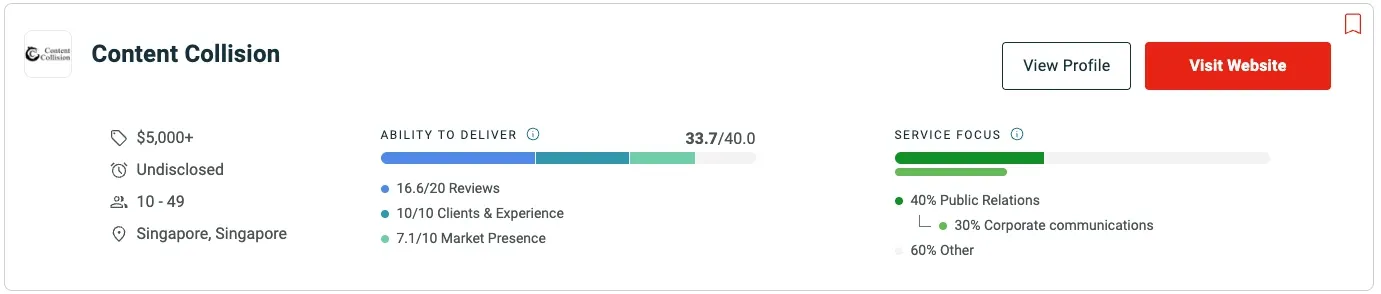
On Clutch’s Singapore corporate communications page, the agency sits at 4.8 out of 5 across 18 verified reviews, with an Ability to Deliver score of 33.7 out of 40, driven by a near-perfect 16.6 out of 20 on reviews and a full 10 out of 10 on client and project experience. That places it second on the page behind only one other agency, ahead of every global network name listed in the same category.
The reviews span multiple industries, including retail, education, financial services, and IT, with client feedback specifically calling out substantial media coverage and adaptability. Worth noting: treat any summary industry count on a directory profile with a grain of salt, since headline tallies and dropdown lists on the same page don’t always agree with each other.
That’s a real, verifiable starting signal. But running it through the five questions is what actually tells you something:
- Does the client mix include genuine tech and B2B work, not just adjacent industries? The review breakdown suggests yes.
- Do the reviews describe who did the work and how responsive they were, or just a generic “great to work with”? Read the actual review text, not just the star average, to find out.
A profile with real depth behind the number looks very different from one that’s simply accumulated a high average from a handful of thin reviews, and that difference only shows up once you go looking for it.
What to do once you’ve shortlisted three agencies
Once the shortlist is down to two or three names, the research phase has done its job, and the next move is a direct conversation, not another data point. Ask each agency the same three questions from the framework above: who specifically staffs the account, what’s the most recent tech or B2B client work they can point to, and how they think about AI-generated search visibility as part of a campaign. The quality of the answer, not just its content, tends to separate a genuinely capable team from one that’s simply good at winning pitches.
One more filter, and it’s a cheap one: ask to speak with a current client, not a past one whose logo appears in the case study. Agencies happy to make that connection usually have less to hide. Agencies that stall on the request, or offer only a written testimonial instead, are telling you something too.