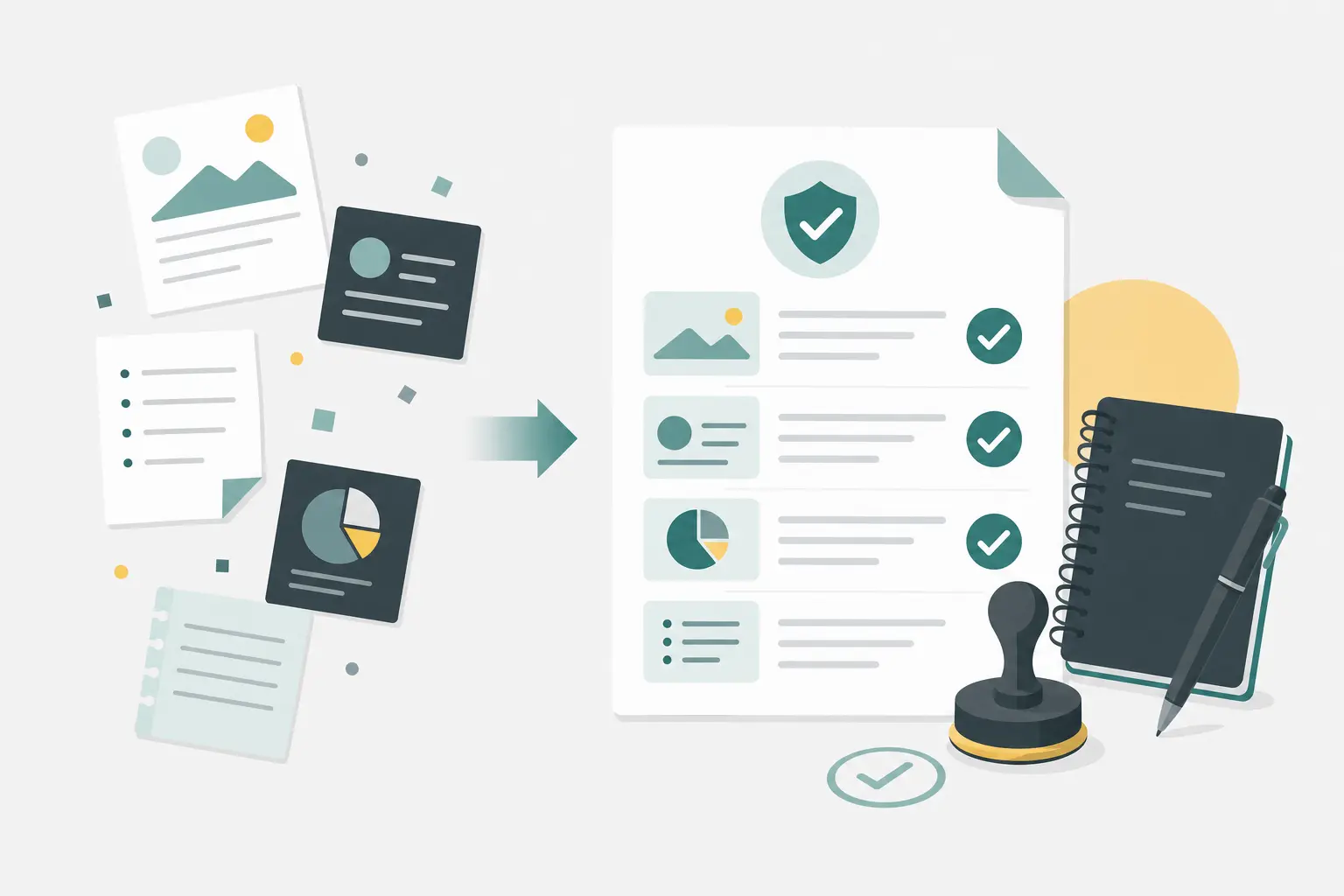
A fact sheet gives journalists, stakeholders, and internal teams the verified facts they need without making them hunt through a press release, deck, website, or spokesperson notes. For PR teams, it is the proof layer that keeps a story accurate when someone else summarizes it.
That matters when earned media has to work across more than one surface. A journalist may use the fact sheet to check a company claim. A sales team may use it after coverage lands.
Key Takeaways
- A PR fact sheet gives journalists and stakeholders a short, verified reference for company, product, event, issue, or campaign facts.
- The strongest fact sheets separate factual proof from promotional language, so the document can support coverage without sounding like an ad.
- PR teams should maintain fact sheets like live source material, with owners, update dates, approval rules, and usage tracking.
Table of contents
Jump to each section:
- What is a fact sheet in PR?
- When should PR teams use a fact sheet?
- What should a PR fact sheet include?
- How is a fact sheet different from a press release, backgrounder, or press kit?
- How do you write a fact sheet journalists can use?
- Which tools make fact sheets easier to maintain?
- How should PR teams measure whether a fact sheet worked?
What is a fact sheet in PR?
A fact sheet in PR is a concise reference document that lists verified facts about a company, product, event, issue, or campaign for journalists and stakeholders.
A fact sheet should help someone understand the essentials quickly. ContentGrip’s press kit examples guide explains the broader asset hub journalists may use, while a fact sheet is the shorter factual insert inside that system.
The document usually fits on one or two pages. It uses headings, bullets, tables, short descriptions, and contact details so readers can scan quickly. The goal is to make the important facts accurate, quotable, and easy to verify.
That makes it especially useful in B2B PR. Complex companies often have products, markets, funding histories, customer proof, technical terms, regulatory context, and executive bios that cannot all fit inside a pitch. A fact sheet gives the reporter a cleaner reference point.
The strongest fact sheets answer three practical questions:
- What is this about?
- Which facts are approved and current?
- Who can verify or explain the details?
Teams also use fact sheets for analyst briefings, investor communications, partner announcements, events, sales enablement, crisis response, and internal alignment. The PR version holds a higher standard because journalists may reuse the facts in public coverage.
86% of journalists say at least some of their work began with a PR pitch, according to Muck Rack’s 2026 State of Journalism report. A useful fact sheet gives that pitch stronger supporting material after it earns attention.
When should PR teams use a fact sheet?
PR teams should use a fact sheet when a story depends on details that must stay accurate across pitches, interviews, briefings, coverage, and follow-up.
A fact sheet is most valuable when the story has enough complexity that a pitch alone will not carry it. That might be a product launch with technical specifications, a funding announcement with investor context, or a crisis update where the timeline must stay precise.
The document is also useful when multiple spokespeople are involved. If the CEO, product lead, regional head, and PR agency are all explaining the same announcement, the fact sheet keeps the factual base steady.
Use a fact sheet when the team needs:
- A single source of truth for approved public facts.
- A reporter-friendly reference that can be read in minutes.
- A reusable asset for press kits, briefings, events, and follow-up emails.
- A guardrail against drift when different teams describe the same story.
- A current record of numbers, milestones, dates, names, and definitions.
Fact sheets are less useful when the story is simple and already well explained in a press release. They can also become clutter if teams try to stuff every possible claim into them. The discipline is deciding what a journalist or stakeholder actually needs to know, then leaving the rest out.
That is why audience selection comes first. A product fact sheet for a technical trade journalist may need specifications, integrations, security details, and customer use cases. A company fact sheet for a business editor may need size, leadership, market position, funding, geography, and media contacts.
What should a PR fact sheet include?
A PR fact sheet should include the subject, short summary, approved facts, proof points, dates, names, media contact, source notes, and last-updated date.
The content depends on the story, but the structure should make factual checking easy. The Comm Spot describes fact sheets as concise documents that present essential information about a company, product, event, issue, or initiative, and that same utility-first logic applies to PR fact sheets in its public relations guide.
For most B2B PR teams, a useful fact sheet includes:
- One-sentence summary: what the reader should understand before seeing the details.
- Core facts: founding date, headquarters, leadership, markets served, customer segments, product category, pricing status, funding, partner names, or event details.
- Proof points: approved data, customer evidence, research findings, certifications, awards, or third-party validation.
- Definitions: short explanations of technical, regulatory, or category terms a journalist may need.
- Timeline: key dates, launch milestones, availability, embargo timing, or response chronology.
- Spokesperson details: names, titles, areas of expertise, and interview availability if relevant.
- Media contact: one reachable person with email, phone, time zone, and backup contact when needed.
- Source and approval notes: where sensitive numbers came from and who approved them.
- Last-updated date: a visible freshness marker so old numbers do not linger.
The last item is easy to miss. A fact sheet with stale employee counts, funding totals, market claims, pricing, or customer numbers creates risk because old details can keep circulating as official facts.
How is a fact sheet different from a press release, backgrounder, or press kit?
A fact sheet lists verified details, while a press release tells the news, a backgrounder explains context, and a press kit stores reusable media assets.
These assets often travel together, but they should not do the same job.
| PR asset | Main job | Best used for | Common mistake |
|---|---|---|---|
| Fact sheet | List approved facts in a concise reference format. |
Company facts, product details, event information, issue timelines, data summaries. |
Turning it into marketing copy instead of factual source material. |
| Press release | Announce a specific news development. |
Launches, funding, appointments, partnerships, research, major milestones. |
Burying the news under background information. |
| Backgrounder |
Explain the deeper context behind a company, issue, market, or announcement. |
Complex categories, technical stories, policy issues, company history. | Making it too promotional or too long to help a deadline reporter. |
| Press kit | Store reusable media materials in one accessible place. |
Logos, images, bios, fact sheets, releases, boilerplates, contact details. |
Letting it become a file dump with no hierarchy or owner. |
A fact sheet should be the easiest of the four to verify. A journalist should be able to pull a number, name, date, or short definition without wondering whether it is a slogan or an approved fact.
That distinction matters in briefings too. ContentGrip’s media briefing guide covers how PR teams give journalists access and context before a story breaks. The fact sheet is one of the materials that helps that session stay concrete.
Tommy Prayoga, Head of Agency at digital PR service provider Content Collision: “A fact sheet is useful when it removes friction for the journalist. If the document only repeats the pitch in prettier formatting, it is not doing its job. The best version gives the reporter names, dates, proof, caveats, and contact paths they can trust under deadline pressure.”
How do you write a fact sheet journalists can use?
Write a journalist-ready fact sheet by choosing one audience, collecting approved facts, cutting opinion, organizing details by priority, and assigning an update owner.
Start with the reader, not the template. A journalist needs the facts that make the story easier to understand, verify, and explain to their audience.
Follow this workflow:
- Define the job of the fact sheet. Decide whether it supports a company profile, product launch, event, research report, crisis update, funding announcement, or market education push.
- Name the primary reader. Specify whether the document is for business journalists, trade reporters, analysts, investors, event partners, customers, or internal spokespeople.
- Collect approved facts. Pull from source documents such as product specs, financial announcements, research methodology, customer approvals, executive bios, legal notes, and press releases.
- Separate fact from interpretation. Keep claims factual and verifiable. Replace phrases like “industry-leading” with evidence such as markets served, customer count, certifications, or measured results.
- Lead with the most useful facts. Put the headline details, summary, and key numbers near the top. Put supporting definitions, timelines, and contact paths after that.
- Add source notes where needed. If a number comes from internal data, customer data, a third-party report, or a public filing, note the source and approval status.
- Design for scanning. Use short sections, bullets, tables, white space, and plain labels. The Research-to-Policy Collaboration’s TrestleLink training also stresses skimmability, audience specificity, and a clear main point in its fact sheet guidance.
- Assign ownership. Add a named owner, approval path, and update cadence so the document does not go stale after the campaign ends.
One useful test is to remove the branding adjectives and read the sheet again. If it still explains the company, product, event, or issue clearly, the document is probably strong.
Another test is the “deadline pass.” Give the sheet to someone outside the project and ask them to answer five questions in two minutes: what is this about, why does it matter, who is involved, what facts are approved, and who should be contacted.
Which tools make fact sheets easier to maintain?
The best fact sheet tools make updates, approvals, design consistency, and sharing easier without hiding the source facts from the PR team.
Fact sheets often fail because ownership is unclear. Someone builds a polished PDF for launch week, sends it to journalists, then forgets to update it when facts change.
Use tools based on the maintenance problem you need to solve:
| Tool | Use case |
|---|---|
| Google Docs or Microsoft Word |
Simple editable fact sheets that need fast collaboration, comments, and approval history. |
| Notion or Confluence |
Living internal source pages that several teams update before creating a public version. |
| Canva, Figma, or Visme |
Designed one-pagers for events, launches, press kits, and sales-ready leave-behinds. |
| Airtable or Google Sheets |
Structured data sources for product specs, locations, spokespeople, customer approvals, or milestone lists. |
| Digital asset management tools |
Press kit environments where fact sheets sit beside images, logos, bios, releases, and usage notes. |
Template platforms can help when the team needs a clean layout quickly. Visme, for example, frames fact sheets as concise one-page documents for product, service, event, project, and company information in its template guide. Design speed helps, but PR still owns accuracy.
The safest workflow is to keep a live source document and export public versions only after approval. That prevents the polished PDF from drifting away from the approved facts.
How should PR teams measure whether a fact sheet worked?
Measure a fact sheet by whether it improved factual accuracy, reduced follow-up friction, supported coverage quality, and stayed current after the campaign.
A fact sheet is not usually judged by traffic alone. Its value shows up in fewer factual errors, faster responses, cleaner coverage, and less internal confusion.
Track signals such as:
- Journalist usage: whether reporters requested, opened, downloaded, or referenced the fact sheet.
- Follow-up quality: whether questions became sharper because basic details were already answered.
- Coverage accuracy: whether articles used correct names, dates, numbers, product descriptions, and spokesperson titles.
- Message consistency: whether coverage repeated the intended facts without distorting the story.
- Internal reuse: whether sales, executives, partners, and regional teams used the same approved details.
- Update hygiene: whether the fact sheet has a current owner, review date, and changelog.
72% of journalists cite press releases as the most useful PR resource, while 86% immediately reject pitches that miss their beat or audience, according to Cision’s 2025 State of the Media announcement. Fact sheets help by making the supporting facts more relevant and easier to verify.
The best reporting links the fact sheet back to the campaign objective. For a product launch, check whether coverage described the product accurately. For a crisis update, check whether timelines and response details stayed consistent.
ContentGrip’s PR report guide is useful here because a fact sheet should feed the same reporting habit as the rest of the campaign: what did we try to change, what happened, what did we learn, and what should we fix next?
The practical value of a fact sheet is simple. It turns scattered knowledge into approved public facts. For PR teams, that means better pitches, cleaner briefings, fewer corrections, stronger press kits, and a public record that is easier to interpret accurately.