
Every growing e-commerce brand hits a wall where standard store templates start feeling tight. Your head of growth wants a custom product builder. Your design lead wants smooth page transitions. Meanwhile, your lead developer keeps staring at site speed scores with a headache. Naturally, someone drops “headless commerce” into Slack, and suddenly everyone wants to talk about Shopify Hydrogen.
Standard Shopify builds rely on Liquid templates for default theme execution. For high-volume merchants moving to React-based frontends, professional Shopify Hydrogen development services assist with custom storefront architecture, state management, and edge deployment.
Before signing off on a major rewrite, you need a clear look at real numbers. Going headless offers speed and creative freedom, sure. But it also adds operational work that glossy agency decks rarely mention. Let us look at what this move costs, where value actually sits, and whether your business is ready for it.
What Hydrogen and Oxygen actually do
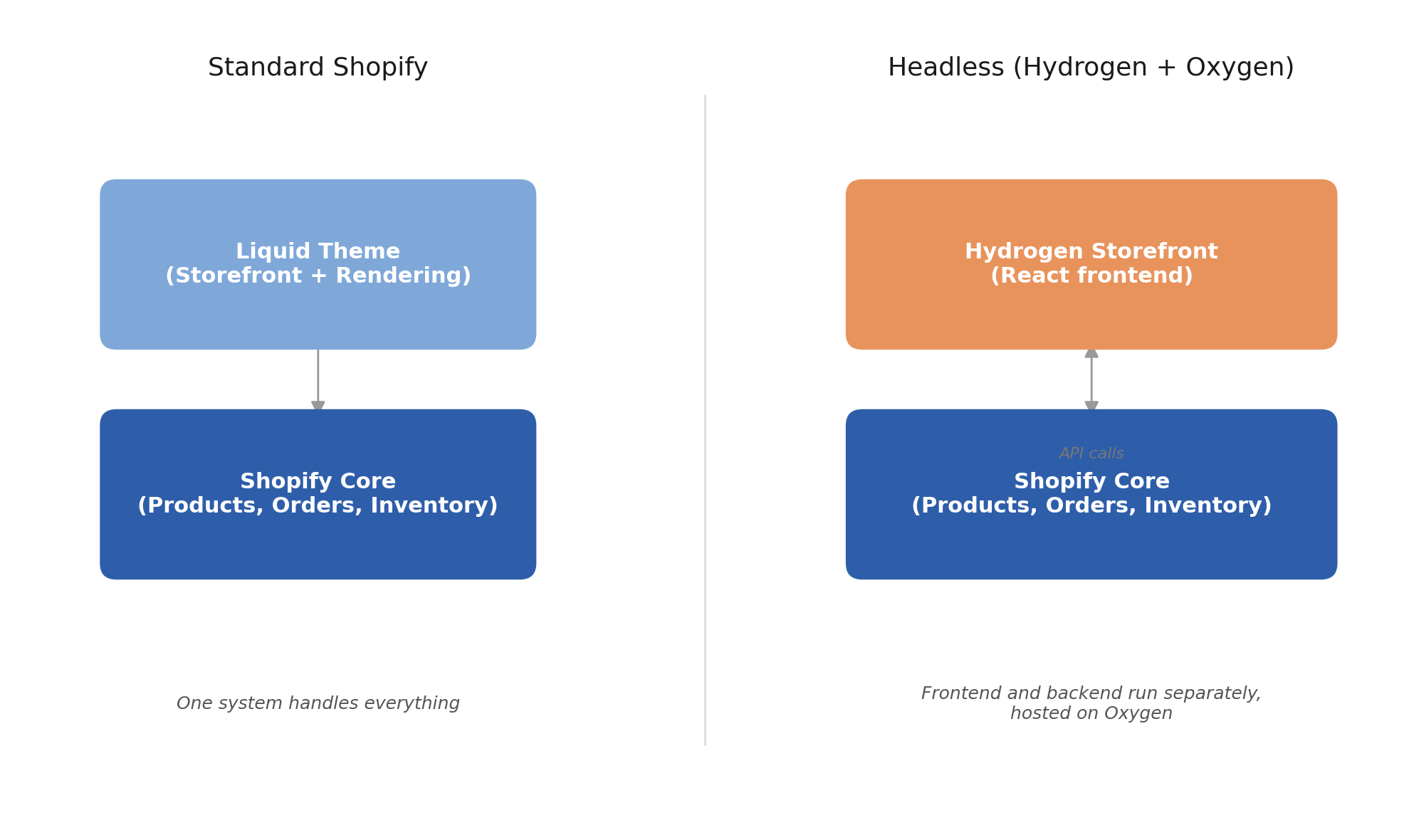
To understand the cost, you need to know how the technology breaks down. On standard Shopify, one engine handles everything: product lists, payments, and the visual pages shoppers see. Headless splits that job in half. Shopify handles orders and inventory in the background, while a separate web app powers the front end.
Hydrogen is Shopify’s official React framework built to create these custom storefronts. It includes ready-made components for shopping carts, variant selectors, and product pages.
Oxygen is the hosting network built to run Hydrogen apps right near your customers. Think of Oxygen as the engine room under the floor and Hydrogen as the custom car body built on top.
Since Oxygen comes included with Shopify Plus plans, you avoid extra cloud hosting bills on Vercel or AWS. That removes server headaches right away. Still, running custom software means your team takes on hands-on code maintenance that normal themes manage automatically.
Where the real business value lives
Why do big brands spend money on custom Hydrogen builds? They are not just chasing trendy tech. They are fixing specific bottlenecks that hurt sales.
Faster page speeds on phones
Normal Liquid themes get heavy over time. Every new tracking script or marketing widget slows things down. Hydrogen uses fast server rendering and smart edge caching through Oxygen. Pages load almost instantly, even on spotty mobile connections. Cutting a second off load time directly raises conversion rates.
Total design freedom
With standard themes, you build inside pre-set template boxes. If your product needs a custom 3D configurator or a dynamic bundle builder, theme code will fight you every step of the way. Hydrogen gives your developers total control over JavaScript and React. You can build custom shopping journeys that feel like a fast mobile app.
Better content without slowdowns
If your brand relies on rich blog posts, lookbooks, or editorial stories, standard Shopify tools feel basic. Decoupling your store lets you plug in modern content management tools like Sanity or Storyblok. Your marketing team can publish heavy media pages without touching core store databases or hurting page speeds.
The trade-offs sales pitch decks skip
The pitch for headless sounds great on paper. The day-to-day reality, though, requires a serious look at maintenance costs.
Higher upfront and ongoing costs
Building a Hydrogen store is a real investment. While tweaking a premium Liquid theme might cost $10,000 to $20,000, a full Hydrogen build starts around $45,000 and can easily top $150,000 for complex setups.
The spending does not end at launch either. You leave behind a low-maintenance setup for a custom React app. That means setting aside money for dev retainers to handle API changes, security updates, and bug fixes every month.
Losing the drag-and-drop theme editor
This change catches marketing teams off guard. On regular Shopify, non-technical staff can swap banners, change layouts, and publish landing pages using the simple visual editor.
With Hydrogen, that native editor goes away. Unless you connect a headless CMS and build custom layout blocks, your marketing team must ask developers for simple page edits. That extra delay can slow down campaigns if you do not plan ahead.
App connection issues
The Shopify app store relies on standard theme code to work right away. When you switch to Hydrogen, simple plug-and-play apps for product reviews, popups, or search stop working out of the box.
Instead, developers must connect those tools through APIs or custom React code. Major platforms like Klaviyo offer solid API support, but smaller apps might require custom coding workarounds.
|
Factor |
Standard Theme |
Shopify Hydrogen |
|
Initial Cost |
Low ($5k – $20k) |
High ($45k – $150k+) |
|
Maintenance |
Low (Shopify updates code) |
High (Requires developers) |
|
Design Freedom |
Limited by template |
Complete control |
|
Page Speed |
Good with cleanup |
Fast edge rendering |
|
Marketing Control |
Easy visual editor |
Depends on CMS setup |
Running the numbers for your store
Choosing Hydrogen comes down to simple revenue math. Your expected lift in sales must clearly exceed high development costs.
A practical rule of thumb: going headless makes sense once your store hits roughly $5 million in yearly sales. At that scale, even a small conversion bump (like moving from 2.0% to 2.3%) brings in six figures of new revenue. That extra margin quickly covers build costs and developer support.
Hydrogen makes sense if:
- Your products require interactive customization on the page.
- You run multi-region stores with distinct regional catalogs.
- Your current site speed hit a wall that regular cleanup cannot fix.
- You already have React developers on staff or an agency partner.
Stick with a Liquid theme if:
- Your store brings in under $2 million a year.
- Your marketing team needs daily, self-serve control over page layouts.
- You need to launch a new design within a few weeks.
- You want to keep monthly software costs low.
Conclusion
Switching to Shopify Hydrogen is a strategic engineering decision, not a quick fix. It is built for growing brands that have outgrown basic templates and need total control over speed and customer experience.
If your store is growing fast and custom user experiences drive your revenue, Hydrogen offers a solid, ultra-fast foundation. But if your current theme converts well and your team needs speed and simplicity, spending those development dollars on marketing will yield a better return. Look closely at your tech roadmap, run the numbers, and pick the path that best fits your bottom line.