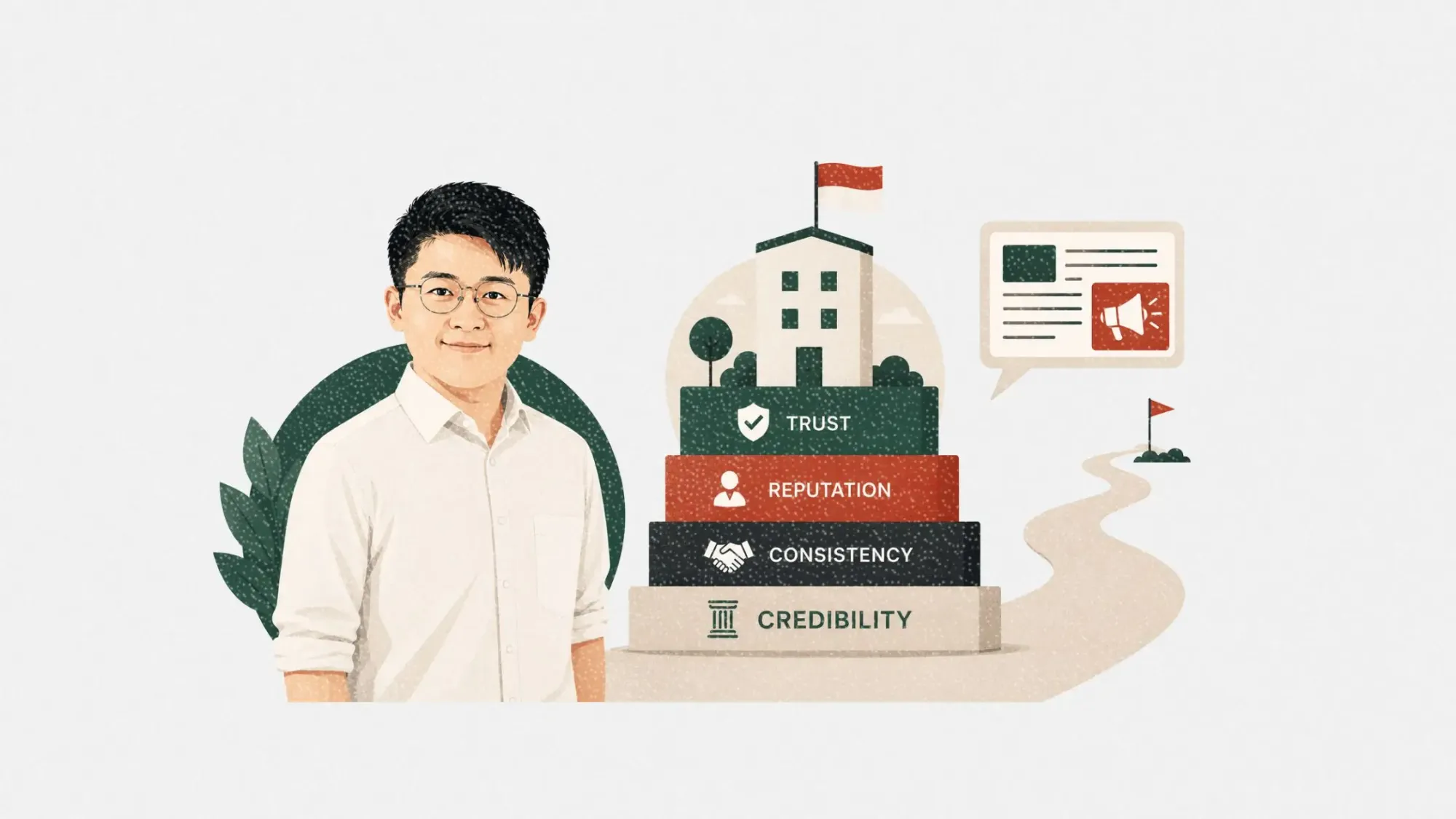
For many founders, PR begins when something big is about to happen. A funding round closes. A product ships. A partnership is signed. Only then does the team start asking what the public should understand, which outlets should care, and which executive can explain the story.
Tommy Prayoga thinks that sequence is backwards. Tommy is Head of Agency at Content Collision, a boutique B2B PR and content marketing agency that works across APAC and the Middle East, serving more than 280 clients and securing more than 5,000 media placements since 2015. Its work spans international PR, content marketing, social media management, KOL campaigns, thought leadership, and crisis communications.
Throughout the past decade, Tommy has developed PR and communications strategies in Indonesia and Southeast Asia for organizations including Alibaba Group, Western Digital, and the Republic of Indonesia. In this Spotlight, his central point is simple: credibility is rarely built by the announcement itself. It is built by the choices a company makes before anyone is asking for a quote.
Table of contents
Jump to each section:
- Credibility starts before the announcement
- B2B PR is a proof system, not a publicity sprint
- AI search makes measurement more uncomfortable
- Human judgment still sits at the center
- The first-year PR plan is deliberately small
Credibility starts before the announcement
The paradox of startup PR is that the moments founders most want covered are often the moments when the brand has the least room to explain itself. A funding announcement has a deadline. A product launch has a feature list. A partnership has approved quotes. The story may be new, but the company’s public identity cannot be invented overnight.
Tommy has seen brands try to borrow attention from scale, stunts, or association. “People tend to remember what they do or that viral moments more than their brand,” he says. Those tactics can create awareness, but he argues that the effect rarely lasts unless the brand has a stronger foundation underneath it.
For Tommy, that foundation starts with knowing what the company wants to be. Stronger brands, he says, “don’t reduce their identity to the product or service they provide, but rather values they bring to their customer.” That does not mean every startup needs a philosophical manifesto. It means the team should understand how it wants to be perceived before it asks the market to pay attention.
His example is blu by BCA Digital. Tommy says the brand is not trying to be a young digital bank in the same way as some competitors. He sees its communications as thoughtful and carrying a kindness nuance. The lesson is not that every B2B company should copy a consumer bank’s tone. It is that consistency becomes easier when announcements are anchored in something more durable than the next campaign.
B2B PR is a proof system, not a publicity sprint
That is why Tommy believes founders should think about PR earlier than they usually do. “You should always think about PR regardless of what stage of business you are in,” he says. “PR is so much more than announcing things and pitching to the media.”
The practical question is not whether a seed-stage startup should hire an agency on day one. It is whether the company knows what public perception needs to support. Tommy frames the work around goals: looking for funding, courting a certain partner, or building relationships with government. Each goal needs a different campaign and a different angle.
This is especially important in B2B, where PR has to do more than make a brand familiar. In consumer PR, Tommy says the work often centers on image, positive association, and making people more likely to purchase through a store or link. B2B is narrower. It reaches buyers, partners, clients, investors, and government stakeholders who may already be evaluating the company’s competence.
That makes proof more important than noise. Tommy puts it plainly: “Show expertise and experience.” The brand still cannot be too hard-selling, but it needs to make its background, portfolio, and industry knowledge visible.
AI search makes measurement more uncomfortable
The old PR dashboard was never perfect, but at least it was legible. Coverage volume, impressions, share of voice, backlinks, referral traffic, and sentiment could be placed in a report and debated. Now communications teams also have to ask whether public information is being picked up, summarized, or ignored by AI systems.
Tommy’s current advice is direct: “Check if the information you put out gets picked up by AI search result.” He is careful not to overstate the signal. AI visibility may show that a team is moving in the right direction, but it does not automatically prove business impact.
That caution fits the industry’s broader measurement problem. Muck Rack’s 2025 State of PR Measurement report says it surveyed more than 800 communications professionals on how teams connect PR work to business goals, trusted metrics, and the growing influence of AI-powered analytics and generative engine optimization. The direction is clear, even if the operating model is still forming.
For Tommy, PR measurement has to leave the comms silo. Teams should ask sales or relationship teams whether potential partners and clients are responding more positively. They should test message effectiveness at networking events. They can also look for correlations between PR campaigns and metrics such as ad spending, ROAS, engagement, search, visits, and sales.
The point is not to pretend PR alone created every outcome. It is to make PR accountable to the parts of the business it is supposed to influence. ContentGrip’s share of voice guide makes the same distinction: visibility is not credibility, and a useful report should explain what kind of visibility a brand earned.
Human judgment still sits at the center
AI complicates the work in another way. It has made it easier for founders, marketers, and agencies to produce press releases, pitches, and content. That can be useful, especially for research and first drafts. But Tommy’s trust threshold remains human.
“AI result is only as good as your prompts and information,” he says. The information behind a good PR program often has to be curated first. Some of it may be confidential. Some of it has to come from the right internal stakeholders. Some messages need to be tested with audiences or journalist contacts before they become public language.
Recent B2B buying data helps explain why that judgment matters. 6sense’s 2025 B2B Buyer Experience Report says its study used more than 4,000 responses and found that buyers can execute 61% of their journey before engaging sellers. The same report says 58% of buyers engaged vendors earlier to clarify AI-related features or claims.
In other words, AI may accelerate research, but it also raises the bar for clarity. If buyers are using AI tools to compare vendors and also questioning AI claims inside the products or services they buy, a vague public narrative becomes riskier. Responsive’s 2025 buyer research, based on a survey of 350 B2B buyers, similarly found that a quarter of B2B buyers said GenAI had overtaken traditional search for vendor research, while trust, industry expertise, and RFP quality still shaped final decisions.
Tommy does not reject AI. He even says a properly trained AI agent could theoretically handle more of the workflow if a company invested enough effort in it. But his final test is the one comms leaders cannot automate away: “Would you trust AI to share info about you to the public before checking on it first?”
The first-year PR plan is deliberately small
For a B2B tech startup with limited budget, Tommy’s recommendations are modest by design. The first investment is a communication SOP. Not a fancy brand guideline, he says, but a simple handbook covering the value the company brings, what it wants to be known for, what it is and is not, and the roadmap of communication goals it wants to achieve.
The second is a specific AI project for communications. In Tommy’s version, that project can gather data, create content, refine messages, and act as a sparring partner. The important detail is that AI has a bounded job inside a communication system. It is not a substitute for the system.
The third is to start small once the company is ready. “Do one interview first, make it count,” Tommy says. Then release a few pieces every quarter while investing in the communications team, whether in-house or through an agency.
That advice may sound restrained in a market that rewards visible momentum. But it returns to the opening problem. If credibility is built only when the company has a major announcement, the team is already late. The better first-year question is not how to appear bigger than the company is. It is how to become easier to understand, easier to verify, and harder to misread before the next announcement arrives.