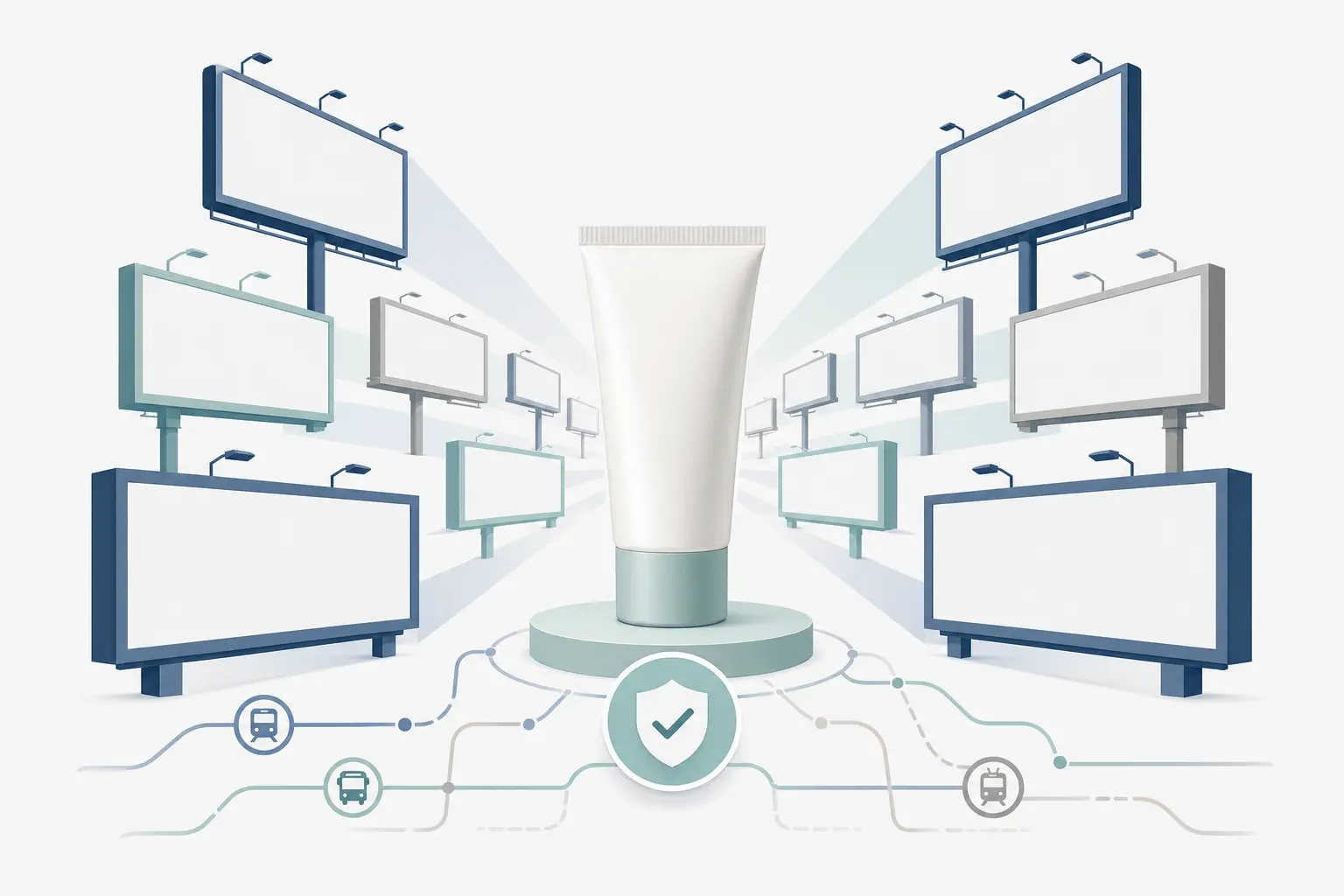
Dermal Therapy is extending its “It Works” campaign into a 2025 update that increases the scale of its influencer and out-of-home push, including 550+ billboards and transit placements.
The brand’s framing is simple: in therapeutic skincare, “works” is the core purchase criterion. The strategy is to treat proof of efficacy as the message, and media weight as the amplifier, rather than trying to win attention with novelty.
Table of contents
Jump to each section:
- What the “It Works 2.0” update actually changes
- Why “it works” is a positioning choice, not a tagline
- The real bet: making efficacy feel visible at scale
- What this means for marketers
What the “It Works 2.0” update actually changes
The campaign’s origin story starts in 2023, when Dermal Therapy set out to understand what drives consumer choice in therapeutic skincare. The brand’s stated insight: the top thing people want is a product that works.
From there, the creative platform followed the insight rather than the other way around. In 2024, the company ran an integrated 360° rollout across nationwide out-of-home (OOH), in-store, and digital, using six loyal users and influencers as the faces of the brand.
In 2025, “It Works 2.0” turns the volume up through two explicit levers:
- More influencer reach: new and returning “influencer loyalists” with a combined reach of 20 million+.
- More physical presence: 550+ billboards across highways, railway stations, high streets, plus bus and tram wraps.
A useful way to read this: the brand is not changing the promise. It is changing the distribution of the promise.
Strategic observation: When a claim is hard to verify instantly, brands try to be entertaining. When they believe the claim is defensible, they try to be unavoidable.
Why “it works” is a positioning choice, not a tagline
“It works” sounds like generic language until you treat it as a competitive constraint. In therapeutic skincare, efficacy is not just a benefit. It is often the category’s permission slip.
The common assumption is that stronger differentiation requires more distinctive messaging. The contrasting reality is that in high-credence categories, the most differentiated position can be the one that removes ambiguity. The strategic implication is that clarity becomes the creative.
Dermal Therapy also ties the message to a measurement claim: consumers rated its products “exceptionally high for efficacy.” Whether or not a marketer has access to the full methodology, the move signals intent. The brand wants “efficacy” to function like a measurable standard, not a subjective vibe.
Strategic observation: In performance-led categories, the brand is the shortcut people use when they cannot run the experiment themselves.
The real bet: making efficacy feel visible at scale
Putting 550+ billboards into market is not just reach. It is a choice to make the brand’s claim feel like a shared, public reality. OOH does something digital cannot always do: it creates ambient familiarity that feels less like targeting and more like presence.
The influencer component serves a different job. “Loyal users” and “influencer loyalists” are positioned as proof carriers. The campaign is effectively building a ladder:
- Claim: “It works.”
- Social proof: real users and influencers as faces.
- Repetition: nationwide OOH presence, plus in-store and digital.
There is a quiet tradeoff here. The simpler the promise, the more pressure sits on consistency. A straightforward efficacy claim can compound trust with repetition, but it can also magnify skepticism if any touchpoint feels off-message or overproduced.
Strategic observation: The more you simplify your promise, the more every channel becomes an audit of your credibility.
What this means for marketers
A scaled “proof-first” campaign like this is a useful case study because it treats persuasion as an accumulation problem, not a creative stunt.
- If your message is a baseline requirement, win by making it memorable“Works” may be table stakes in therapeutic skincare, but repeating it with discipline can still differentiate. The edge comes from consistency across OOH, in-store, and digital, not from constantly refreshing the claim.
- Use creators to carry evidence, not just attentionThe campaign’s emphasis on loyal users suggests a deliberate choice: credibility over trend alignment. For marketers, that is a reminder that influencer strategy is not only about reach, it is about the kind of proof your category needs.
- Treat OOH as a trust channel when claims are hard to verifyDigital can optimize for clicks, but it can also feel transient. OOH’s role here is to make the promise feel widely endorsed through visibility and repetition.
- Build campaigns that stack, not campaigns that spike“It Works 2.0” is framed as a continuation, not a reinvention. That is often how brand equity is built: a platform that can be refreshed without changing what it stands for.
The deeper shift is that more brands are trying to operationalize trust. Not by adding more messages, but by narrowing the message and broadening the evidence around it.
For marketing teams, the lesson is not “run more billboards” or “use influencers.” It is to decide what your simplest defendable promise is, then orchestrate channels so that every exposure feels like corroboration.
That is also where creative discipline starts to look like performance strategy: when the brand promise is stable enough that media weight compounds rather than resets.