New York already has its own visual language for a night out. A packed corner restaurant, a basement room, tacos on the table, music spilling into the street and people arriving because they know the place before a brand ever touches it.
That is what makes YSL Beauty‘s latest Block Party more interesting than another luxury launch with a celebrity guest list.
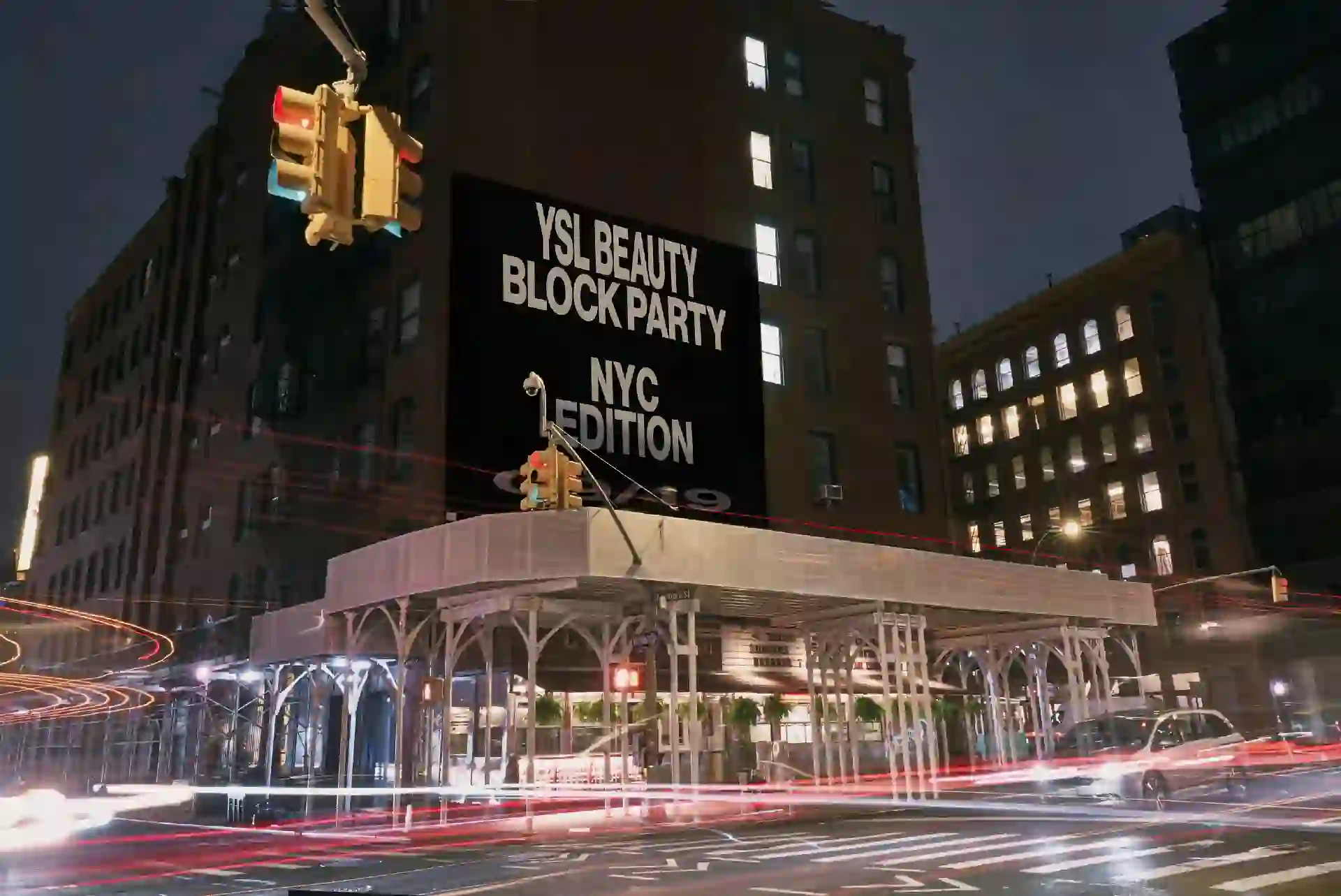
On September 19, the brand took over La Esquina, the SoHo taqueria at Kenmare and Lafayette, for the New York edition of a global event series that has already traveled through other cities. Instead of hiding the restaurant behind a completely new set, YSL Beauty kept the architecture and nightlife character visible, then layered its own pink-and-black codes, product displays, music and beauty experiences on top.
The result makes a useful case for brands trying to build global campaigns without making every market look interchangeable.
Table of contents
Jump to each section:
- Why La Esquina matters more than a generic event space
- How YSL turns local rituals into product discovery
- Why the celebrity mix works better as a scene than a roster
- What marketers can learn from the Block Party format
Why La Esquina matters more than a generic event space
Luxury events often try to control every visual detail. YSL Beauty did something slightly different in New York: it chose a place with an identity of its own and let that identity remain visible.
La Esquina is not a blank event box. The SoHo restaurant is tied to downtown nightlife, with a street-level taqueria and rooms below ground. YSL Beauty used that familiarity as part of the campaign rather than something to cover up.
The intervention was deliberately layered. Pink-and-black accents appeared alongside the restaurant’s existing materials. Deli-style windows became product displays. A custom pool table and vending machines brought the beauty products into the visual grammar of the venue instead of asking guests to move into a conventional cosmetics environment.
That distinction matters because localization is often reduced to translation, casting or a market-specific media buy. Here, the physical setting does the localization work.
A Block Party in another city can keep the same central idea while changing what people actually see, eat, hear and move through. The global brand codes stay recognizable, but the experience does not need to pretend that New York feels like London, Madrid or anywhere else.
How YSL turns local rituals into product discovery
The event supported two launches: Black Opium Pink Glaze fragrance and Make Me Blush Cream Blush.
Neither was presented only through a standard product counter. The fragrance and makeup appeared inside a wider night-out experience that included tacos, cocktails, a Mark Ronson DJ set and tattoo artists from Bang Bang.
That mix gives the products a setting rather than only a display.
Fragrance in particular benefits from context because it is bought as much for mood and identity as for function. Black Opium Pink Glaze enters a room already coded around nightlife, music and going out. Make Me Blush sits inside the same world, where makeup is part of getting ready and being seen rather than a standalone technical demonstration.
This resembles a broader shift in experiential beauty: the store counter is no longer the only place where a product has to make sense. Brands are increasingly building environments where people can connect the product to a memory, a person or a social ritual.
ContentGrip recently saw a smaller version of that logic in LADOR’s Osaka event booth, where scent and texture sampling sat inside a Korean culture festival. The scale and audience are different, but the behavioral idea is similar: give people something physical to experience while the surrounding culture makes the product easier to remember.
Why the celebrity mix works better as a scene than a roster
The guest list was broad: Teyana Taylor, Lauryn Hill, Emmy Rossum, Karl-Anthony Towns and Jordyn Woods joined YSL Beauty U.S. makeup ambassadors Amelia Gray and Laura Harrier, while Mark Ronson DJed.
It would be easy to treat that as the whole campaign. Famous names create photos, photos create coverage, and the event earns attention.
But the casting is more useful when viewed as part of the place.
Music, fashion, film, sports and beauty all coexist in New York nightlife. Bringing those worlds together makes the room feel less like one tightly defined fandom event and more like a version of the downtown social scene YSL Beauty wants to associate with.
That is also why the brand ambassadors do not have to carry the entire event themselves. Gray and Harrier provide continuity with YSL Beauty’s makeup story, while the wider guest mix adds cultural texture around them.
The value is not that every attendee reaches the same audience. It is that the room visually communicates the brand’s desired social world before anyone needs to explain it in a tagline.
What marketers can learn from the Block Party format
YSL Beauty’s New York edition offers four useful lessons for global experiential campaigns.
- Keep the format, not the furniture. A repeatable campaign does not require identical staging. The Block Party name and YSL codes can travel while the venue and local details change.
- Use places that already mean something. La Esquina gives the event history, behavior and visual texture that a purpose-built venue would have to manufacture.
- Let product discovery borrow from local rituals. Food windows, nightlife, tattoos and music turn a beauty launch into something people can move through instead of simply observe.
- Treat celebrity as part of the environment. A mixed guest list can help define the cultural world of an event without forcing one person to carry every message.
The larger idea is simple: a global campaign can become more consistent by being less identical.
YSL Beauty does not need every Block Party to look the same if each one makes the same promise about where the brand wants to live: inside the culture of the city rather than above it.