Coach sits at #35 in a new U.S. youth-brand ranking, with 71% of respondents who rated it saying they like or love it. At the same time, 73% of the same age group say they are budgeting carefully. Brand preference is holding up. The purchase is getting harder to earn.
Pion, a marketing platform that helps brands run offer programs and reach verified young consumer audiences, launched the second U.S. wave of its PION100 report in September, ranking more than 1,000 brands across 13 sectors and digging into how young consumers discover brands, decide what is worth paying for, and use discounts and loyalty tools.
ContentGrip spoke with Will Weeks, Pion’s Chief Marketing Officer, about what the new data says marketers should do after they have won attention and affinity.
Short on time?
Here is a table of contents for quick access:
- What the PION100 U.S. report found
- Affinity is only the first decision
- Walmart’s rise is a value story with a social layer
- Discovery can happen online while loyalty gets built elsewhere
- Pion would put more weight on the handoff to conversion
What the PION100 U.S. report found
For its PION100 U.S. Wave 2 report, Pion surveyed more than 2,000 U.S. consumers aged 16–24 in July 2026. Each participant named the most recent brand they had discovered, said where they found it, and rated around 50 brands on a five-point scale from love to hate, with each brand evaluated by at least 100 respondents. Pion combines the love and like responses to calculate positive affinity.
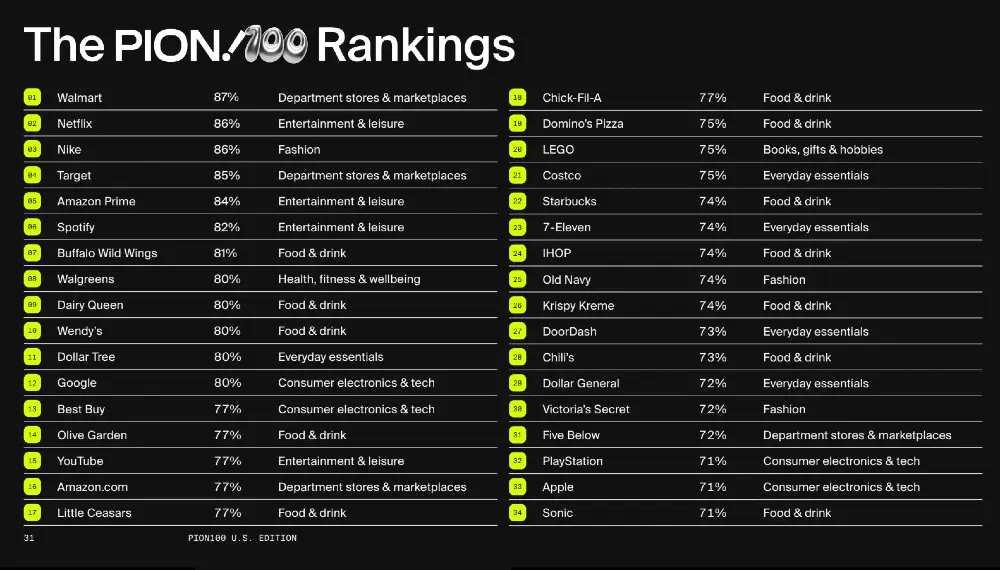
Walmart leads the ranking, followed by Netflix, Nike, Target, Amazon Prime and Spotify:
- Walmart — 87%
- Netflix — 86%
- Nike — 86%
- Target — 85%
- Amazon Prime — 84%
- Spotify — 82%
Six of the top 10 are brands with a strong physical-location component: Walmart, Target, Buffalo Wild Wings, Walgreens, Dairy Queen and Wendy’s.
The new report gives more texture to the spending side of the story than the launch release did:
- 85% of 16–24-year-olds say they like or love brands
- 73% say they are budgeting carefully
- Student discount usage has reached 54%, passing 50% for the first time
- 37% use loyalty cards
- 34% use cashback offers
Pion also identifies four spending personas, with the two largest making up nearly three-quarters of respondents:
- Supported but cautious — 38%
- Independent cautious — 35%
- Parent-supported splurgers — 14%
- Work hard, play hard — 13%
The split reinforces the report’s broader point that the same generation can be highly brand-positive while behaving very differently at checkout.
Discovery is just as fragmented:
- Organic social — 44%
- Paid ads — 38%
- Influencers or creators — 34%
- Word of mouth — 22%
- Online marketplaces — 22%
- Search engines — 16%
The report argues that discovery increasingly happens before active search, then moves through recommendation, shopping environments and physical experiences.
The ranking itself leans toward dependability. Pion groups most of the top 10 around everyday anchors, regular habits and quiet infrastructure. Nike is the only top-10 brand the report describes as being built primarily on aspiration, and it is also the only one of those 10 that fell from the prior year’s position.
That makes Will a useful person to interrogate the gap between being liked and being bought. He has been Pion’s CMO since January 2025 after four years as its head of brand and communications, and his remit spans brand, growth and product marketing.
Affinity is only the first decision
Coach is where the report and interview line up most cleanly. The full data places Coach at #35 with a 71% like-or-love score in fashion, while Pion’s broader sample shows how cautious the same age group has become with money.
Will said a consumer can prefer Coach and still wait for the right promotion, price or occasion before buying. Affinity gets the brand into consideration. It does not remove the need to justify the transaction.
Will said: “Price sensitivity doesn’t necessarily mean that Gen Z has lost interest in brands, it means they are becoming more selective about when their affinity translates into spend.”
The new deal-seeking data makes that argument more concrete. A majority of students now use student discounts, while loyalty cards and cashback are also mainstream behaviors. For marketers, an offer is increasingly part of the decision architecture rather than a last-minute rescue for a weak brand.
That changes what teams should measure. Awareness and preference can both look healthy while conversion stalls. The useful question is what happens between “I like this brand” and “I am buying from it today.”
Walmart’s rise is a value story with a social layer
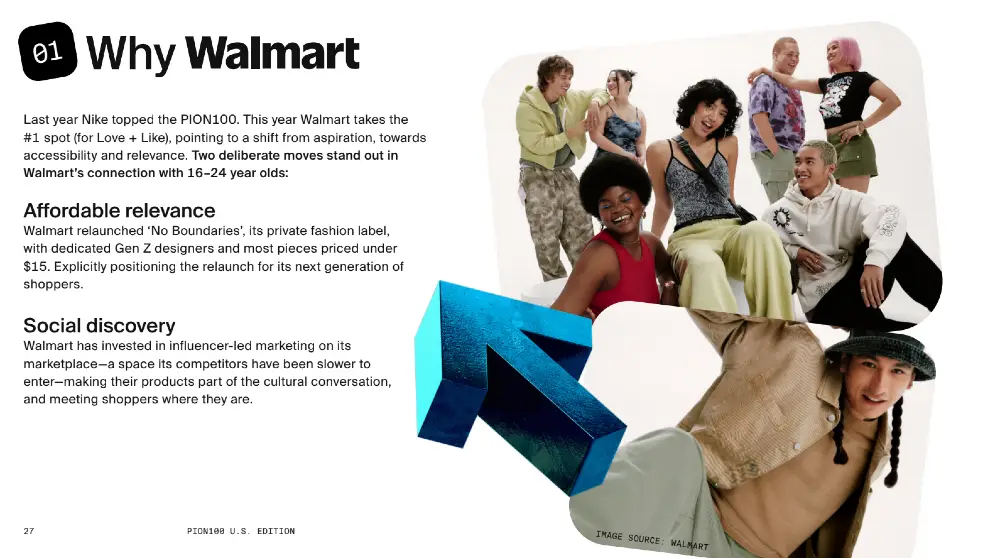
Walmart’s move to #1 sharpens the same point. The full report describes the shift from Nike to Walmart as a move toward accessibility and relevance, and points to two specific elements in Walmart’s approach: affordable fashion and social discovery.
Its No Boundaries private label was relaunched with Gen Z-focused designers, with most items priced under $15. The report also highlights Walmart’s influencer-led marketplace marketing, which puts products into social conversations before shoppers reach the store or app.
Will reads the result as a broader move toward utility. He said: “We’re seeing a move away from purely emotional resonance and aspiration towards utility, accessibility and affordability.”
That does not make brand-building less important. Walmart still has to be recognized, preferred and culturally present. The difference is that the promise lands closer to a concrete use case: something accessible, useful and priced within reach.
For campaign planning, that puts creative and value in the same frame. A brand can earn attention through culture and creators, then make the next step easier with an offer, product mix or retail experience that makes the spending decision feel sensible.
Discovery can happen online while loyalty gets built elsewhere
The full report’s physical-first finding adds another layer. Pion says six of the top 10 brands are built around real-world locations, even though organic social is the biggest discovery channel overall.
Will used Chick-fil-A to explain the habit effect. The full PION100 ranks Chick-fil-A at #18, so it is separate from the six physical-location brands in the top 10, but its routine-based appeal illustrates the same mechanism.
Will said: “Young consumers may discover a brand online, but some of the strongest relationships are still being built through convenience, routine and experiences in the real world.”
Nike shows how the digital and physical pieces can connect. Will described its organic social presence around athletes, culture and products as a way to stay inside conversations young consumers are already having. The report adds that Nike outfitted 12 national teams during the 2026 World Cup despite not being an official tournament sponsor, using athletes and retail presence to stay attached to the cultural moment.
The marketing implication is practical: the first touchpoint does not need to be the place where loyalty is won. Social can start the relationship. The offer, store visit, product experience or repeated habit can be what makes the relationship stick.
Pion would put more weight on the handoff to conversion
Asked what Pion itself would change because of the U.S. findings, Will focused on the middle of the journey.
Will said: “The biggest change we’d make is to put more emphasis on the bridge between discovery and conversion, rather than treating those as separate parts of the journey.”
He said that would mean connecting discovery earlier to a relevant offer, a useful experience or a physical interaction. Pion’s own data gives marketers several places to test that handoff: discount eligibility, loyalty mechanics, marketplace presence, creator recommendations and in-store experiences.
For a marketer looking at the report, three checks are more useful than another awareness metric:
- After someone discovers the brand, what gives them a reason to act now?
- Does the value exchange match how price-conscious this audience has become?
- Is there a repeatable experience, digital or physical, that gives them a reason to come back?
The PION100 data suggests Gen Z’s relationship with brands is still strong. The harder job sits one step later: turning that affection into a purchase without assuming affection alone will do the work.