
A Halloween monster can make an ordinary kitchen feel cursed, and PETA has found its latest villain in a tin of ham. With a face that belongs on a horror poster and a name that sounds like a slasher-film antagonist, Hamface makes a familiar food look like something nobody would want to invite home.
The animal-rights charity has teamed with creative agency Pablo London for a new film that borrows the tension and menace of horror rather than simply dressing an advocacy message in Halloween decorations. PETA has also extended the campaign into a public appeal to Nigella Lawson, asking the celebrity cook to replace the ham in one of her best-known recipes with a vegan alternative.
Table of contents
Jump to each section:
- Meet Hamface, the monster at the dinner table
- Why the horror premise carries an advocacy message
- How the campaign moves from film to street
- What marketers can learn from Hamface
Meet Hamface, the monster at the dinner table
Hamface is the kind of character whose name sounds absurd until the camera starts treating him seriously. The villain has the smiling face of a processed-meat tin where a human head should be. That incongruity is central to the gag: a food product usually presented as everyday and harmless becomes something that looks as if it escaped from a frightening film.
Pablo London’s first campaign for PETA follows the grammar of a horror movie. A domestic space becomes unsettling, suspense builds, and the audience is encouraged to anticipate danger from an intruder who should not belong there. The concept is recognizably Halloween entertainment, but the apparent monster is designed to embody the charity’s warning about processed meat.
Directing duo RIOT, Amy Fasey and Nathalie Gordon, worked with production company ArtClass to bring the film to life. The creative keeps the horror atmosphere rather than turning immediately into a broad comedy sketch. That choice gives viewers a chance to understand the character as a villain before the campaign reveals what it represents.
The film is a small piece of original character-making. Hamface does not borrow a famous slasher mask, licensed movie franchise or celebrity cameo. His face, name and threat are built around the campaign’s central claim. For a viewer encountering the work for the first time, the food itself is the reveal, not a product placed into somebody else’s story.
Why the horror premise carries an advocacy message
A horror film is an unusual vehicle for a food message because it asks people to fear something before asking them to understand it. In Hamface, the unsettling element is a familiar item from the fridge. The character turns the distance between everyday habits and their possible consequences into a visual problem that can be grasped without a long explanation.
The science behind PETA’s message needs more precision than the monster provides. The World Health Organization reports that its cancer agency classified processed meat as carcinogenic to humans based on evidence concerning colorectal cancer. That classification describes the strength of evidence, not an assertion that eating processed meat is as dangerous as smoking. Hamface compresses this distinction into deliberately frightening creative shorthand.
PETA is also making an animal-welfare argument, not only a health claim. Hamface represents meat products in a form that invites an emotional reaction, while the charity argues that those products come from animals that should not be killed for food. The horror styling allows both concerns to sit behind the same unsettling image without spelling out every part of the debate.
PETA representative Dawn Carr described the campaign as revealing “the horror behind something we’ve made far too ordinary” in the launch coverage from Little Black Book. The line explains the creative’s central tension: rather than inventing a wholly alien threat, it makes the audience look again at something they already recognize.
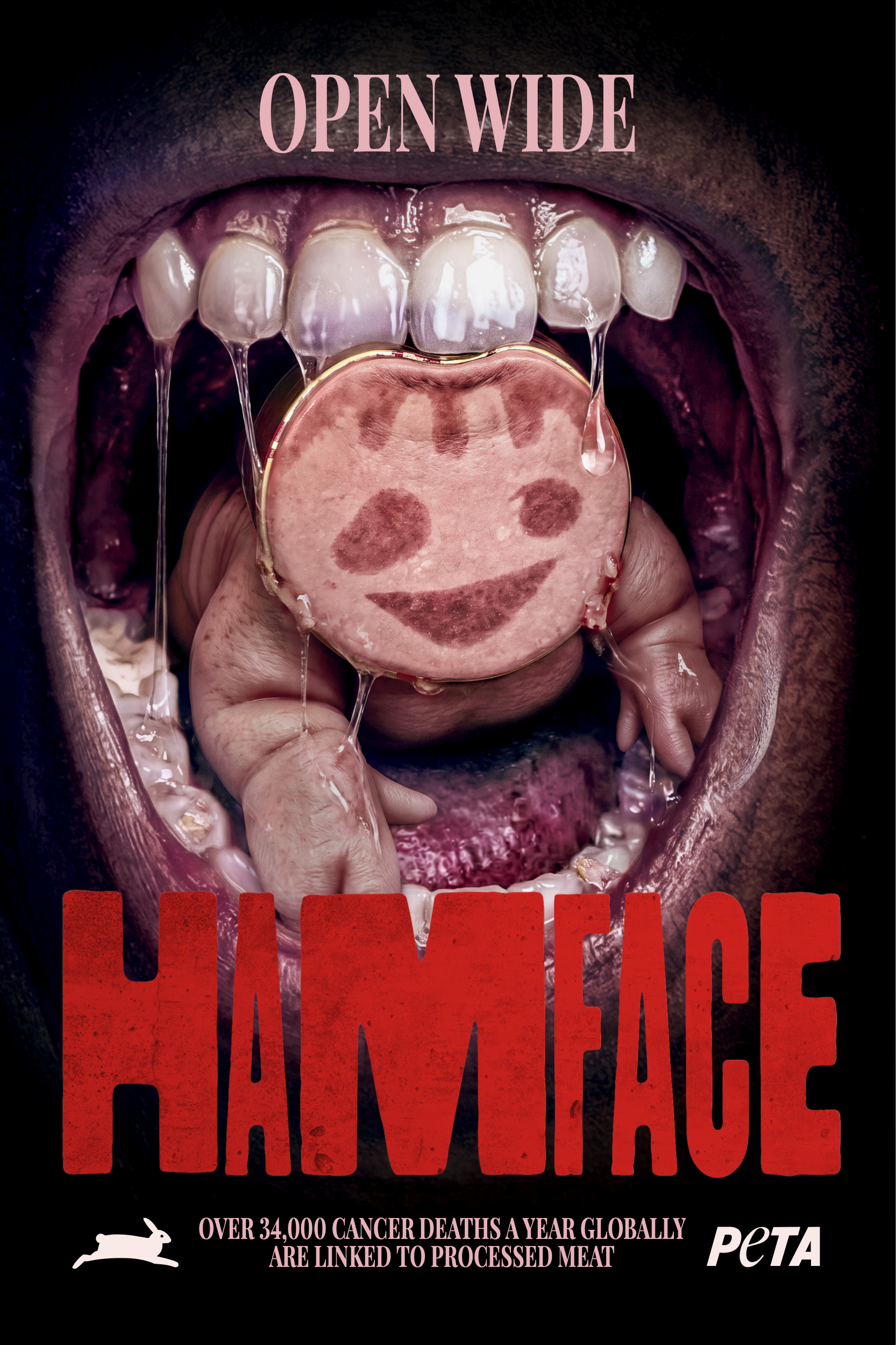
That is also the risk of this approach. Some people may remember the grotesque villain without taking away the nuanced public-health information. The work succeeds as a clear creative premise, but the published materials do not establish whether it changed purchasing habits or attitudes.
How the campaign moves from film to street
The idea is not confined to a video player. Pablo’s campaign material includes dramatic posters and photographs of the work displayed on city walls. Across the film and out-of-home artwork, the same antagonist carries the message, so the campaign can be recognized even when the audience sees only a still image.
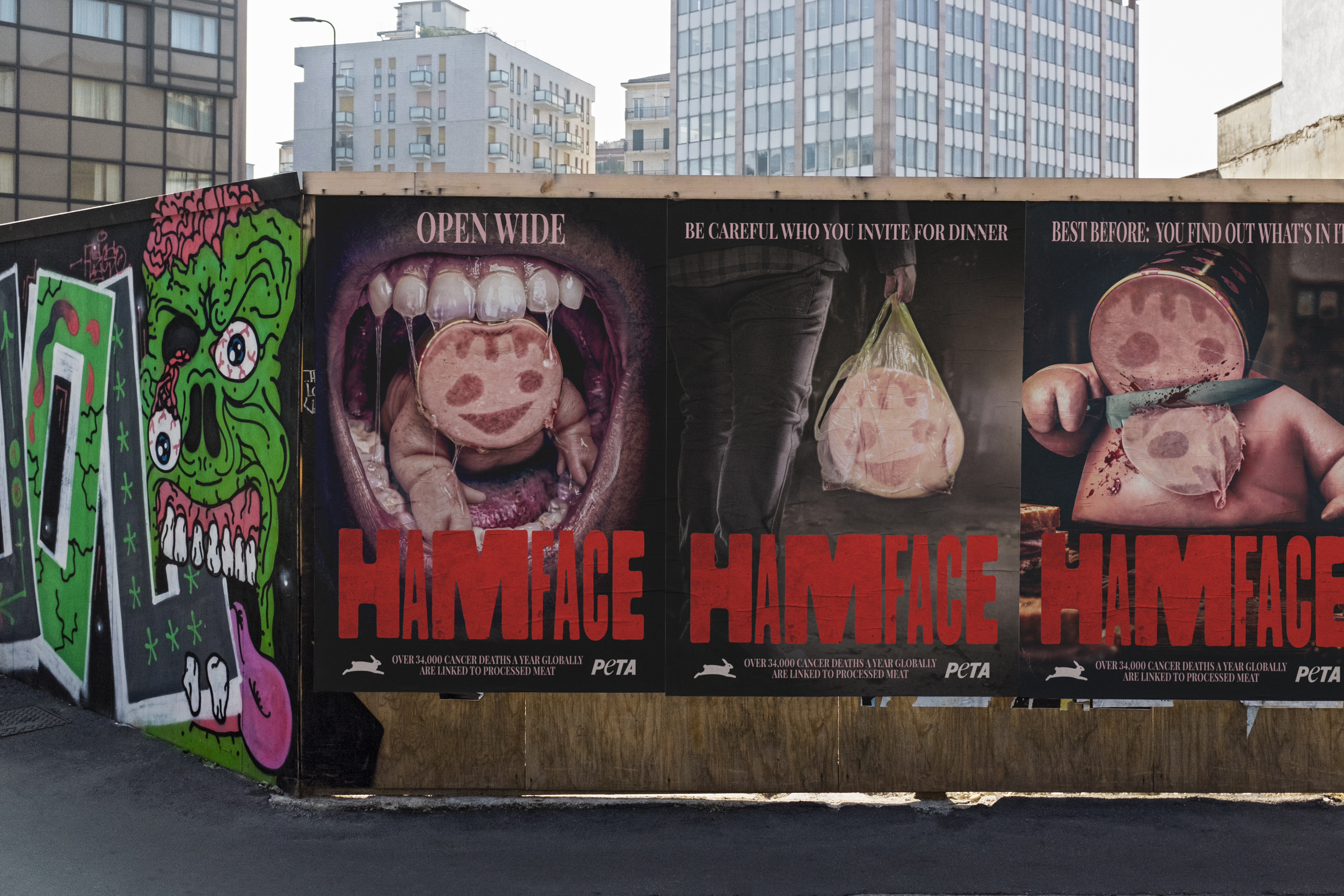
The street images make the concept look closer to promotion for a horror release than to a conventional nonprofit poster. This matters for the creative: a striking fictional character can carry a topic into places where a long explanation of dietary research would be harder to read. It also risks turning public education into spectacle if the framing is not accompanied by a way to understand the claim.
PETA’s separate Halloween appeal to Nigella Lawson broadens the idea in another direction. The charity asked the television cook to change a ham recipe to a plant-based version, bringing the film’s fictional threat into a real conversation about familiar food choices. There is no verified response from Lawson in the material reviewed, and the campaign’s letter should not be framed as a partnership or endorsement.
Taken together, the film, posters and public letter show three different ways the charity can use the same monster. The film supplies atmosphere, the posters provide instant recognition and the letter gives journalists a timely, named cultural reference. None of these elements comes with verified audience or donation results, so the outcomes remain an open question.
What marketers can learn from Hamface
Horror advertising is appealing because it can offer viewers an experience before asking for attention to a message. The Hamface character is distinct from Fanta’s Haunted Universe, which uses an original cast of monsters to build a seasonal entertainment world around a soft-drink brand. Both borrow genre conventions, but PETA’s monster is meant to challenge a familiar habit rather than make a product more fun to buy.
- Let the character embody the argument. Hamface makes the contested product the villain, so the audience can see the intended message in the costume and title. A generic scary character would have required more explanation to connect back to processed meat.
- Commit to the genre. Slow dread and horror production give the creative the appearance of a real film rather than a quick seasonal joke. The genre is doing storytelling work, not merely supplying pumpkins and shadows.
- Create assets that can travel. The poster art and outdoor photographs translate the film’s antagonist into a static format. A character with a recognizable face can be legible in both motion and still imagery.
- Keep the evidence distinct from the metaphor. An unsettling fictional killer is a communication device. Clear sourcing for medical and dietary claims remains necessary when the campaign asks audiences to rethink a health-related behavior.
The wider opportunity is to build work that people can immediately understand as entertainment while allowing them to examine the message behind it. A horror fan does not have to agree with PETA’s stance to understand what kind of film Hamface is imitating. That gives the creative an accessible starting point.
The limitation is equally important. Attention is not the same as agreement, and memorable fear does not by itself establish a change in public behavior. Hamface is a vivid example of a cause campaign borrowing a popular storytelling language, with its eventual impact still unmeasured.
For brands and advocacy groups considering original characters, the useful question is not simply whether the idea is scary, funny or shareable. It is whether the character makes the underlying message clearer after the audience has finished watching.
