
Microsoft Windows has found an unusual way to put a high-performance laptop through its paces: ask a horror filmmaker to finish a movie without plugging the machine into an outlet. The resulting short film, Mama Bear, is also a demonstration of the computer used to make it.
Created with agency Droga5, the project puts director Curry Barker, known for Obsession, behind a campaign for the Surface Laptop Ultra. An official Windows campaign video makes the challenge explicit: complete the film’s editing on one unplugged laptop. The result was released around Halloween, with a wider behind-the-scenes rollout designed to explain how the work was made.
Table of contents
Jump to each section:
- The horror film is the product test
- Why the demonstration sits behind the story
- How the creator relationship carries the message
- What marketers can learn from the campaign
The horror film is the product test
Barker wrote, directed and edited Mama Bear, which follows a house cleaner receiving an alarming phone call. The film plays as a self-contained piece of unsettling entertainment rather than a product walkthrough. The branded proposition becomes clearer when viewers learn about the production constraint behind the camera.
The device at the center of the experiment is the Surface Laptop Ultra, which Microsoft positions for demanding video-editing, graphics and other creative workloads. Barker handled the editing and finishing while the laptop was unplugged. Corridor Digital, the team behind Corridor Crew, also worked on visual effects and documented its production process using the machine.
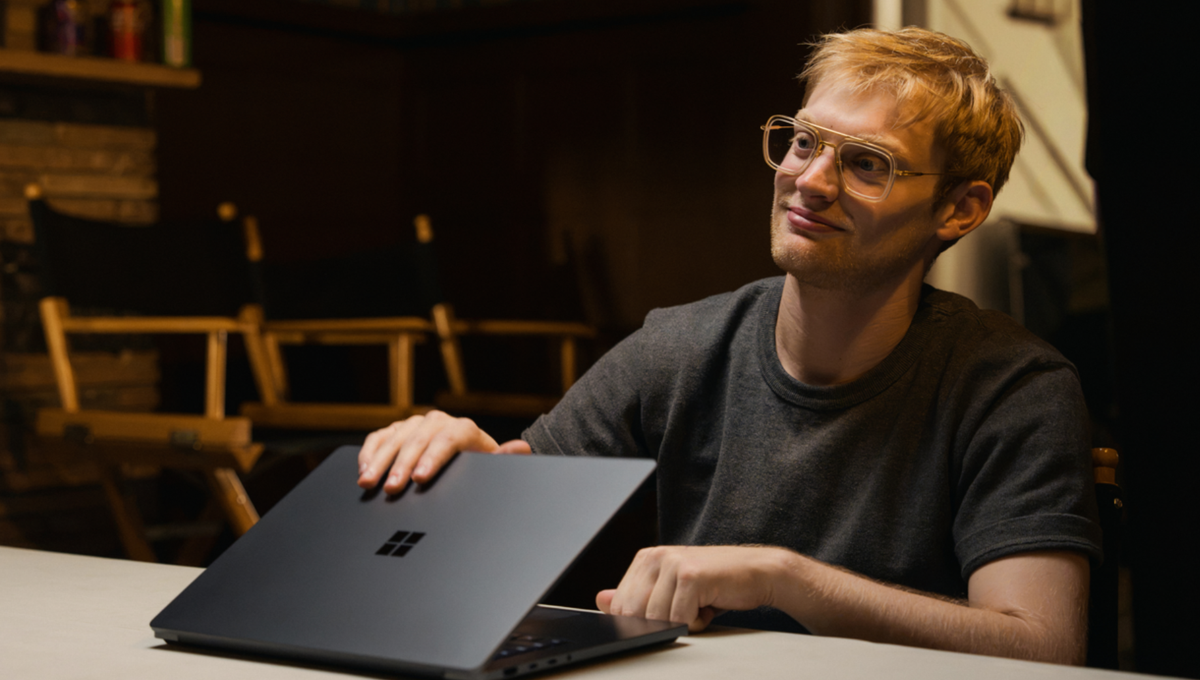
The distinction is important. An unplugged editing demonstration is not the same as a claim that the entire production was finished on one battery charge. Behind-the-scenes coverage explicitly notes that the work was not performed on a single charge. The campaign is evidence of a particular creative workflow, not a substitute for independent battery or performance testing.
Why the demonstration sits behind the story
Most technology demonstrations try to make the product the main attraction. Here, the product does its job in the background, while the film gives audiences a reason to pay attention in the first place.
The setup works because the advertising promise is tied to the actual production of the asset. If the laptop were removed from the process, the campaign would lose the challenge that connects the story to Windows. The creative is not merely placed next to a product claim. The production itself becomes the demonstration.
Droga5’s chief creative experience officer Cristina Reina described the thinking succinctly: “The best product demonstrations shouldn’t feel like demonstrations. They should be entertaining.”
That idea also changes what the supporting content needs to accomplish. The horror film attracts attention on its own terms; the making-of material can show the tools, constraints and practical work behind it. The film and the explanation have different jobs, and neither needs to carry the entire message alone.
How the creator relationship carries the message
Barker is more than an on-screen endorsement. His established horror style is the reason the film can feel like something audiences might choose to watch even without a sponsor. His official YouTube upload also acknowledges Windows’ sponsorship, keeping the commercial relationship visible.
There is a trade-off in that arrangement. The stronger the creator’s own identity, the easier it is for viewers to remember the artist and forget the brand. Windows and Droga5 address that risk by making the hardware constraint central to the premise, then using supporting content to connect what people watched with how it was made.
The film is also a useful reminder that a brand need not appear in every scene to have a meaningful role. Brand integration is strongest when the product changes the creative possibilities, rather than simply occupying screen time.
Microsoft’s wider “What will you do with all this power?” positioning provides the backdrop. The campaign turns an abstract statement about capability into a specific assignment given to a recognizable creator. That makes the proposition easier to inspect, even if audiences should still distinguish sponsored proof from independent testing.
What marketers can learn from the campaign
The useful lesson is not that every brand needs a horror director. It is that a product demonstration can become editorially interesting when the product plays a necessary role in a real creative challenge.
Build the proof into the idea. A claim about creative performance becomes easier to understand when a filmmaker uses the equipment to produce the work being shared.
Give the hero asset its own appeal. Mama Bear has a story and a style independent of the hardware message. That gives the campaign a reason to be watched before it asks for belief.
Separate entertainment from explanation. A full film can build interest, while behind-the-scenes content shows how the brand helped make it possible. One asset does not need to do both jobs.
Protect credibility with precise claims. Unplugged editing should not be confused with completing a production on one battery charge. Clear boundaries keep the demonstration more persuasive than an overstated claim would.
For marketers, the harder question is whether a campaign would still be worth watching if viewers knew it was sponsored. Here, the entertainment stands on its own, and the sponsorship has a concrete reason to exist.
The broader opportunity is to stop treating proof and storytelling as competing formats. When a brand can make a credible creative constraint part of the work, the story can carry attention while the process explains the product.
