
At Westfield, Specsavers turned a familiar retail fixture into a Black Friday spectacle: an eight-metre rack of 25 real faces, each wearing a different pair of designer frames. The activation, called Rack Friday, gave shoppers a literal way to browse glasses before trying a style on themselves.
The object is deliberately strange, but the commercial problem is ordinary. Specsavers says people can lack confidence about face shape and frame choice, so the London activation makes comparison visible, social and less intimidating.
In this article: the human rack, its retail logic, and the lesson for visual activations.
The rack makes frame choice visible
The installation placed 25 people behind cut-out openings, turning their faces into a living display of designer eyewear. Specsavers dispensing opticians selected the frames around face shape, while visitors could browse styles and then try options themselves.
That gives a service problem a physical form. Instead of asking shoppers to imagine what a frame might look like, the display lets them scan multiple real faces at once.
Rack Friday turns a discount into a retail scene
Rack Friday promotes Specsavers’ Black Friday offer of 25% off dozens of designer brands. The campaign does not present the discount as the whole idea. It uses an unmistakable retail image to connect affordability with the uncertainty shoppers can feel when choosing eyewear.
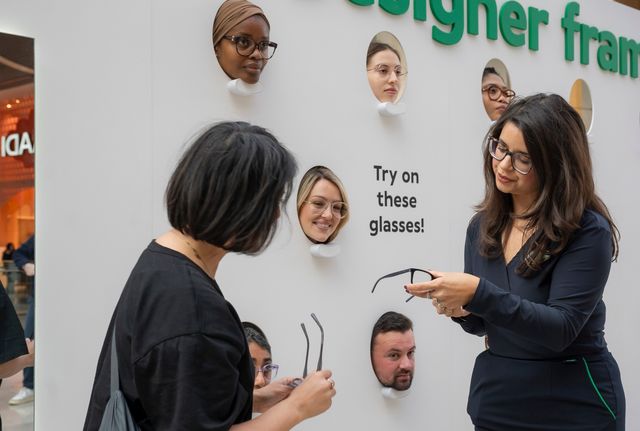
According to LBB’s campaign report, the work was created by Golin Ketchum London and supported by opticians on site. That blend of visual theatre and practical help matters: the activation earns attention, then gives visitors a reason to act on it.
The insight is confidence, not only price
Specsavers commissioned research saying six in ten UK consumers are unsure of their face shape, while more than half do not know which frame styles suit it. Those are brand-commissioned findings, not a market-wide measure, but they explain why a display built around many different faces is more useful than a generic Black Friday sign.
The creative also treats choice as a shared experience. People can compare styles on faces unlike their own, talk to an optician and move from a playful photograph to a purchase decision in the same place.
What marketers can learn from Rack Friday
Make the product decision part of the spectacle. The strongest part of this activation is not simply its scale. The human rack turns the exact hesitation behind the purchase into something passers-by can see and test.
For retail brands, that is a useful standard for a visual stunt: the memorable object should demonstrate the product’s value, not just decorate the campaign. Specsavers has not disclosed sales or engagement results, so the business outcome remains unproven. The execution still shows how experiential work can make a crowded promotional moment easier to understand.
Source: Little Black Book, 25 November 2026.
