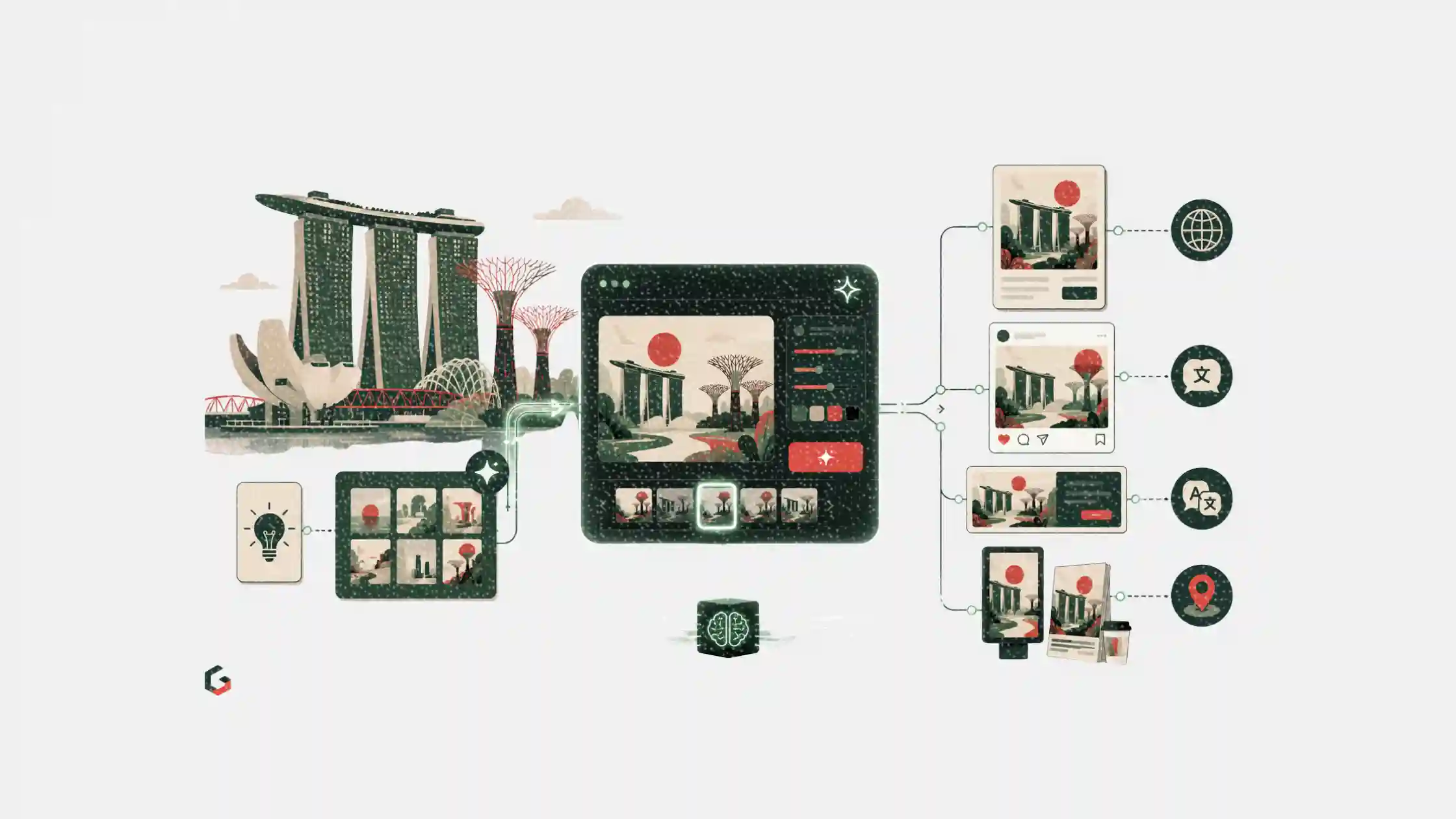
Singapore is quickly becoming one of Asia’s strongest growth markets for AI-generated visuals, according to a report by MARKETING-INTERACTIVE citing OpenAI data showing major increases in adoption for ChatGPT Images 2.0.
The latest image generation model is gaining traction among both consumers and marketers as creative teams look for faster ways to produce localized campaigns, mockups, and visual concepts.
This article explores how ChatGPT Images 2.0 is moving from experimentation into everyday marketing workflows, why Singapore is emerging as a key growth market, and what the shift means for brands navigating AI-generated creative, localization, and trust.
Table of contents
Jump to each section:
- What’s driving Singapore’s AI image generation boom
- Why ChatGPT Images 2.0 is moving beyond experimentation
- How AI visuals are reshaping marketing workflows in APAC
- What marketers should know about AI-generated creative at scale
- Why trust and disclosure are becoming the next battleground
- The bigger shift marketers should pay attention to
 Patrecia Meliana
What’s driving Singapore’s AI image generation boom
According to OpenAI, Singapore has emerged as one of Asia’s fastest-growing markets for ChatGPT Images 2.0, with usage increasing more than 80% week-on-week and over 90% month-on-month.
The growth is notable because it is not only driven by existing AI users. OpenAI said that 50% of image generation activity in Singapore during the past week came from first-time users, suggesting that AI-generated visuals are crossing into mainstream adoption.
Singapore joins Taiwan, Japan, and Thailand as major growth markets for OpenAI’s image generation products across Asia.
The timing also reflects broader shifts in the creative technology market. Competition around generative visuals is intensifying as companies race to make AI-generated images and videos more commercially viable.
ByteDance is reportedly developing Goku AI, a multimodal video generation framework designed to turn text prompts, images, and motion inputs into realistic video content. Adobe is also expanding Firefly across Creative Cloud products, positioning it as a commercially safe AI model trained on licensed content for enterprise users.
For marketers, this means the AI visual generation market is moving quickly from fragmented experimentation into a highly competitive production ecosystem.
Why ChatGPT Images 2.0 is moving beyond experimentation
Jennifer Lien, head of marketing, APAC, at OpenAI, described the current moment as a transition from experimentation to utility.
“Every major technology shift starts with experimentation. People first ask, ‘Can this do something surprising?’ Then eventually the question becomes, ‘Can this help me work better?’,” she said.
That distinction matters because earlier generations of AI image tools often struggled with consistency, text rendering, localization, and practical campaign usability.
According to Lien, ChatGPT Images 2.0 introduces more advanced “thinking capabilities,” allowing the system to search for real-time information, generate multiple outputs from a single prompt, and iteratively refine results.
This is pushing AI-generated visuals into more practical marketing use cases, including:
- Product mockups
- Campaign visualization
- Packaging concepts
- Localized campaign assets
- Social content iteration
- Creative testing and rapid prototyping
The shift is especially relevant in APAC, where marketing teams often need to adapt campaigns across multiple languages and cultural contexts.
OpenAI said improvements in multilingual understanding and non-Latin text rendering are helping marketers create more locally relevant assets without relying on extensive manual production workflows.
How AI visuals are reshaping marketing workflows in APAC
The operational impact for marketers is becoming increasingly clear.
Tasks that previously required days of design work or agency coordination can now be explored in hours. Creative teams are using AI-generated visuals to test campaign directions faster, iterate on concepts more frequently, and reduce bottlenecks between ideation and execution.
For always-on social media teams, this matters significantly.
Content demands across TikTok, Instagram, LinkedIn, YouTube Shorts, and regional platforms continue to increase, while many in-house teams face tighter budgets and smaller headcounts. AI-generated visuals are becoming one way to maintain production velocity without scaling creative operations at the same pace.
The trend also reflects a larger industry shift toward “compressed production cycles,” where marketers prioritize speed, iteration, and rapid testing over long-form creative development timelines.
At the same time, the growing accessibility of AI-generated visuals could create a new wave of creative sameness.
As more brands rely on similar AI workflows and prompting techniques, differentiation may become harder. The advantage will likely shift from simply generating assets quickly to building stronger creative systems, brand voice consistency, and smarter human oversight.
What marketers should know about AI-generated creative at scale
Marketers experimenting with AI-generated visuals should pay attention to several strategic shifts:
- Localization is becoming easier, but governance matters
AI-generated visuals can help brands adapt campaigns across languages and regional markets faster than traditional workflows. However, localization mistakes can also scale quickly if review systems are weak.
- Creative testing cycles are accelerating
AI tools make it easier to generate multiple visual concepts rapidly. This creates opportunities for faster A/B testing and performance optimization, especially in paid social campaigns.
- Production speed is no longer the main differentiator
As AI image generation becomes more accessible, the competitive edge will shift toward strategy, storytelling, audience insight, and brand distinctiveness.
- Creative teams are evolving, not disappearing
OpenAI emphasized that AI is not replacing creative professionals. Instead, it is compressing operational workflows, reducing friction between ideas and execution.
- AI fluency is becoming a marketing skill
Teams that treat AI as a collaborative workflow layer rather than a replacement tool are likely to move faster and adapt more effectively.
For B2B marketers and agencies, this could also reshape client expectations around turnaround times, campaign iteration speed, and creative experimentation.
Why trust and disclosure are becoming the next battleground
The rapid growth of AI-generated visuals is also creating new concerns around trust and transparency.
A recent YouGov and Meltwater study found that 84% of Singaporeans believe AI-generated content should be clearly labeled. Nearly half said their trust in a brand would decrease if AI-generated content was used without disclosure.
The findings highlight a growing tension inside AI marketing adoption.
Consumers are increasingly comfortable interacting with AI-generated content, but they also want greater transparency about when and how it is being used.
The report also showed that:
- 83% of Singaporeans are concerned about AI’s increasing role in daily life
- 74% worry about misinformation and scams
- 68% are concerned about misleading content
- 64% struggle to identify AI-generated material
- 58% worry about misuse of personal data
For marketers, this creates a balancing act between efficiency and authenticity.
Brands that rely heavily on AI-generated content without clear governance policies could face growing reputational risks, particularly in sectors where trust and credibility are critical.
The bigger shift marketers should pay attention to
The bigger story is not simply that AI image generation is becoming more popular. It is that AI visuals are becoming operational.
The industry is moving from isolated experimentation into integrated creative workflows where AI supports ideation, localization, production, testing, and optimization simultaneously.
That shift could fundamentally change how marketing teams structure creative operations over the next few years.
The brands that benefit most will likely be the ones that combine AI speed with strong creative direction, human oversight, transparent policies, and differentiated storytelling.
As generative visuals become easier to produce, originality and trust may become the most valuable creative assets left.