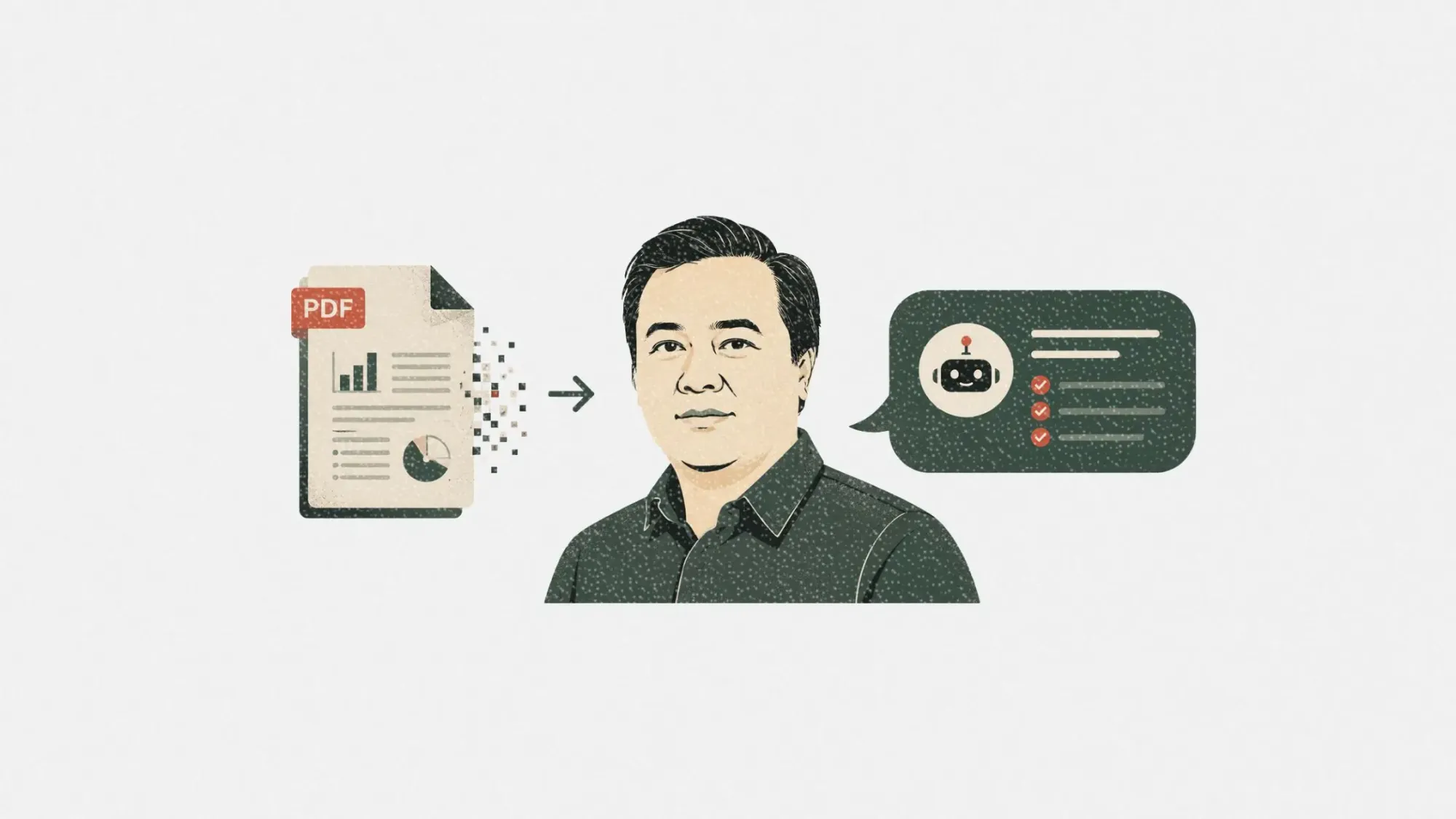
Ridho Putradi S’Gara has spent five years running an SEO agency. In December 2025, he started building a product that quietly competes with part of his own service line.
Ridho is the founder and CEO of Search Agency, a Jakarta-based SEO consultancy he started in 2021 that works with SMB founders, in-house marketing teams, and enterprise growth functions across Southeast Asia. The agency’s pitch is unglamorous by design: technical SEO that gets pages crawled and indexed, content built around real buyer questions, and links earned rather than bought.
More recently, Search Agency has leaned into the AEO and GEO side of the business, helping clients get cited when buyers ask ChatGPT, Perplexity, or Gemini for recommendations instead of typing a query into Google.
That shift helped shape StoryMint, alongside a broader effort to help marketing teams turn research and search data into action. StoryMint, the product Ridho founded in December 2025, pulls a company’s Google Search Console data, compares each page’s click-through rate against the benchmark for its position, and surfaces the pages bleeding clicks they’ve already earned. It then drafts the rewrite, in the brand’s voice, targeted at specific buyer personas.
What makes it different from a typical persona deck, in Ridho’s telling, is that the persona doesn’t stay static. It’s meant to become “a living tool you can talk to, challenge, and turn directly into a brief or content that’s ready to use.”
What most people who follow Ridho on LinkedIn might not know is that he started out as a developer, not a marketer, writing code at a forestry research institute and building web apps before he ever ran a search campaign. That background matters here: when he decided to turn fifteen years of agency frustration into a product, he built it himself with a small team of developer friends, rather than handing the idea to someone else’s roadmap.
Speaking with ContentGrip, Ridho shares why he built a product instead of scaling the agency further, what StoryMint automates and what it deliberately won’t, and what surprised him most once users started showing up.
Table of contents
Jump to each section:
- Why the persona deck kept dying after the workshop
- What StoryMint automates, and what it never will
- Running a product is a different sport than running an agency
- The mindset shift Ridho thinks marketers still need
- What to validate before writing a line of code
Why the persona deck kept dying after the workshop
Ridho didn’t set out to build StoryMint as a product. It grew, in his words, out of a frustration he kept running into across years of agency work, solving the same problem for different clients: how to connect a deep understanding of an audience to campaign execution that actually happened.
The pattern repeated itself almost identically across clients, regardless of industry or market. A serious workshop would produce a clean, polished persona deck. Everyone in the room would nod. Then the file would get saved, and people would go back to their old routines. Campaigns kept getting planned off keyword lists, content kept getting briefed from familiar topics and formats, and the persona deck the agency had worked hard to produce almost never got opened again.
The lesson he took from that, repeatedly, stuck with him: “Insight that isn’t connected to daily decisions ends up as beautiful decoration, nothing more.” A persona doesn’t matter much if it only lives inside a PDF instead of inside the actual workflow of the team using it, which is the gap StoryMint was built to close.
Two things converged to make this the moment to act on it: AI search was starting to change how people find information, shifting the SEO discipline he’d spent over fifteen years in, and AI itself had become mature enough to turn messy research into a structured persona within minutes.
What StoryMint automates, and what it never will
StoryMint combines search data with AI, which raises an obvious question: what gets handed to the machine, and what stays with a person.
Ridho’s answer starts from a belief he holds firmly. “AI isn’t the hero of this story,” he says. “It’s just a tool to reduce friction.” So the tasks he automates are the ones that are tedious but don’t demand deep judgment: turning messy research notes into a structured persona, mapping the range of questions a buyer might ask, finding content gaps, or preparing a rough first draft.
Everything that touches judgment stays with a person, in his view: strategy, point of view, the core message, and the final call on what’s worth publishing. That’s why StoryMint doesn’t have a single button that produces a finished output. Every draft instead runs through an eight-point refinement system with two layers of feedback, one from the persona’s point of view and one from a strategist’s, before it reaches the user.
His rule of thumb: “When a part makes people stop thinking, that part shouldn’t be automated. When a part just slows people down without adding value, that’s exactly where automation makes sense.”
Running a product is a different sport than running an agency
Since launch, StoryMint has reached what Ridho describes as 419 users and counting, though the biggest surprises weren’t about the numbers. They were personal.
Running an agency and maintaining a SaaS product are genuinely different disciplines, he admits, and the second hasn’t been easy. Years of agency work trained him to finish a project and move to the next one. A product instead demands showing up daily, listening to users, and maintaining something that’s never really finished, which reshaped his assumptions about how light this journey would feel.
On the user side, the surprise was how much a single, narrow entry point outperformed a broad feature list. What actually pulled people in to try a full suite was one simple question: does ChatGPT mention their brand, or their competitor’s, when someone asks?
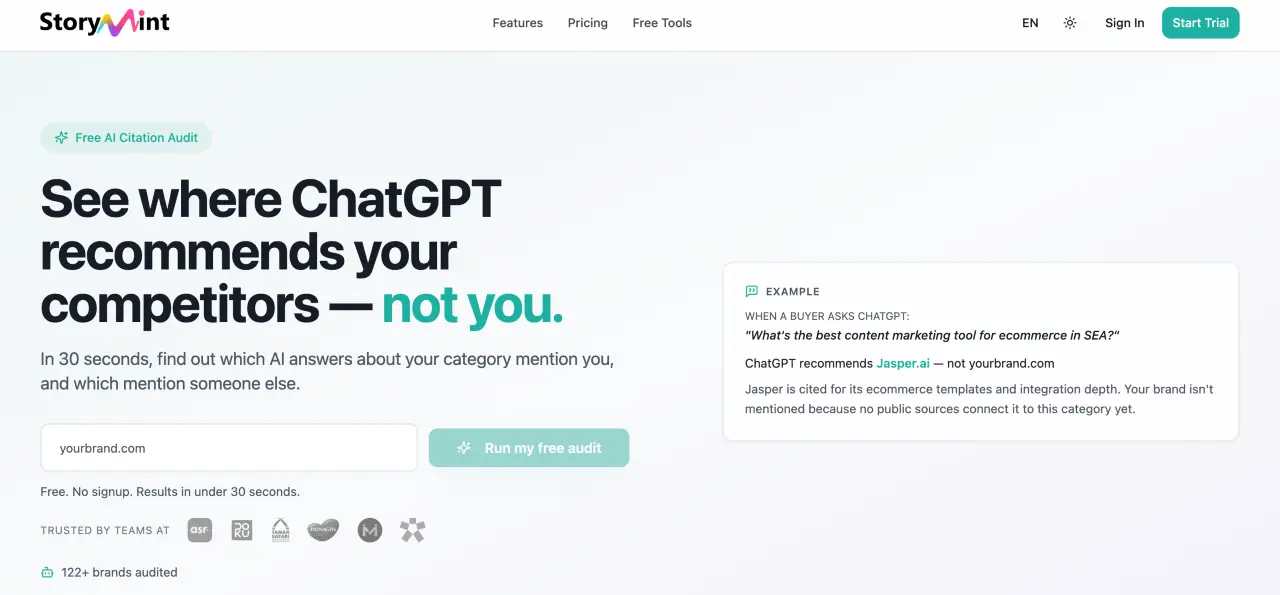
That hook is now the front door of StoryMint’s own site, leading with a free 30-second check of whether ChatGPT, Claude, Perplexity, and Gemini recommend a brand over its competitors, ahead of the persona and content tooling underneath it.
A second surprise came from the local market. Ridho had assumed payment method was a minor detail, but for a meaningful share of Indonesian businesses, paying in rupiah through QRIS or bank transfer turned out to be a real reason they were willing to try the product at all.
He also learned that small teams weren’t chasing the most sophisticated tool available. What they wanted was one dashboard that could replace three separate tools they’d been paying for individually.
The mindset shift Ridho thinks marketers still need
Many marketers are still working out how AI search is reshaping SEO, and Ridho’s answer, shaped by building StoryMint, is to stop chasing rank and start thinking about the answer a buyer actually sees.
For years, SEO revolved around where a page landed in results. In AI search, the sharper question is whether a brand’s name shows up in the answer at all when someone asks ChatGPT, Gemini, or Perplexity about a category.
That means marketing teams need to think in the actual questions buyers ask rather than in keywords, and write content worth citing, not just worth ranking. Ridho sums up the principle he keeps returning to: “Users first, SEO will follow.” In his view, the teams that come out ahead over the next year won’t be the ones fastest to adopt AI, but the ones that understand most clearly who they’re serving and what question that person actually wants answered.
What to validate before writing a line of code
For agency owners considering the same leap into a SaaS product, Ridho’s advice centers on one thing to validate first: whether the problem is real, repeats often, and is painful enough that someone would pay to have it solved. Agency owners have an advantage here, since they’ve already watched the same pattern show up across dozens of clients.
The second thing to validate, in his view, is whether you’re productizing a way of thinking or just wrapping your own labor in software. Plenty of agencies build a SaaS product that turns out to be their existing service repackaged, which is very hard to scale.
StoryMint itself started as an internal tool Ridho built to solve his own frustration, and it only became a product once he realized other teams were running into nearly the same problem. He believes that sequence matters: use it yourself first until you’re genuinely convinced it solves something real, then build it for other people. As he puts it, “Never fall in love with the technology. Fall in love with the problem you want to solve.”