“How much does an influencer post actually cost?” It is the first question every marketer asks, and the answer never satisfies: it depends.
On what, exactly? Follower tier, platform, niche, engagement quality, usage rights, whether the creator has a manager, and whether you want exclusivity. That answer is frustrating when you are trying to build a budget. This rate card draws on 2025 to 2026 benchmark data compiled from the Influencer Marketing Hub, Shopify, Collabstr, Click Analytic, and Favikon to give you workable numbers while accounting for the variables that move them.
This is not a list calibrated for B2C cosmetics brands negotiating with lifestyle creators. The breakdowns below include a B2B and LinkedIn column that most pricing guides skip entirely, because the audience premium for professional decision-makers changes the economics significantly.
Table of contents
Jump to each section:
- How influencer pricing actually works in 2026
- Rate card by influencer tier
- Platform-by-platform pricing breakdown
- The B2B and LinkedIn pricing premium
- Beyond the base rate: usage rights, exclusivity, and performance pay
- How to budget for your first influencer campaign
How influencer pricing actually works in 2026
The influencer pricing market has matured considerably. The global market reached an estimated US$32.55 billion in 2025 according to the Influencer Marketing Hub 2025 Benchmark Report, and that growth has brought more pricing transparency, more standardized rate cards, and more creator professionalism at every follower tier. It has also introduced more variables into any single negotiation.
The two most significant shifts in 2026 pricing are the normalization of usage rights as a separate line item, distinct from the posting fee, and the spread of hybrid compensation models that blend a flat fee with a performance component. Creators who drive conversions now often structure deals as a base rate plus CPA (cost per acquisition) or revenue share, and their total earnings under those arrangements can exceed what a standard rate card would suggest.
What you pay for in a base posting fee reflects three core factors: audience reach, engagement quality (not just the rate, but the type of engagement including saves and shares as signals of purchase intent), and niche authority. A SaaS creator with 20,000 LinkedIn followers who regularly draws comments from VP-level practitioners can charge multiples of what a general lifestyle creator with 200,000 Instagram followers earns. The purchasing power of the audience changes the commercial logic entirely.
It is also worth noting that follower count is now a weak proxy for value at every tier. Engagement rate, audience authenticity scores, and the percentage of followers who match your ICP are the metrics that informed buyers use to evaluate whether a rate is justified. Tools like HypeAuditor, Modash, and Favikon make this assessment considerably faster than manual audits.
Rate card by influencer tier
The following ranges reflect 2025 to 2026 data compiled from Shopify, the Influencer Marketing Hub, Collabstr, and Click Analytic. These benchmarks represent a single Instagram feed post or equivalent content unit. Platform-specific variation follows in the next section.
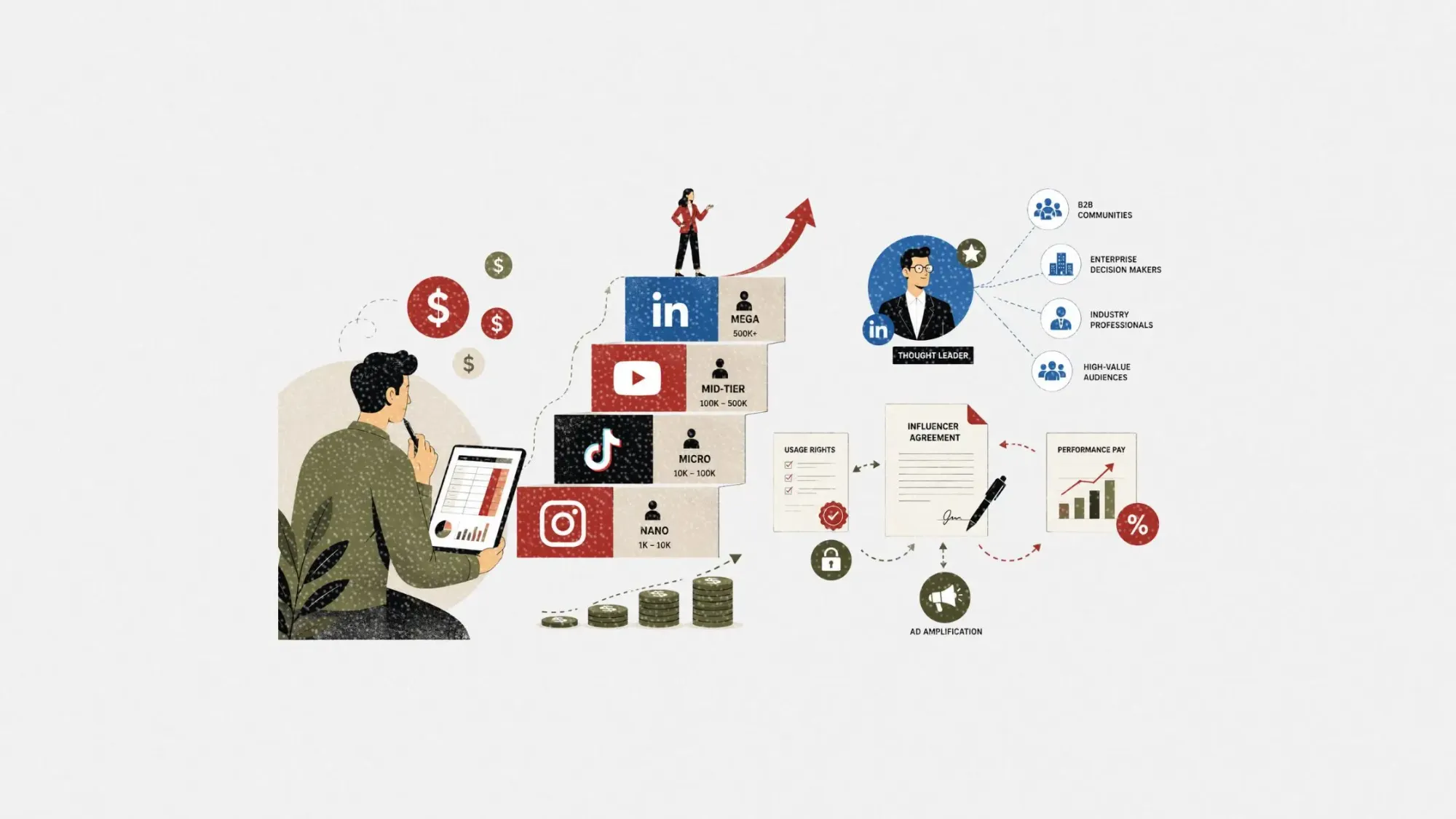
Nano-influencers (1K to 10K followers) typically charge US$50 to US$500 per post, with occasional outliers reaching US$1,000 for creators with exceptional engagement in premium niches like finance or B2B technology. Nano creators remain attractive for brands running distributed campaigns across multiple niche accounts.
In 2025, 39 percent of brands named nano-influencers as their most likely category partner, per Influencer Marketing Hub, and that preference is continuing into 2026. Engagement rates for this tier average 5 to 8 percent on Instagram and above 10 percent on TikTok, per IMH 2025 data.
Micro-influencers (10K to 100K followers) command US$500 to US$5,000 per Instagram post and represent the highest-volume tier for brand partnerships. Per 2025 creator marketplace data, micro-influencers account for roughly 65 percent of all brand partnerships. Average engagement sits between 2 and 4 percent. TikTok micro-influencers typically come in lower at US$200 to US$2,000, reflecting the platform’s different revenue dynamics and shorter content lifecycle.
Mid-tier influencers (100K to 500K followers) generally charge US$5,000 to US$20,000 per post. This is where professional management structures typically appear and where rates begin including bundled deliverables: a primary post plus stories, cross-posting rights, and sometimes basic usage licenses. Engagement compresses to approximately 1.2 to 2.5 percent on average for this tier.
Macro-influencers (500K to 1M followers) command US$10,000 to US$50,000 or more per post. At this tier, audience demographic quality rather than engagement rate becomes the primary value driver. Agent involvement and compliance review add meaningful lead time to the negotiation cycle.
Mega-influencers (1M+ followers) are priced at US$100,000 and above and are typically negotiated as multi-deliverable campaign packages rather than individual posts. Brand safety due diligence and legal review are standard costs on top of the creator fee, and deals at this level are rarely concluded in fewer than four weeks of back-and-forth.
Platform-by-platform pricing breakdown
Platform choice shapes the rate card materially. The following benchmarks draw from Click Analytic and Shopify’s 2025 to 2026 pricing data.
Instagram remains the highest-rate platform for most creator tiers. Reels command a premium over feed posts, with average rates running approximately 32 percent higher than TikTok video for equivalent follower counts, according to Collabstr’s 2025 report. For context across formats:
- Reels range from US$1,000 to US$50,000 depending on tier
- Feed posts run US$500 to US$30,000
- Stories are typically sold in bundles of three to five frames ranging from US$300 to US$10,000
TikTok rates sit below Instagram benchmarks at most tiers but are rising, particularly for mid-tier and macro creators as TikTok Shop integration raises the direct-commerce value of content. For nano and micro-influencers, hybrid flat fee plus performance arrangements are increasingly common, especially for Shop-linked campaigns. Notably, TikTok delivers the highest engagement rates across all tiers: nano-influencers reach approximately 10.3 percent engagement on the platform versus around 5 to 8 percent on Instagram, per the Influencer Marketing Hub 2025 Benchmark Report.
YouTube commands the highest per-piece rates across the board due to production requirements and the lasting shelf life of video content. Micro-influencer integrations (10K to 100K subscribers) run US$500 to US$5,000. Mid-tier channels (100K to 500K subscribers) charge US$5,000 to US$20,000 per dedicated video.
YouTube long-form integrations carry strong brand recall value and often serve as bottom-of-funnel content for B2B brands, particularly in SaaS where product walkthroughs and review videos appear at the point of purchase research.
LinkedIn is the pricing outlier, and for B2B marketers it is also the most commercially consequential one. Rates on LinkedIn do not follow the same follower-to-fee logic as consumer platforms, for reasons the next section covers in detail.
The B2B and LinkedIn pricing premium
Most influencer rate card articles stop at Instagram, TikTok, and YouTube. For B2B marketers, that omission is the most expensive oversight in budget planning.
According to Favikon’s analysis of 136 LinkedIn influencers with follower counts ranging from 200 to 700,000, about 81 percent of LinkedIn creator posts are priced between US$200 and US$2,000 per post. That range includes a wide spectrum of audience quality, from general career content creators to deep domain specialists. For B2B SaaS campaigns targeting VP, director, and C-suite decision-makers specifically, the relevant pricing band sits higher.
InfluenceFlow’s 2026 pricing guide puts B2B LinkedIn thought leader rates at US$2,000 to US$15,000 per post, noting that video content commands a premium and that the platform’s professional focus justifies higher rates despite smaller absolute audience sizes. Influencer Advisory’s 2026 trend analysis, drawing on a live deal log across 37 priced LinkedIn creators, shows rates converging to a US$500 to US$5,000 band per post regardless of follower count, because audience role-match matters more than audience size when the brief is B2B-oriented.
The pricing logic for B2B is structurally different from consumer influencer marketing. In consumer, you are typically buying reach multiplied by engagement rate. In B2B, you are buying access to a small, high-authority professional audience, and the scarcity of that audience drives the rate premium.
A creator with 8,000 LinkedIn followers who writes weekly about CRM strategy for revenue operations practitioners is a more commercially valuable partner for a CRM platform than a macro-influencer with 800,000 generalist business followers.
Dinda Anandita, Account Director at Content Collision, a content-led comms agency, puts it plainly: “B2B influencer budgets are often calibrated against reach metrics borrowed from consumer marketing, and that is where brands leave ROI on the table. The right LinkedIn creator with a small, role-specific audience can move a pipeline faster than a broad awareness campaign. The rate premium reflects the scarcity of that audience access, not vanity.”
For a wider view of how these US-centric rates compare against APAC market benchmarks, the global vs Asia influencer marketing cost breakdown covers regional pricing variation in detail, including the meaningful discount available in Southeast Asian markets relative to US rates.
Beyond the base rate: usage rights, exclusivity, and performance pay
The base posting fee is only one component of the total cost. Three add-ons are now standard in most professional creator agreements, and failing to budget for them is one of the most common ways a campaign runs over.
Usage rights cover permission to repurpose creator content across your own channels, including paid social, email, and your website. Standard usage rights for six months in one geography typically add 20 to 30 percent to the base posting fee. Whitelisting access, where your brand runs paid ads directly from the creator’s handle, is priced separately from content usage and reflects the anticipated ad spend behind that content rather than just the production cost.
Exclusivity fees compensate the creator for not partnering with direct competitors during a defined period. Category exclusivity for 30 days commonly adds 15 to 25 percent to the base rate. Broader geographic scope or longer windows push that figure higher, and the calculation is different for B2B creators whose niche means even one competing brand deal can represent a meaningful share of their annual income.
Performance-based models are increasingly prevalent in 2026. According to impact.com’s 2026 influencer marketing trends report, more brands are moving toward hybrid compensation: a reduced base fee paired with commission on verified conversions. This structure is particularly common in affiliate-linked influencer programs and benefits brands that need to demonstrate ROI accountability to internal stakeholders.
Creators with proven conversion track records can earn considerably more under these arrangements than flat-rate benchmarks would suggest. One practical note: rush fees of 20 to 50 percent are standard when the brief arrives fewer than 72 hours before the required post date. For B2B campaigns tied to product launches or events, this is a budget line worth building in explicitly.
How to budget for your first influencer campaign
A workable starting structure for most B2B SaaS brands running their first LinkedIn influencer campaign:
- Identify five to ten micro or mid-tier creators in your category
- Budget US$1,000 to US$3,000 per creator for a single post including a 90-day usage rights extension
- Reserve 20 percent of the total creator budget for usage rights uplift and exclusivity on your top two performers after the first round of results
That structure puts the median first B2B campaign in the US$7,000 to US$25,000 range, excluding internal management time. It generates enough data on content type, creator fit, and audience segment performance to make the second campaign materially more efficient.
For consumer brands on Instagram running nano campaigns, a distributed model of 15 to 20 nano-influencers at US$150 to US$300 each delivers comparable aggregate reach to a single micro-influencer at US$2,000, with higher total engagement and more content assets available for paid amplification. The trade-off is coordination overhead: managing 20 relationships simultaneously requires either a tool or a dedicated fractional resource.
Before any rate card becomes a signed contract, the harder question is whether the spend is justifiable to your stakeholders. The influencer marketing ROI framework for B2B covers how to build that case in terms a CFO will accept, including attribution window design and cost-per-outcome benchmarks that hold up in a budget review.
For brands running campaigns in Southeast Asia, where creator economics and platform behavior differ significantly from Western benchmarks, the guide to influencer marketing agencies in Singapore covers the regional players best positioned to navigate those differences on your behalf.